







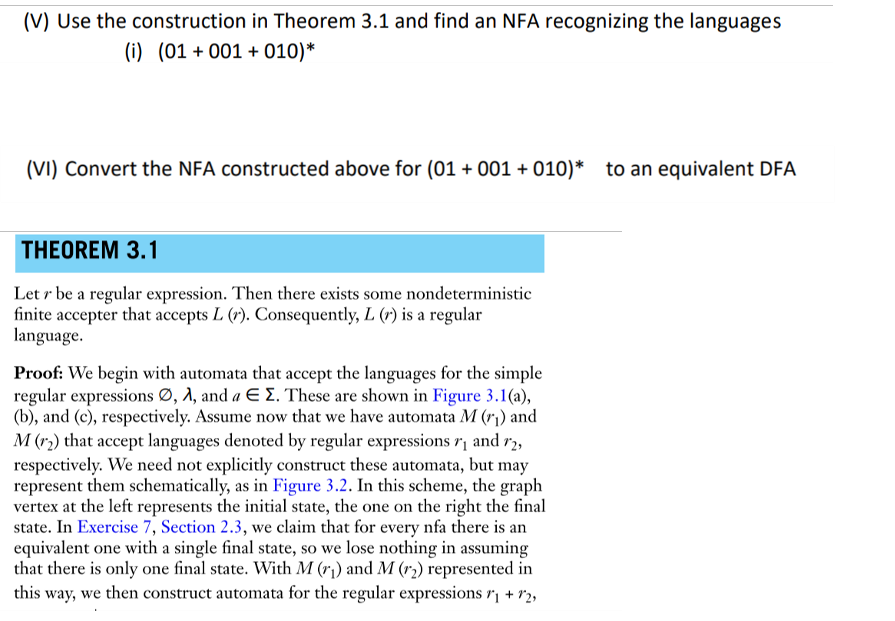
Question: ( V ) Use the construction in Theorem 3 . 1 and find an NFA recognizing the languages ( i ) ( 0 1 +
V Use the construction in Theorem and find an NFA recognizing the languages
i
VI Convert the NFA constructed above for to an equivalent DFA
THEOREM
Let be a regular expression. Then there exists some nondeterministic
finite accepter that accepts Consequently, is a regular
language.
Proof: We begin with automata that accept the languages for the simple
regular expressions and ain These are shown in Figure a
b and c respectively. Assume now that we have automata and
that accept languages denoted by regular expressions and
respectively. We need not explicitly construct these automata, but may
represent them schematically, as in Figure In this scheme, the graph
vertex at the left represents the initial state, the one on the right the final
state. In Exercise Section we claim that for every nfa there is an
equivalent one with a single final state, so we lose nothing in assuming
that there is only one final state. With and represented in
this way, we then construct automata for the regular expressions
PLEASE GIVE VISUAL Thank you
Step by Step Solution
There are 3 Steps involved in it
1 Expert Approved Answer
Step: 1 Unlock

Question Has Been Solved by an Expert!
Get step-by-step solutions from verified subject matter experts
Step: 2 Unlock
Step: 3 Unlock
 Study Help