Question: V=5153 Vs = 14 FTX Inc, an electronics system integrator, is developing a new product as part of their annual generational upgrades. Owing to their
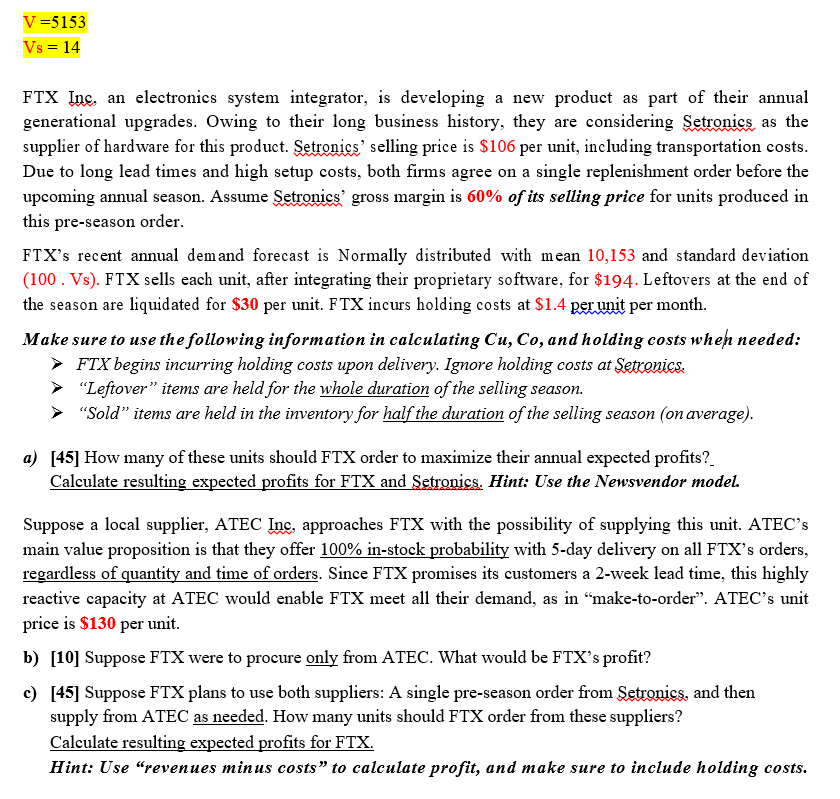
V=5153 Vs = 14 FTX Inc, an electronics system integrator, is developing a new product as part of their annual generational upgrades. Owing to their long business history, they are considering Setronics, as the supplier of hardware for this product. Setronics' selling price is $106 per unit, including transportation costs. Due to long lead times and high setup costs, both firms agree on a single replenishment order before the upcoming annual season. Assume Setronics' gross margin is 60% of its selling price for units produced in this pre-season order. FTX's recent annual demand forecast is Normally distributed with mean 10,153 and standard deviation (100. Vs). FTX sells each unit, after integrating their proprietary software, for $194. Leftovers at the end of the season are liquidated for $30 per unit. FTX incurs holding costs at $1.4 per unit per month. Make sure to use the following information in calculating Cu, Co, and holding costs when needed: FTX begins incurring holding costs upon delivery. Ignore holding costs at Setronics. "Leftover" items are held for the whole duration of the selling season. "Sold" items are held in the inventory for half the duration of the selling season (on average). a) [45] How many of these units should FTX order to maximize their annual expected profits? Calculate resulting expected profits for FTX and Setronics. Hint: Use the Newsvendor model. Suppose a local supplier, ATEC Inc, approaches FTX with the possibility of supplying this unit. ATEC's main value proposition is that they offer 100% in-stock probability with 5-day delivery on all FTX's orders, regardless of quantity and time of orders. Since FTX promises its customers a 2-week lead time, this highly reactive capacity at ATEC would enable FTX meet all their demand, as in "make-to-order". ATEC's unit price is $130 per unit. b) [10] Suppose FTX were to procure only from ATEC. What would be FTX's profit? c) [45] Suppose FTX plans to use both suppliers: A single pre-season order from Setronics, and then supply from ATEC as needed. How many units should FTX order from these suppliers? Calculate resulting expected profits for FTX. Hint: Use "revenues minus costs" to calculate profit, and make sure to include holding costs. V=5153 Vs = 14 FTX Inc, an electronics system integrator, is developing a new product as part of their annual generational upgrades. Owing to their long business history, they are considering Setronics, as the supplier of hardware for this product. Setronics' selling price is $106 per unit, including transportation costs. Due to long lead times and high setup costs, both firms agree on a single replenishment order before the upcoming annual season. Assume Setronics' gross margin is 60% of its selling price for units produced in this pre-season order. FTX's recent annual demand forecast is Normally distributed with mean 10,153 and standard deviation (100. Vs). FTX sells each unit, after integrating their proprietary software, for $194. Leftovers at the end of the season are liquidated for $30 per unit. FTX incurs holding costs at $1.4 per unit per month. Make sure to use the following information in calculating Cu, Co, and holding costs when needed: FTX begins incurring holding costs upon delivery. Ignore holding costs at Setronics. "Leftover" items are held for the whole duration of the selling season. "Sold" items are held in the inventory for half the duration of the selling season (on average). a) [45] How many of these units should FTX order to maximize their annual expected profits? Calculate resulting expected profits for FTX and Setronics. Hint: Use the Newsvendor model. Suppose a local supplier, ATEC Inc, approaches FTX with the possibility of supplying this unit. ATEC's main value proposition is that they offer 100% in-stock probability with 5-day delivery on all FTX's orders, regardless of quantity and time of orders. Since FTX promises its customers a 2-week lead time, this highly reactive capacity at ATEC would enable FTX meet all their demand, as in "make-to-order". ATEC's unit price is $130 per unit. b) [10] Suppose FTX were to procure only from ATEC. What would be FTX's profit? c) [45] Suppose FTX plans to use both suppliers: A single pre-season order from Setronics, and then supply from ATEC as needed. How many units should FTX order from these suppliers? Calculate resulting expected profits for FTX. Hint: Use "revenues minus costs" to calculate profit, and make sure to include holding costs









 Study Help