



Question: VA payment Yuzu: Library 1 / 2 100% replies are due by 11:59pm on the last day of the week assigned. Activity: 1) Research. I.
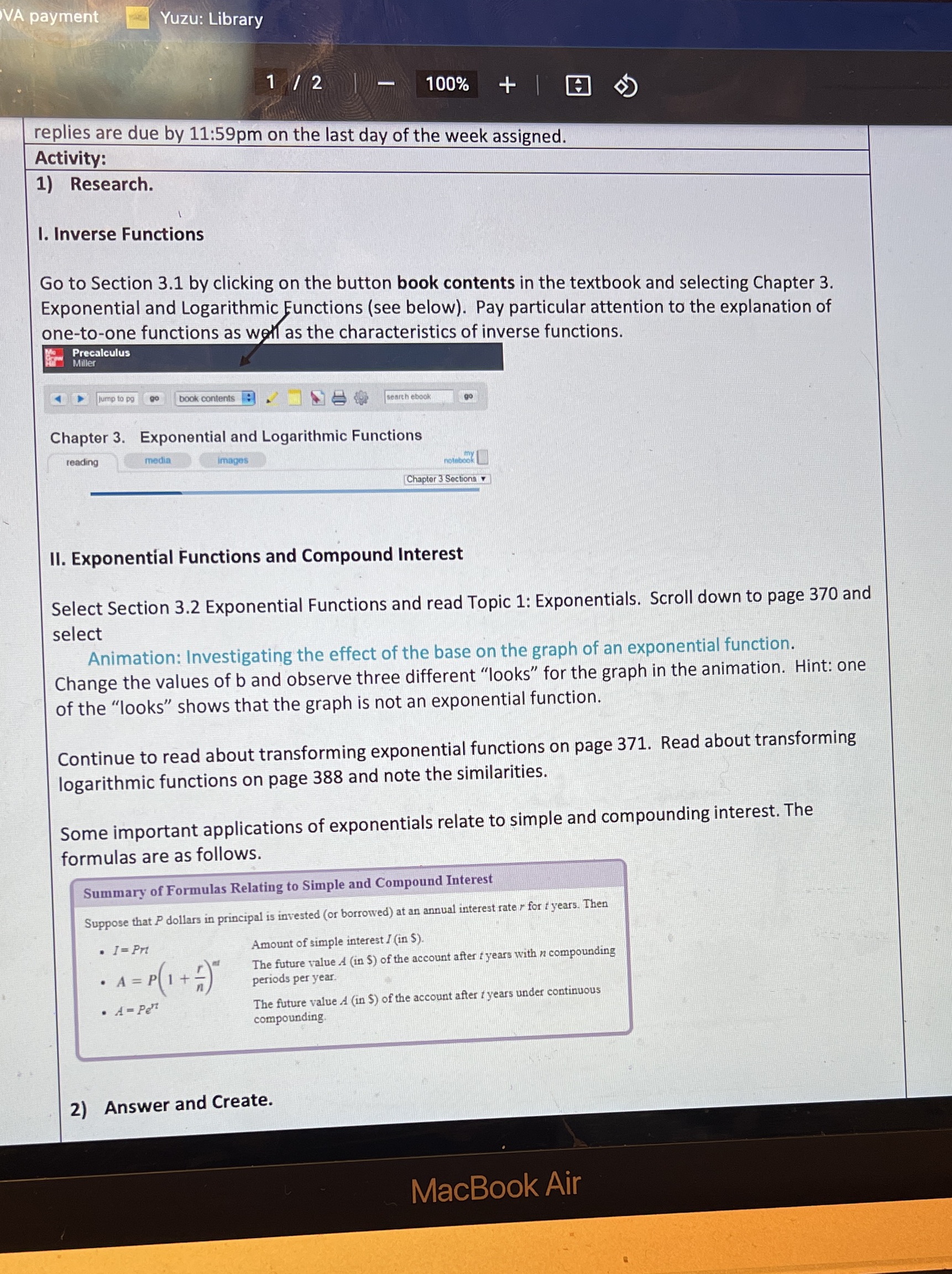
VA payment Yuzu: Library 1 / 2 100% replies are due by 11:59pm on the last day of the week assigned. Activity: 1) Research. I. Inverse Functions Go to Section 3.1 by clicking on the button book contents in the textbook and selecting Chapter 3. Exponential and Logarithmic Functions (see below). Pay particular attention to the explanation of one-to-one functions as well as the characteristics of inverse functions. Precalculus jump to po go book contents search ebook Chapter 3. Exponential and Logarithmic Functions reading media Images [Chapter 3 Sectiona II. Exponential Functions and Compound Interest Select Section 3.2 Exponential Functions and read Topic 1: Exponentials. Scroll down to page 370 and select Animation: Investigating the effect of the base on the graph of an exponential function. Change the values of b and observe three different "looks" for the graph in the animation. Hint: one of the "looks" shows that the graph is not an exponential function. Continue to read about transforming exponential functions on page 371. Read about transforming logarithmic functions on page 388 and note the similarities. Some important applications of exponentials relate to simple and compounding interest. The formulas are as follows. Summary of Formulas Relating to Simple and Compound Interest Suppose that P dollars in principal is invested (or borrowed) at an annual interest rate r for t years. Then . I = Pri Amount of simple interest / (in $) . A = P( 1 + =)" The future value A (in $) of the account after i years with n compounding periods per year. . A = Pelt The future value A (in $) of the account after i years under continuous compounding 2) Answer and Create. MacBook Air
Step by Step Solution
There are 3 Steps involved in it

Get step-by-step solutions from verified subject matter experts