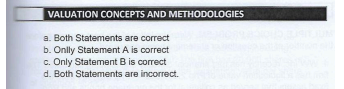
Question: VALUATION CONCEPTS AND METHODOLOGIES DIERCISES we or False. Write TRUE if the Statement is true and the word FALSE if u and the statement inconsistent
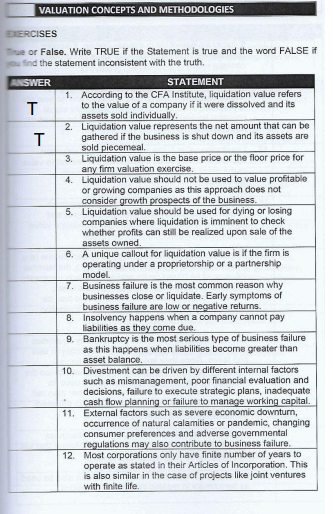
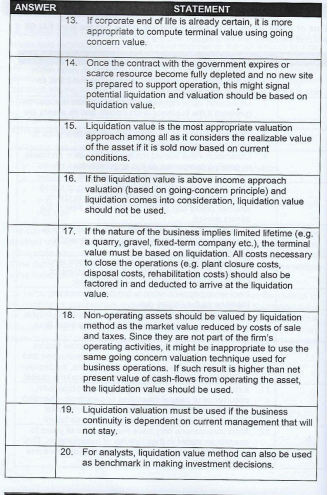
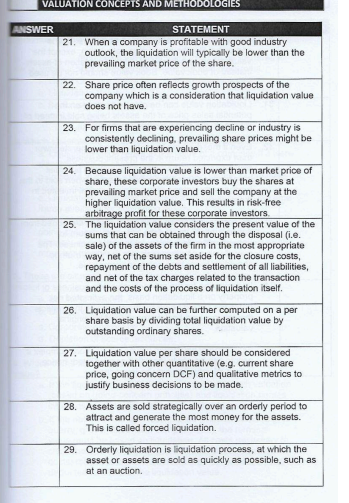
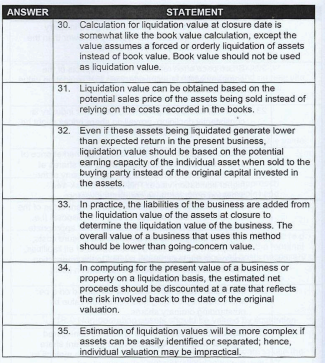
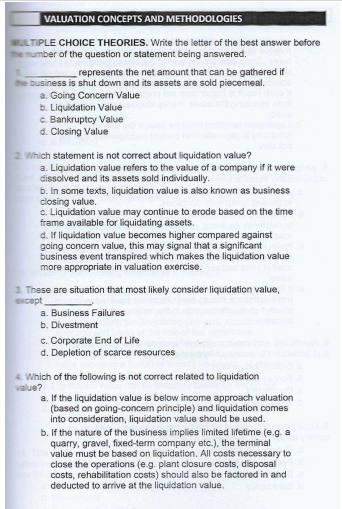
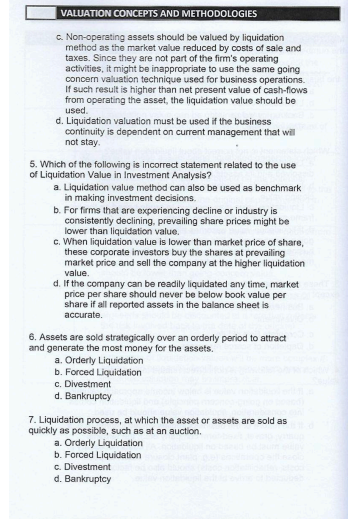
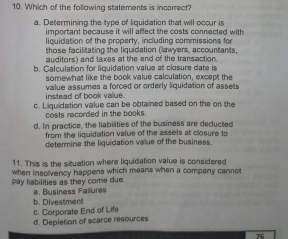
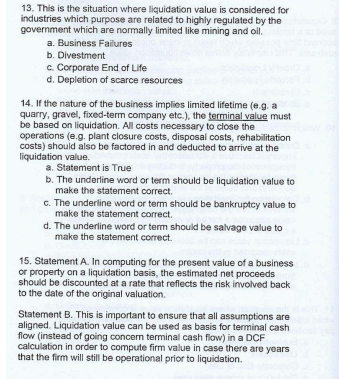
VALUATION CONCEPTS AND METHODOLOGIES DIERCISES we or False. Write TRUE if the Statement is true and the word FALSE if u and the statement inconsistent with the truth. ANSWER STATEMENT 1. According to the CFA Institute, liquidation value refers T to the value of a company if it were dissolved and its assets sold individually. 2. Liquidation value represents the net amount that can be T gathered if the business is shut down and its assets are sold piecemeal. 3. Liquidation value is the base price or the floor price for any firm valuation exercise 4. Liquidation value should not be used to value profitable of growing companies as this approach does not consider growth prospects of the business. 5. Liquidation value should be used for dying or losing companies where liquidation is imminent to check whether profits can still be realized upon sale of the assets owned. 6. A unique callout for liquidation value is if the firm is operating under a proprietorship or a partnership model 7. Business failure is the most common reason why businesses close or liquidate. Early symptoms of business failure are low or negative returns. B. Insolvency happens when a company cannot pay liabilities as they come due 9. Bankruptcy is the most serious type of business failure as this happens when liabilities become greater than asset balance. 10. Divestment can be driven by different internal factors such as mismanagement, poor financial evaluation and decisions, failure to execute strategic plans, inadequate cash flow planning or failure to manage working capital. 11. External factors such as severe economic downturn, occurrence of natural calamities or pandemic, changing consumer preferences and adverse governmental regulations may also contribute to business failure, 12. Most corporations only have finite number of years to operate as stated in their Articles of Incorporation. This is also similar in the case of projects like joint ventures with finite life.ANSWER STATEMENT 13. If corporate end of life is already certain, it is more appropriate to compute terminal value using going concem value. 14. Once the contract with the government expires or scarce resource become fully depleted and no new site is prepared to support operation, this might signal potential liquidation and valuation should be based on liquidation value. 15. Liquidation value is the most appropriate valuation approach among all as it considers the realizable value of the asset if it is sold now based on current conditions. 16. If the liquidation value is above income approach valuation (based on going-concern principle) and liquidation comes into consideration, liquidation value should not be used. 17, If the nature of the business implies limited lifetime (e.g. a quarry, gravel, fixed-term company etc.), the terminal value must be based on liquidation. All costs necessary to close the operations (e.g. plant closure costs, disposal costs, rehabilitation costs) should also be factored in and deducted to arrive at the liquidation en BA 18. Non-operating assets should be valued by liquidation method as the market value reduced by costs of sale and taxes, Since they are not part of the firm's operating activities, it might be inappropriate to use the same going concern valuation technique used for business operations. If such result is higher than net present value of cash-flows from operating the asset, the liquidation value should be used. 19. Liquidation valuation must be used if the business continuity is dependent on current management that will not stay. 20. For analysts, liquidation value method can also be used as benchmark in making investment decisions.VALUATION CONCEPTS AND METHODOLOGIES ANSWER STATEMENT 21. When a company is profitable with good industry outlook, the liquidation will typically be lower than the prevailing market price of the share. 22. Share price often reflects growth prospects of the company which is a consideration that liquidation value does not have. . For firms that are experiencing decline or industry is consistently declining. prevailing share prices might be lower than liquidation value. 24. Because liquidation value is lower than market price of share, these corporate investors buy the shares at prevailing market price and sell the company at the higher liquidation value. This results in risk-free arbitrage profit for these corporate investors 25. The liquidation value considers the present value of the sums that can be obtained through the disposal (i.9. sale) of the assets of the firm in the most appropriate way, net of the sums set aside for the closure costs, repayment of the debts and settlement of all liabilities, and net of the tax charges related to the transaction and the costs of the process of liquidation itself. 26. Liquidation value can be further computed on a per share basis by dividing total liquidation value by outstanding ordinary shares. 27. Liquidation value per share should be considered together with other quantitative (e.g. current share price, going concern DCF) and qualitative metrics to justify business decisions to be made. 28. Assets are sold strategically over an orderly period to altract and generate the most money for the assets. This is called forced liquidation. 29. Orderly liquidation is Liquidation process, at which the asset or assets are sold as quickly as possible, such as at an auction.ANSWER STATEMENT 30. Calculation for liquidation value at closure date is somewhat like the book value calculation, except the value assumes a forced or orderly liquidation of assets instead of book value. Book value should not be used as liquidation value. 31. Liquidation value can be obtained based on the potential sales price of the assets being sold instead of relying on the costs recorded in the books, 32. Even if these assets boing liquidated generate lower than expected return in the present business, liquidation value should be based on the potential earning capacity of the individual asset when sold to the buying party instead of the original capital invested in the assets. 33. In practice, the liabilities of the business are added from the liquidation value of the assets at closure to determine the liquidation value of the business. The overall value of a business that uses this method should be lower than going-concern value, 34. In computing for the present value of a business or property on a liquidation basis, the estimated net proceeds should be discounted at a rate that reflects the risk involved back to the date of the original valuation. 35. Estimation of liquidation values will be more complex if assets can be easily identified or separated; hence, individual valuation may be impracticalVALUATION CONCEPTS AND METHODOLOGIES ULTIPLE CHOICE THEORIES. Write the letter of the best answer before number of the question or statement being answered. represents the net amount that can be gathered if he business is shut down and its assets are sold piecemeal. a. Going Concern Value b. Liquidation Value c. Bankruptcy Value d. Closing Value 1 Which statement is not correct about liquidation value? a. Liquidation value refers to the value of a company if it were dissolved and its assets sold individually. b. In some texts, liquidation value is also known as business closing value. c. Liquidation value may continue to erode based on the time frame available for liquidating assets. d. If liquidation value becomes higher compared against going concern value, this may signal that a significant business event transpired which makes the liquidation value more appropriate in valuation exercise. 1 These are situation that most likely consider liquidation value, a. Business Failures b. Divestment c. Corporate End of Life d. Depletion of scarce resources 4. Which of the following is not correct related to liquidation a, If the liquidation value is below income approach valuation (based on going-concern principle) and liquidation comes into consideration, liquidation value should be used. b. If the nature of the business implies limited lifetime (e.g. a quarry, gravel, fixed-term company etc.), the terminal value must be based on liquidation. All costs necessary to close the operations (e.g. plant closure costs, disposal costs, rehabilitation costs) should also be factored in and deducted to arrive at the liquidation value.VALUATION CONCEPTS AND METHODOLOGIES c. Non-operating assets should be valued by liquidation method as the market value reduced by costs of sale and taxes. Since they are not part of the firm's operating activities, it might be inappropriate to use the same going concern valuation technique used for business operations. If such result is higher than net present value of cash-flows from operating the asset, the liquidation value should be used. d. Liquidation valuation must be used if the business continuity is dependent on current management that will not stay. 5. Which of the following is incorrect statement related to the use of Liquidation Value in Investment Analysis? a. Liquidation value method can also be used as benchmark in making investment decisions. b. For firms that are experiencing decline or industry is consistently declining, prevailing share prices might be lower than liquidation value. c. When liquidation value is lower than market price of share, these corporate investors buy the shares at prevailing market price and sell the company at the higher liquidation value. d. If the company can be readily liquidated any time, market price per share should never be below book value per share if all reported assets in the balance sheet is accurate. 6. Assets are sold strategically over an orderly period to attract and generate the most money for the assets. a. Orderly Liquidation b. Forced Liquidation c. Divestment d. Bankruptcy 7. Liquidation process, at which the asset or assets are sold as quickly as possible, such as at an auction. a. Orderly Liquidation b. Forced Liquidation c. Divestment d. Bankruptcy10. Which of the following statements is inconect? a. Determining the type of liquidation that will occur is important because it will affect the costs connected with liquidation of the property, including commissions for those facilitating the liquidation (lawyers, accountants, auditors) and texas at the end of the transaction. b. Calculation for liquidation value at closure date is Somewhat like the book value calculation, except the value assumes a forced or orderly liquidation of assets instead of book value. C. Liquidation value can be obtained based on the on the Costs recorded in the books. d. In practice, the liabilities of the business are deducted from the liquidation value of the assets at dosure to determine the liquidation value of the business. 11. This is the situation where liquidation value is considered when Insolvency happens which means when a company cannot Pay liabilities as they come due. a. Business Failures b. Divestment C. Corporate End of Life d. Depletion of scarce resources13. This is the situation where liquidation value is considered for industries which purpose are related to highly regulated by the government which are normally limited like mining and oil. a. Business Failures b. Divestment c. Corporate End of Life d. Depletion of scarce resources 14. If the nature of the business implies limited lifetime (e.g. a quarry, gravel, fixed-term company etc ), the terminal value must be based on liquidation. All costs necessary to close the operations (e.g. plant closure costs, disposal costs, rehabilitation costs) should also be factored in and deducted to arrive at the liquidation value. a. Statement is True b. The underline word or term should be liquidation value to make the statement correct. c. The underline word or term should be bankruptcy value to make the statement correct. d. The underline word or term should be salvage value to make the statement correct. 15. Statement A. In computing for the present value of a business or property on a liquidation basis, the estimated net proceeds should be discounted at a rate that reflects the risk involved back to the date of the original valuation. Statement B. This is important to ensure that all assumptions are aligned. Liquidation value can be used as basis for terminal cash flow (instead of going concern terminal cash flow) in a DCF calculation in order to compute firm value in case there are years that the firm will still be operational prior to liquidation.VALUATION CONCEPTS AND METHODOLOGIES 8. Both Statements are correct b. Onlly Statement A is correct c. Only Statement B is correct d. Both Statements are incorrect
Step by Step Solution
There are 3 Steps involved in it
1 Expert Approved Answer
Step: 1 Unlock
Question Has Been Solved by an Expert!
Get step-by-step solutions from verified subject matter experts
Step: 2 Unlock
Step: 3 Unlock
Students Have Also Explored These Related Accounting Questions!









 Study Help