







Question: Rating agencies-such as Standard & Poor's Corporation (S&P), Moody's Investor Service, and Fitch Ratings-assign credit ratings to bonds based on both quantitative and qualitative
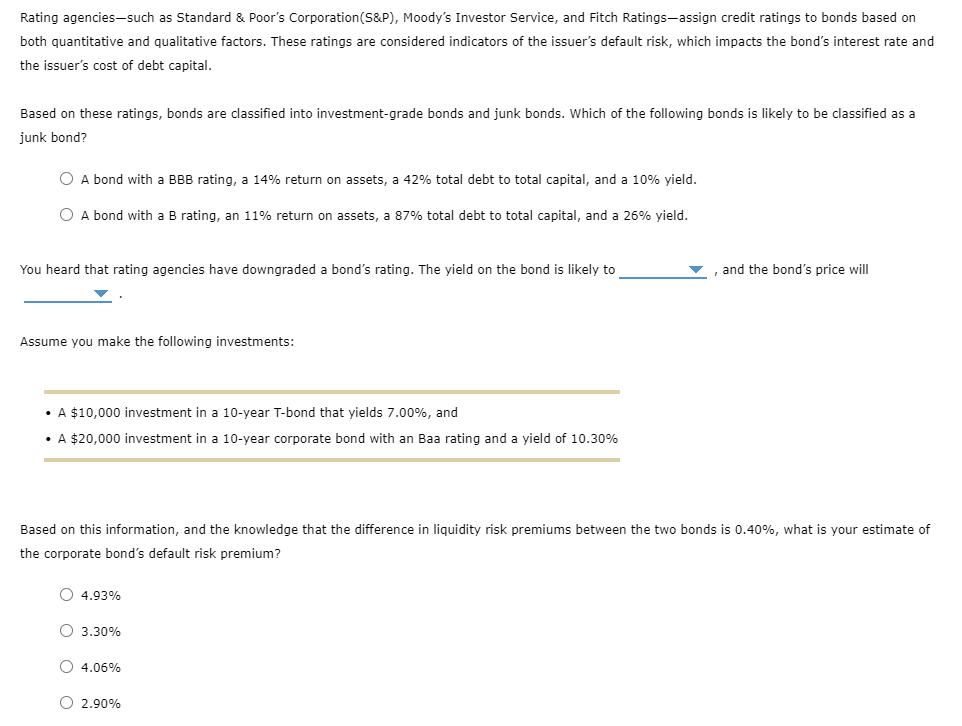
Rating agencies-such as Standard & Poor's Corporation (S&P), Moody's Investor Service, and Fitch Ratings-assign credit ratings to bonds based on both quantitative and qualitative factors. These ratings are considered indicators of the issuer's default risk, which impacts the bond's interest rate and the issuer's cost of debt capital. Based on these ratings, bonds are classified into investment-grade bonds and junk bonds. Which of the following bonds is likely to be classified as a junk bond? O A bond with a BBB rating, a 14% return on assets, a 42% total debt to total capital, and a 10% yield. O A bond with a B rating, an 11% return on assets, a 87% total debt to total capital, and a 26% yield. You heard that rating agencies have downgraded a bond's rating. The yield on the bond is likely to Assume you make the following investments: A $10,000 investment in a 10-year T-bond that yields 7.00%, and A $20,000 investment in a 10-year corporate bond with an Baa rating and a yield of 10.30% Based on this information, and the knowledge that the difference in liquidity risk premiums between the two bonds is 0.40%, what is your estimate of the corporate bond's default risk premium? 4.93% 3.30% 4.06% and the bond's price will O 2.90%
Step by Step Solution
3.46 Rating (159 Votes )
There are 3 Steps involved in it
Answer 1 A bond with a B rating an 11 return on assets a 87 total debt to total capital and a 26 yie... View full answer

Get step-by-step solutions from verified subject matter experts
 Study Help