







Question: Value of Project: Method Provided Need the answer this question You are a manager at Northern Fibre, which is considering expanding its operations in synthetic
Value of Project: Method Provided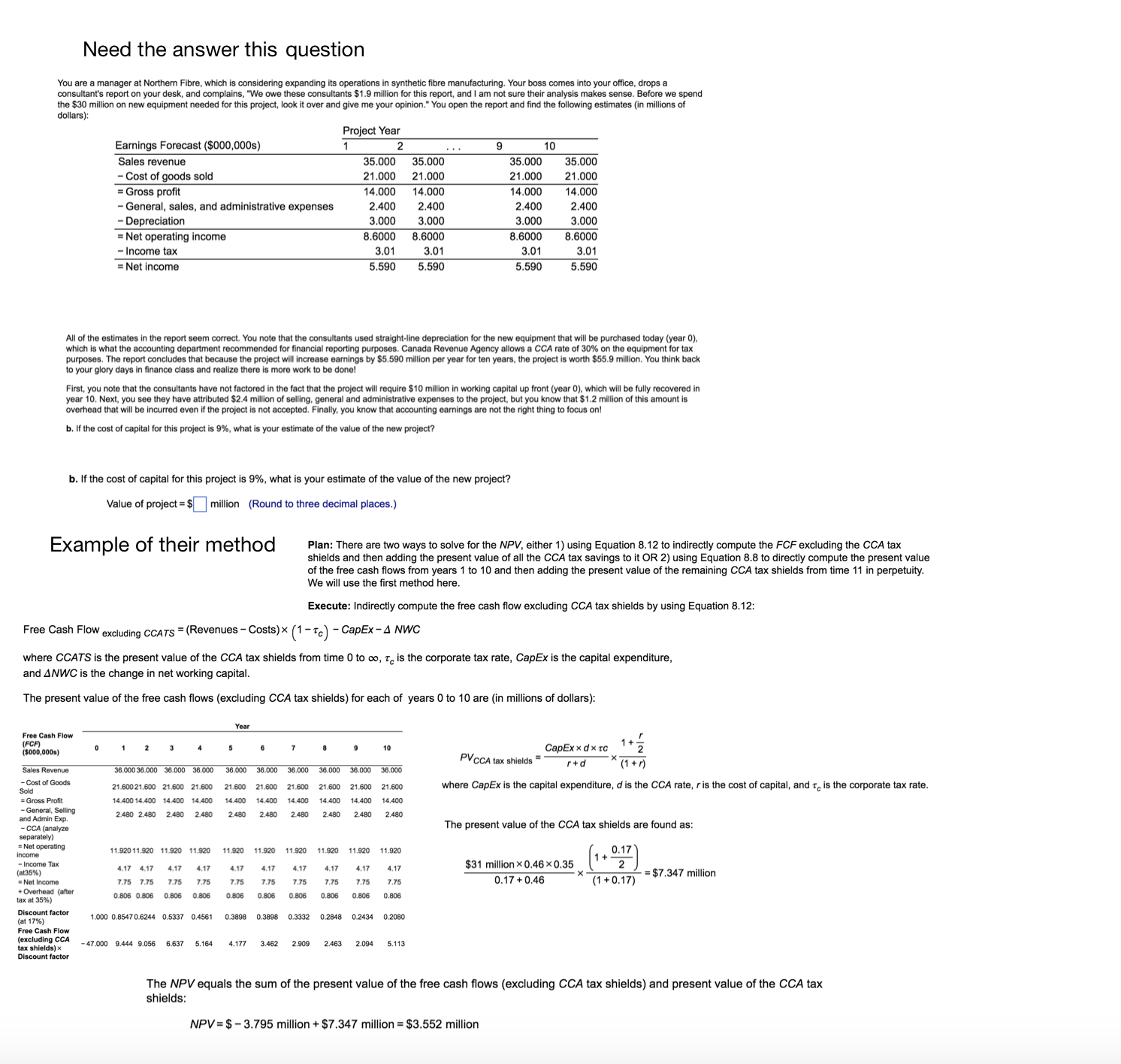
Need the answer this question You are a manager at Northern Fibre, which is considering expanding its operations in synthetic fibre manufacturing. Your boss comes into your office, drops a consultant's report on your desk, and complains, "We owe these consultants $1.9 million for this report, and I am not sure their analysis makes sense. Before we spend the $30 million on new equipment needed for this project, look it over and give me your opinion." You open the report and find the following estimates (in millions of dollars): Project Year Earnings Forecast ($000,000s) 2 35.000 35.000 21.000 21.000 4.000 14.000 2.400 2.400 3.000 3.000 8.6000 8.6000 35.000 35.000 21.000 21.000 4.000 14.000 2.400 3.000 8.6000 8.6000 Sales revenue Cost of goods sold Gross profit -General, sales, and administrative expenses 2.400 3.000 Depreciation Net operating income 3.01 5.590 - Income tax 3.01 3.01 Net income 5.590 5.590 5.590 All of the estimates in the report seem correct. You note that the consultants used straight-line depreciation for the new equipment that will be purchased today (year 0) which is what the accounting department recommended for financial reporting purposes. Canada Revenue Agency allows a CCA rate of 30% on the equipment for tax purposes. The report concludes that because the project will increase earnings by $5.590 million per year for ten years, the project is worth $55.9 million. You think back to your glory days in finance class and realize there is more work to be done First, you note that the consultants have not factored in the fact that the project will require $10 million in working capital up front (year 0), which will be fully recovered in year 10. Next, you see they have attributed $2.4 million of selling, general and administrative expenses to the project, but you know that $1.2 million of this amount is overhead that will be incurred even if the project is not accepted. Finally, you know that accounting earnings are not the right thing to focus on! b. If the cost of capital for this project is 996, what is your estimate of the value of the new project? b. If the cost of capital for this project is 9%, what is your estimate of the value of the new project? Value of project= $ million (Round to three decimal places.) Example of their method Plan: There are two ways to solve for the NPV, either 1) using Equation 8.12 to indirectly compute the FCF excluding the CCA tax shields and then adding the present value of all the CCA tax savings to it OR 2) using Equation 8.8 to directly compute the present value of the free cash flows from years 1 to 10 and then adding the present value of the remaining CCA tax shields from time 11 in perpetuity We will use the first method here Execute: Indirectly compute the free cash flow excluding CCA tax shields by using Equation 8.12 Free Cash Flow excluding CCATS -Revenues-Costs) x (1-%)-Capex is the corporate tax rate, CapEx ?S the capital expenditure where CCATs is the present value of the CCA tax shields from time 0 to oo, and ??WC is the change in net working capital The present value of the free cash flows (excluding CCA tax shields) for each of years 0 to 10 are (in millions of dollars) Free Cash Flow 2 ($000,000s) CCA tax shields 36.000 36.000 36.000 36.000 36.000 36.000 36.000 36.000 36.000 36.000 21.60021.600 21.600 21.600 21.600 21.600 21.600 21.600 21.600 21.600 14.400 14.400 14.400 14.400 14.400 14.400 14.400 14.400 14.400 14.400 2.480 2.480 2480 2480 2480 2480 2480 2480 2480 2.480 Sales Revenue -Cost of Goods Sold - Gross Profit where CapEx is the capital expenditure, d is the CCA rate, r is the cost of capital, and c is the corporate tax rate -General, Selling and Admin Exp. -CCA (analyze The present value of the CCA tax shields are found as -Net operating 11.920 11.920 11.920 11.920 11.920 11.920 11.920 11.920 11.920 11.920 .17 4.17 4.17 4.17 4.17 4.174.174.1747 4.17 .75 7.75 7.75 7.75 7.75 7.75 7.757.75.75 7.75 0.806 0.806 0.806 0.806 0.806 0.806 0.806 0.806 0.806 0.806 - Income Tax (at35%) Net Income +Overhead (after tax at 35%) $31 million 0.46 x 0.35 0.17+0.46 -$7.347 million Discount factor (at 17%) Free Cash Flow 1,000 0.8547 0.6244 0.5337 0.4561 0.3898 0.3898 0.3332 0.2848 0.2434 0.2080 (excluding CCA tax shields)x Discount factor 47.000 9444 9.056 6.637 5.1644.1773.462 2.909 2.463 2.094 5.113 The NPV equals the sum of the present value of the free cash flows (excluding CCA tax shields) and present value of the CCA tax shields NPV-$ -3.795 million+ $7.347 million $3.552 million
Step by Step Solution
There are 3 Steps involved in it

Get step-by-step solutions from verified subject matter experts
 Study Help