







Question: vec ( B ) = 0 I 4 d ( v e c ( s ) ) ( h a t ( r ) )
vec
Problem : Let's examine what the vectors involved in the BiotSavart Law represent, think about how we might write them down using proper vector notation, and apply what we know about cross products.
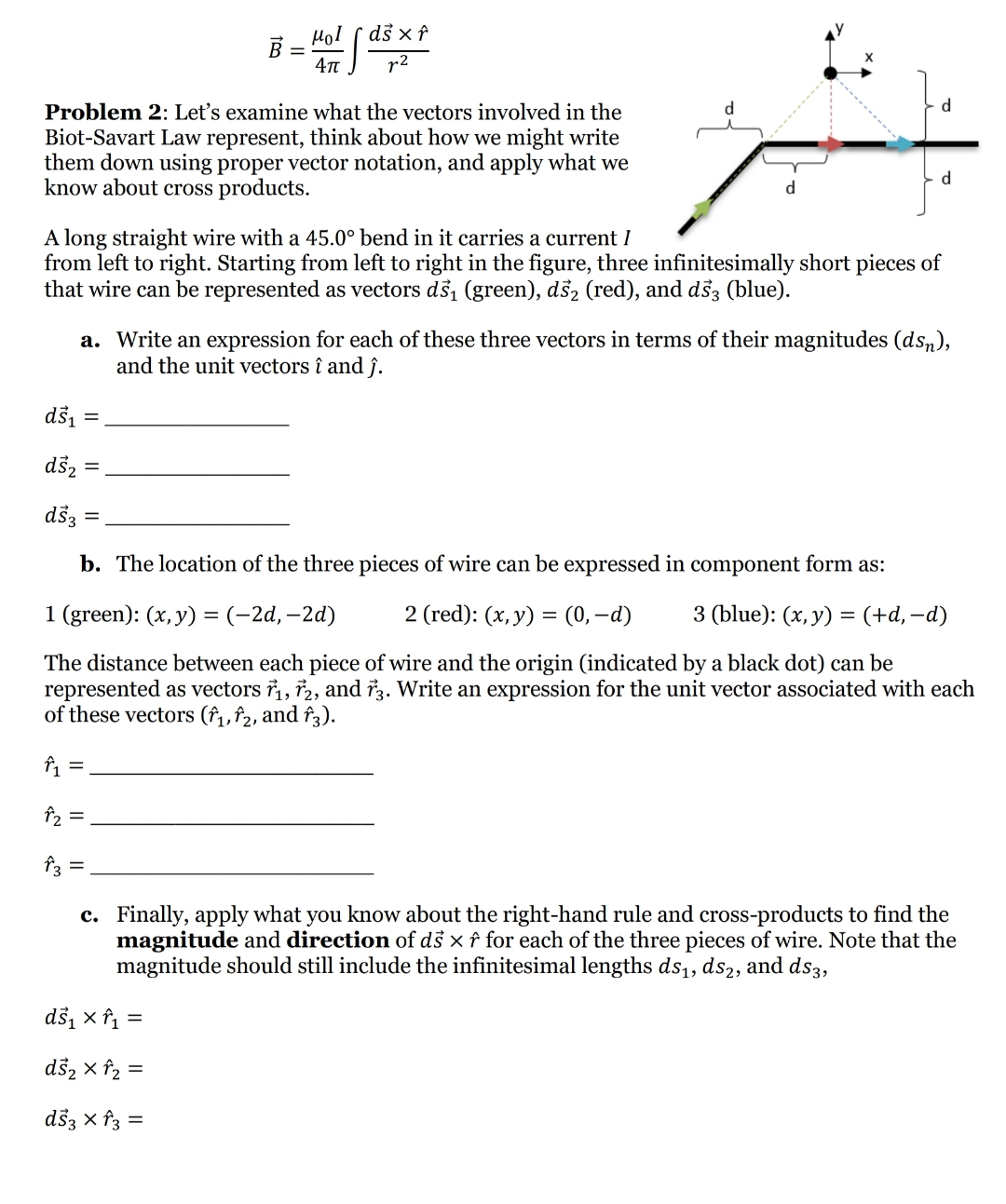
A long straight wire with a bend in it carries a current I from left to right. Starting from left to right in the figure, three infinitesimally short pieces of that wire can be represented as vectors dvecgreen dvecred and dvecblue
a Write an expression for each of these three vectors in terms of their magnitudes and the unit vectors hat and hat
dvec
dvec
dvec
b The location of the three pieces of wire can be expressed in component form as:
: : :
The distance between each piece of wire and the origin indicated by a black dot can be represented as vectors vecvec and vec Write an expression for the unit vector associated with each of these vectors and :hat
hat
hat
hat
c Finally, apply what you know about the righthand rule and crossproducts to find the magnitude and direction of dvechat for each of the three pieces of wire. Note that the magnitude should still include the infinitesimal lengths and
dvechat
dvechat
dvechat
Step by Step Solution
There are 3 Steps involved in it
1 Expert Approved Answer
Step: 1 Unlock

Question Has Been Solved by an Expert!
Get step-by-step solutions from verified subject matter experts
Step: 2 Unlock
Step: 3 Unlock
 Study Help