



Question: Vector Calculus (10) Consider a fluid of density u(x, y, z) = 1 (measured in g/ in3 ) flowing with velocity v(x, y, z) =
Vector Calculus
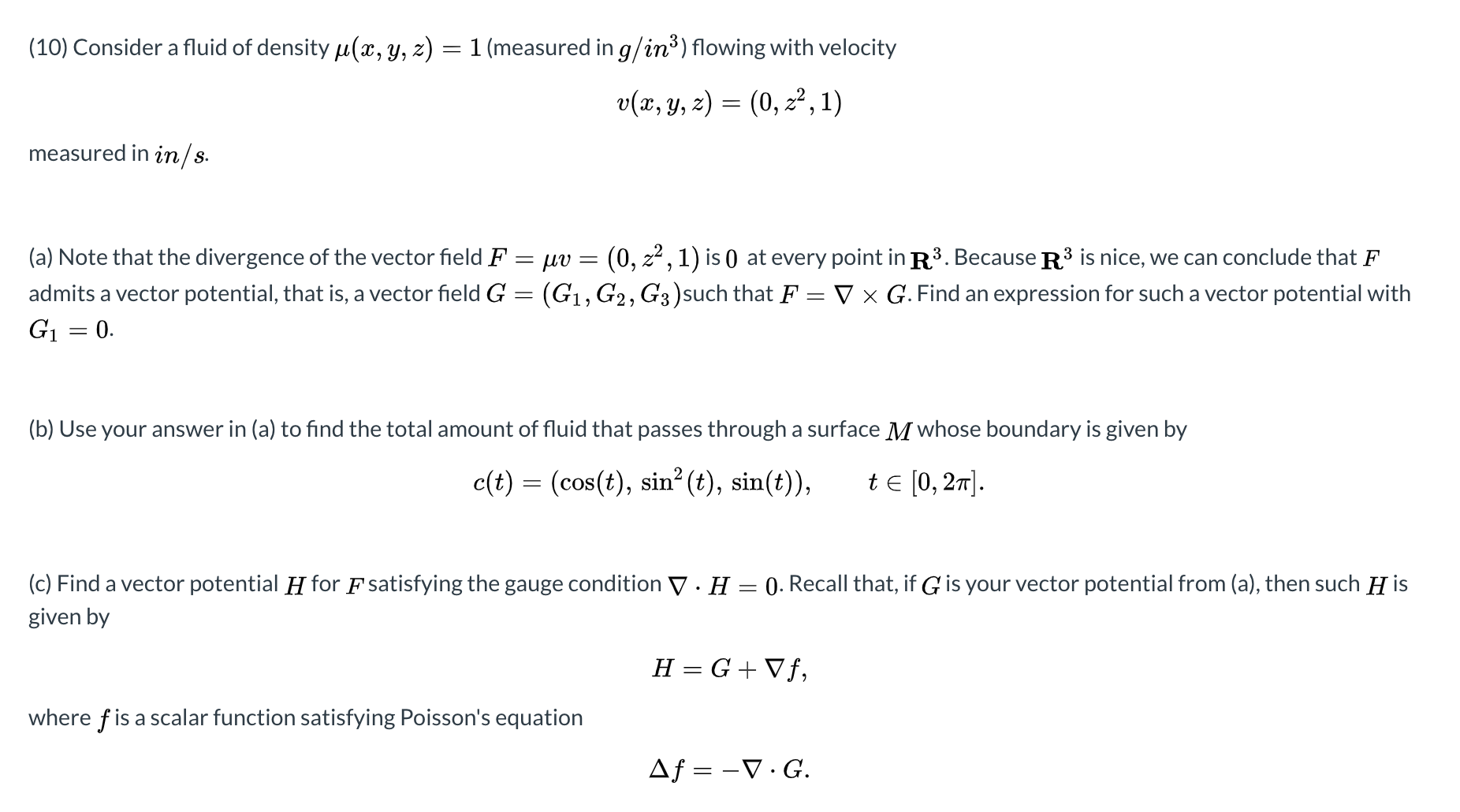
(10) Consider a fluid of density u(x, y, z) = 1 (measured in g/ in3 ) flowing with velocity v(x, y, z) = (0, 22, 1) measured in in / s. (a) Note that the divergence of the vector field F = Mv = (0, 22, 1) is 0 at every point in R3. Because R3 is nice, we can conclude that F admits a vector potential, that is, a vector field G = (G1, G2, G3 ) such that F = V x G. Find an expression for such a vector potential with G1 = 0. (b) Use your answer in (a) to find the total amount of fluid that passes through a surface M whose boundary is given by c(t) = (cos(t), sin? (t), sin(t)), te [0, 27]. (c) Find a vector potential H for F satisfying the gauge condition V . H = 0. Recall that, if G is your vector potential from (a), then such H is given by H = G+Vf, where f is a scalar function satisfying Poisson's equation Af = -V . G
Step by Step Solution
There are 3 Steps involved in it

Get step-by-step solutions from verified subject matter experts