







Question: Vehicle.h #pragma once #include using namespace std; class Vehicle { private: int numWheels, numDoors; public: // Default constructor Vehicle(); Vehicle(int, int); Vehicle(int); // Copy Constructors
Vehicle.h
#pragma once #include using namespace std;
class Vehicle { private: int numWheels, numDoors; public: // Default constructor Vehicle(); Vehicle(int, int); Vehicle(int); // Copy Constructors Vehicle(Vehicle &); Vehicle(Vehicle *); // Additional function void printVehicle(); // Destructor ~Vehicle(); };
Vehicle.cpp
// Vehicle.cpp #include "Vehicle.h"
Vehicle::Vehicle():Vehicle(0, 0){}
void Vehicle::printVehicle() { cout
Vehicle::Vehicle(int w, int d) { numWheels = w; numDoors = d; cout
Vehicle::Vehicle(int w):Vehicle(w, 2){}
// Implementing copy constructors
Vehicle::Vehicle(Vehicle ©):Vehicle(copy.numWheels, copy.numDoors) { cout
Vehicle::Vehicle(Vehicle *copy) {
this->numWheels = copy->numWheels; this->numDoors = copy->numDoors; cout
Vehicle::~Vehicle(){}
week2.cpp
#include #include "Vehicle.h"
using namespace std;
// CreateVehicle function
void CreateVehicle(Vehicle &v, int w=4, int d=2) { v = Vehicle(w, d); }
int main(int argc, char** argv) {
Vehicle original; //empty constructor no ()
Vehicle copy(original); // copy constructor by reference
Vehicle secondCopy(&original); //copy constructor by point
copy.printVehicle();
CreateVehicle(copy, 2); //wheels is 2, everything else is default value copy.printVehicle(); CreateVehicle(copy, 2, 3); //wheels is 2, doors is 3
copy.printVehicle();
copy = secondCopy;
copy.printVehicle(); // copy is same as second copy
return 0; }
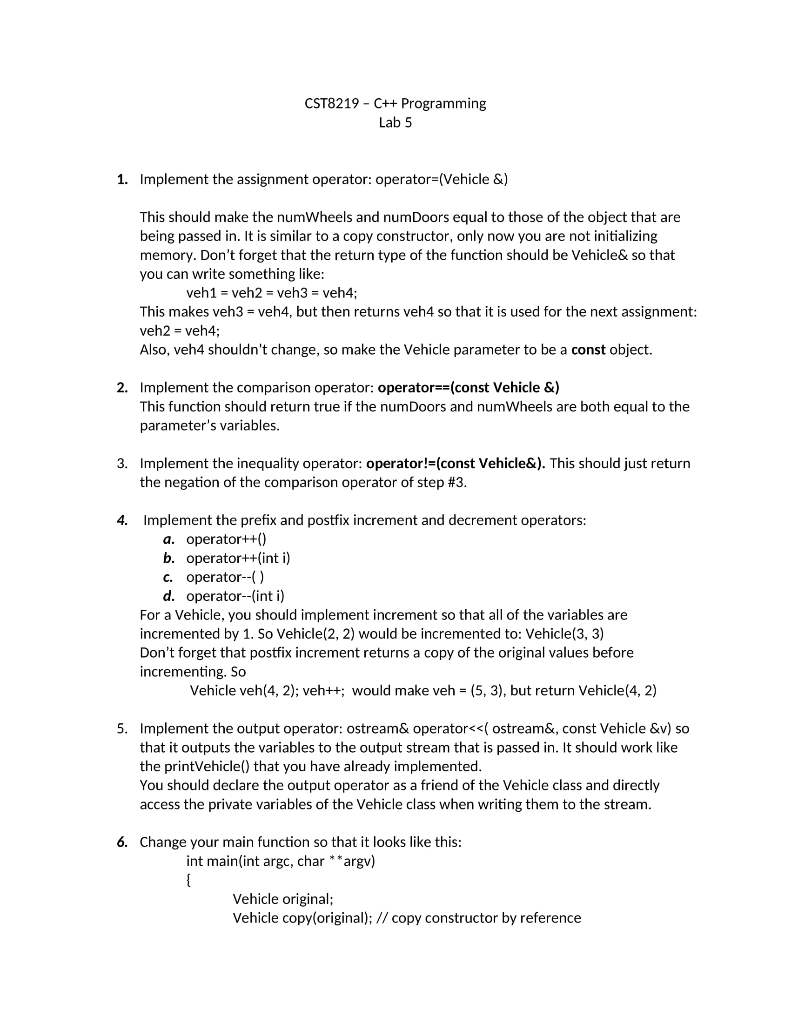
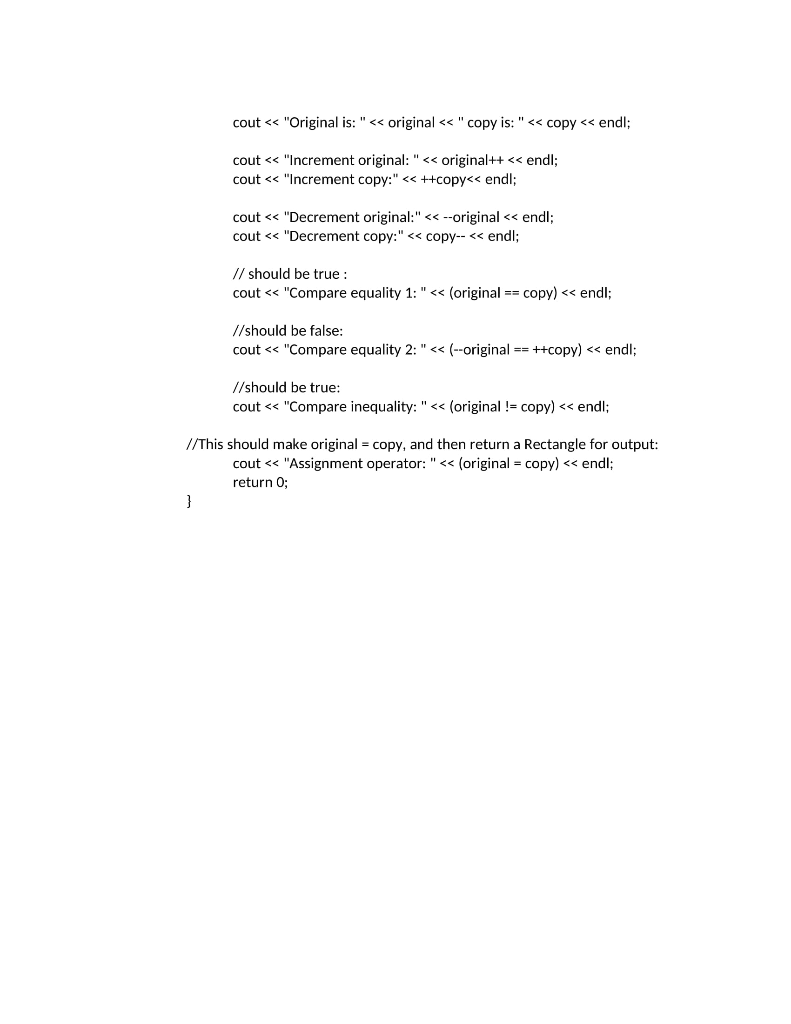
CST8219 - C++ Programming Lab 5 1. Implement the assignment operator: operator=(Vehicle &) This should make the numWheels and numDoors equal to those of the object that are being passed in. It is similar to a copy constructor, only now you are not initializing memory. Don't forget that the return type of the function should be Vehicle& so that you can write something like: veh1 = veh2 = veh3 = veh4; This makes veh3 = veh4, but then returns veh4 so that it is used for the next assignment: veh2 = veh4; Also, veh4 shouldn't change, so make the Vehicle parameter to be a const object. 2. Implement the comparison operator: operator==(const Vehicle &) This function should return true if the numDoors and numWheels are both equal to the parameter's variables. 3. Implement the inequality operator: operator!=(const Vehicle&). This should just return the negation of the comparison operator of step #3. 4. Implement the prefix and postfix increment and decrement operators: a. operator++0) b. operator++(int i) C. operator--( ) d. operator--(int i) For a Vehicle, you should implement increment so that all of the variables are incremented by 1. So Vehicle(2, 2) would be incremented to: Vehicle(3, 3) Don't forget that postfix increment returns copy of the original values before incrementing. So Vehicle veh(4, 2); veh++; would make veh = (5,3), but return Vehicle(4, 2) 5. Implement the output operator: ostream& operator
Step by Step Solution
There are 3 Steps involved in it

Get step-by-step solutions from verified subject matter experts
 Study Help