







Question: verify that the indicated function is an explicit solution of the given differential y + y = tan x; y = (cos x)ln(secx +
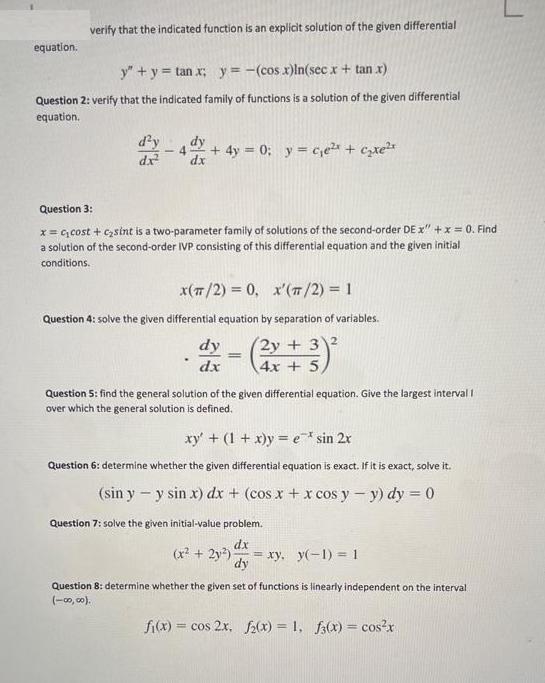
verify that the indicated function is an explicit solution of the given differential y" + y = tan x; y = (cos x)ln(secx + tan .x) Question 2: verify that the indicated family of functions is a solution of the given differential equation. equation. dy 513 4 dx +4y=0; y = + x Question 3: x = ccost + csint is a two-parameter family of solutions of the second-order DE x" + x = 0. Find a solution of the second-order IVP consisting of this differential equation and the given initial conditions. x(/2) = 0, x'(/2) = 1 Question 4: solve the given differential equation by separation of variables. 2y + 3)2 4x + 5 dy dx = Question 5: find the general solution of the given differential equation. Give the largest interval 1 over which the general solution is defined. xy' + (1+x)y=e* sin 2x Question 6: determine whether the given differential equation is exact. If it is exact, solve it. (sin y - y sin x) dx + (cos x + x cos y - y) dy = 0 Question 7: solve the given initial-value problem. dx (x + 2y) H dy xy, y(-1) = 1 Question 8: determine whether the given set of functions is linearly independent on the interval. (-00,00). fi(x) = cos 2x, f(x) = 1, f3(x) = cosx
Step by Step Solution
3.39 Rating (158 Votes )
There are 3 Steps involved in it
First question To confirm if cos ln sec tan y cosxThe answer to y y tan y tanx is lnsecxtanx Finding y is the first step in solving the differential equation to see if it holds true y sinxlnsecxtanx s... View full answer

Get step-by-step solutions from verified subject matter experts
 Study Help