







Question: Verify that y1(x) = e4x is a solution to the initial value problem: y +3y 4y=0; y(0)=1; y(0)=4. Problem 2. Find y2(x), the solution to
Verify that y1(x) = e4x is a solution to the initial value problem: y +3y 4y=0; y(0)=1; y(0)=4.
Problem 2. Find y2(x), the solution to the initial value problem:
y +3y 4y=0; y(0)=5; y(0)=10. Problem 3. The linear transformation T : C2(R) C0(R) is defined by
d2 d
T(f) = dx2f+3dxf4f.
Show that the functions y1(x) and y2(x) from Problem 1 and Problem 2 form a basis for kerT. (Hint: By Theorem 8.1.6, the set of solutions to a second order differential equation
y + 3y 4y = 0
is a vector space of dimension 2.)
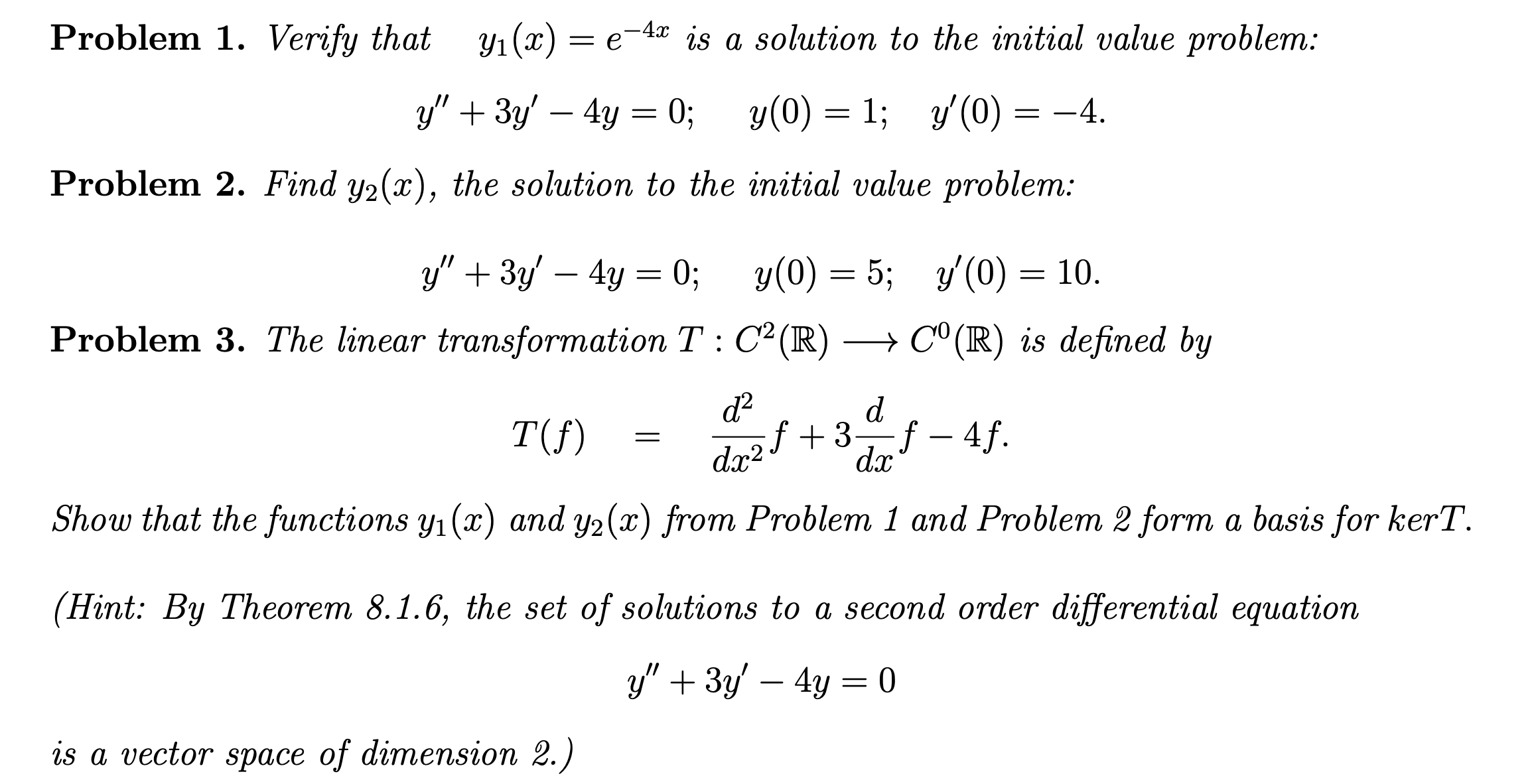
Problem 1. Verify that y1(x) = e'4x is a solution to the initial value problem: v\" + 3v' 4y = 0; 11(0) = 1; y'(0) = -4- Problem 2. Find y2(a:), the solution to the initial value problem: 31\" + 31/ 4y = 0; 31(0) = 5; v'(0) = 10- Problem 3. The linear transformation T : C2 (R) > COOK) is dened by T(f) d2f + 31f 4f _ dx2 d1: ' Show that the functions y1(x) and 3/2 (x) from Problem 1 and Problem 2 form a basis for kerT. (Hint: By Theorem 8.1.6, the set of solutions to a second order dierential equation v\"+3v'4v=0 is a vector space of dimension 2.)
Step by Step Solution
There are 3 Steps involved in it

Get step-by-step solutions from verified subject matter experts
 Study Help