



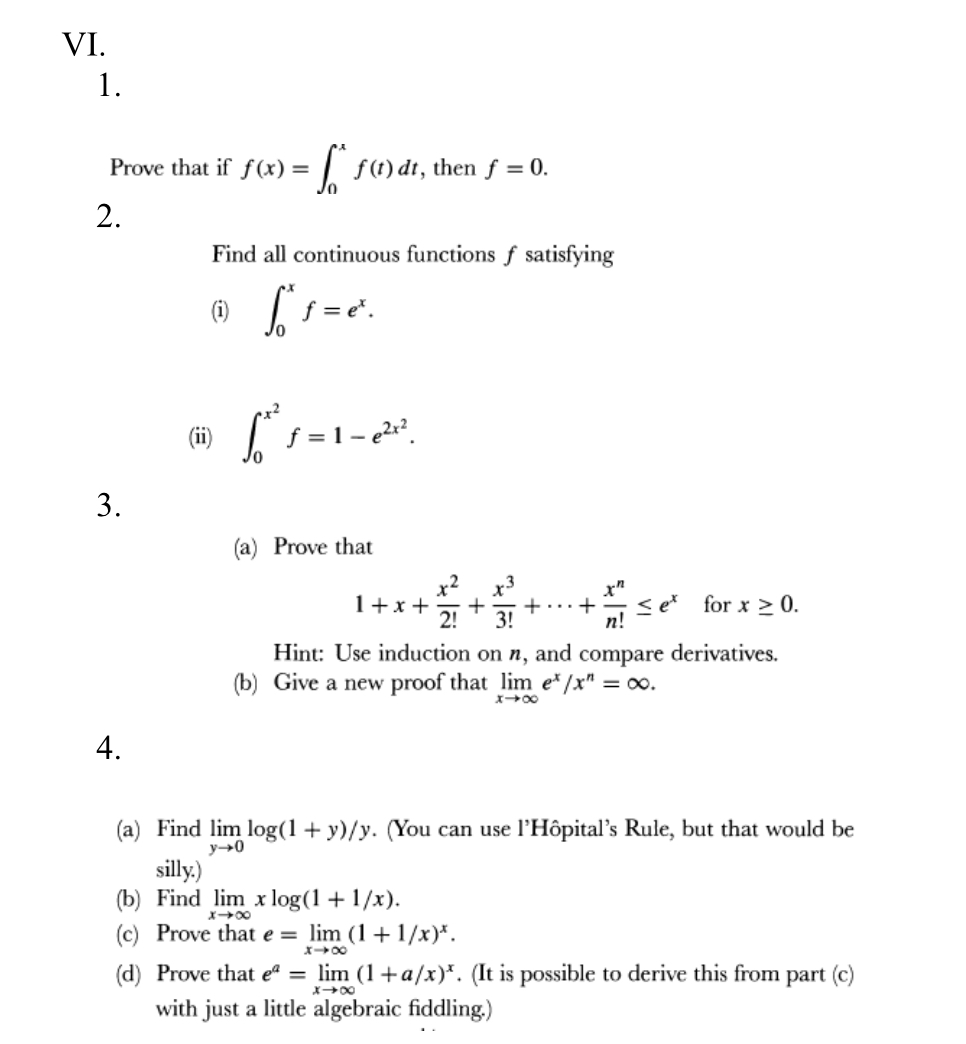
Question: VI . 1 . Prove that if f ( x ) = 0 x f ( t ) d t , then f = 0
VI
Prove that if then
Find all continuous functions satisfying
i
ii
a Prove that
cdots for
Hint: Use induction on and compare derivatives.
b Give a new proof that
a Find You can use lHpitals Rule, but that would be silly.
b Find
c Prove that
d Prove that It is possible to derive this from part c with just a little algebraic fiddling.
Step by Step Solution
There are 3 Steps involved in it
1 Expert Approved Answer
Step: 1 Unlock

Question Has Been Solved by an Expert!
Get step-by-step solutions from verified subject matter experts
Step: 2 Unlock
Step: 3 Unlock