







Question: View Available Hint ( s ) Learning Goal: For a truss to be in equilibrium, each of its joints also must be in equilibrium. Trusses
View Available Hints
Learning Goal:
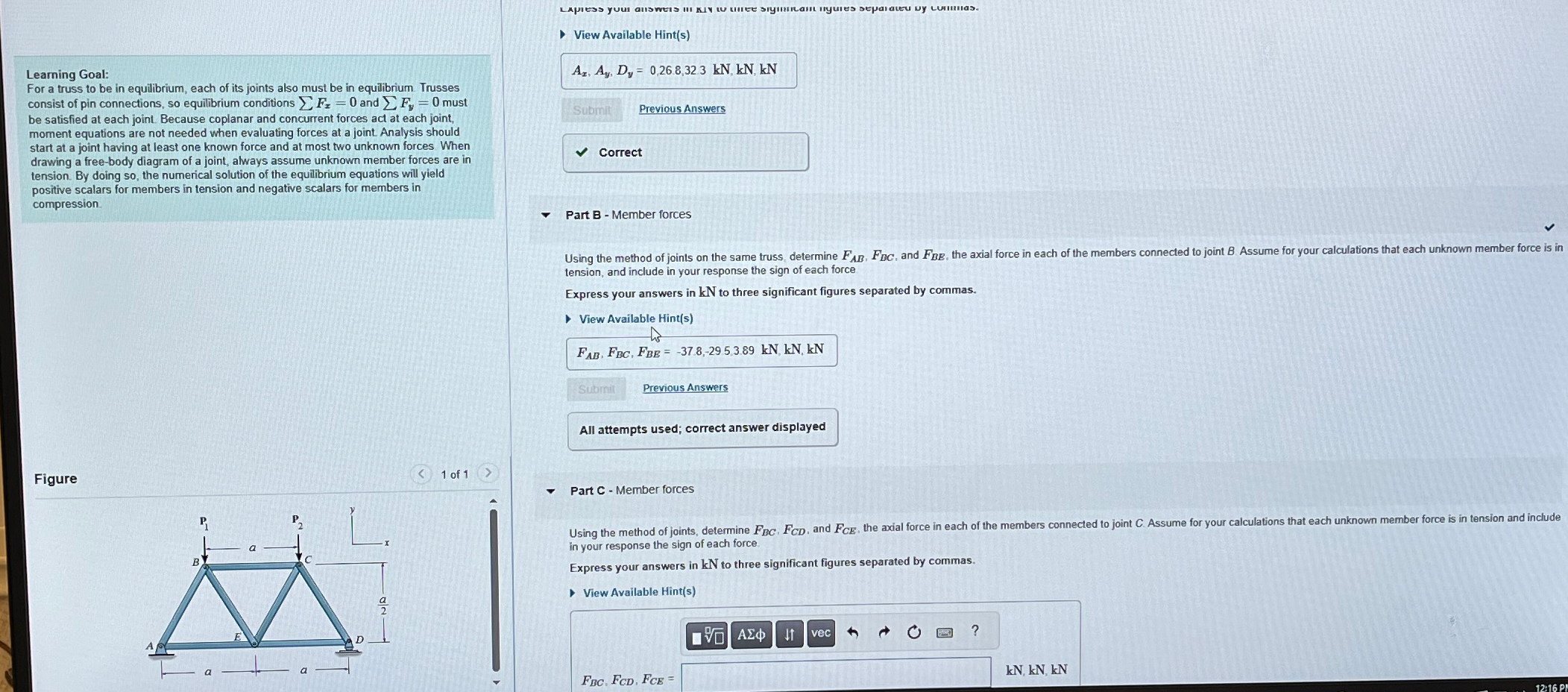
For a truss to be in equilibrium, each of its joints also must be in equilibrium. Trusses consist of pin connections, so equilibrium conditions and must be satisfied at each joint. Because coplanar and concurrent forces act at each joint, moment equations are not needed when evaluating forces at a joint. Analysis should start at a joint having at least one known force and at most two unknown forces. When drawing a freebody diagram of a joint, always assume unknown member forces are in tension. By doing so the numerical solution of the equilibrium equations will yield positive scalars for members in tension and negative scalars for members in compression.
Previous Answers
Correct
Part B Member forces
Using the method of joints on the same truss, determine and the axial force in each of the members connected to joint Assume for your calculations that each unknown member force is in tension, and include in your response the sign of each force
Express your answers in to three significant figures separated by commas.
View Available Hints
Previous Answers
All attempts used; correct answer displayed
Part C Member forces
Using the method of joints, determine and the axial force in each of the members connected to joint Assume for your calculations that each unknown member force is in tension and include in your response the sign of each force.
Express your answers in to three significant figures separated by commas.
View Available Hints
darr
vec
N
A m
P kN
P kN
Step by Step Solution
There are 3 Steps involved in it
1 Expert Approved Answer
Step: 1 Unlock

Question Has Been Solved by an Expert!
Get step-by-step solutions from verified subject matter experts
Step: 2 Unlock
Step: 3 Unlock
 Study Help