







Question: W' MAT152 Practice Problems Cha} X n Course Hero X I @ Risk-Free, Guaranteed Charlotte X I G AConsumer Products Magazine X I + 7
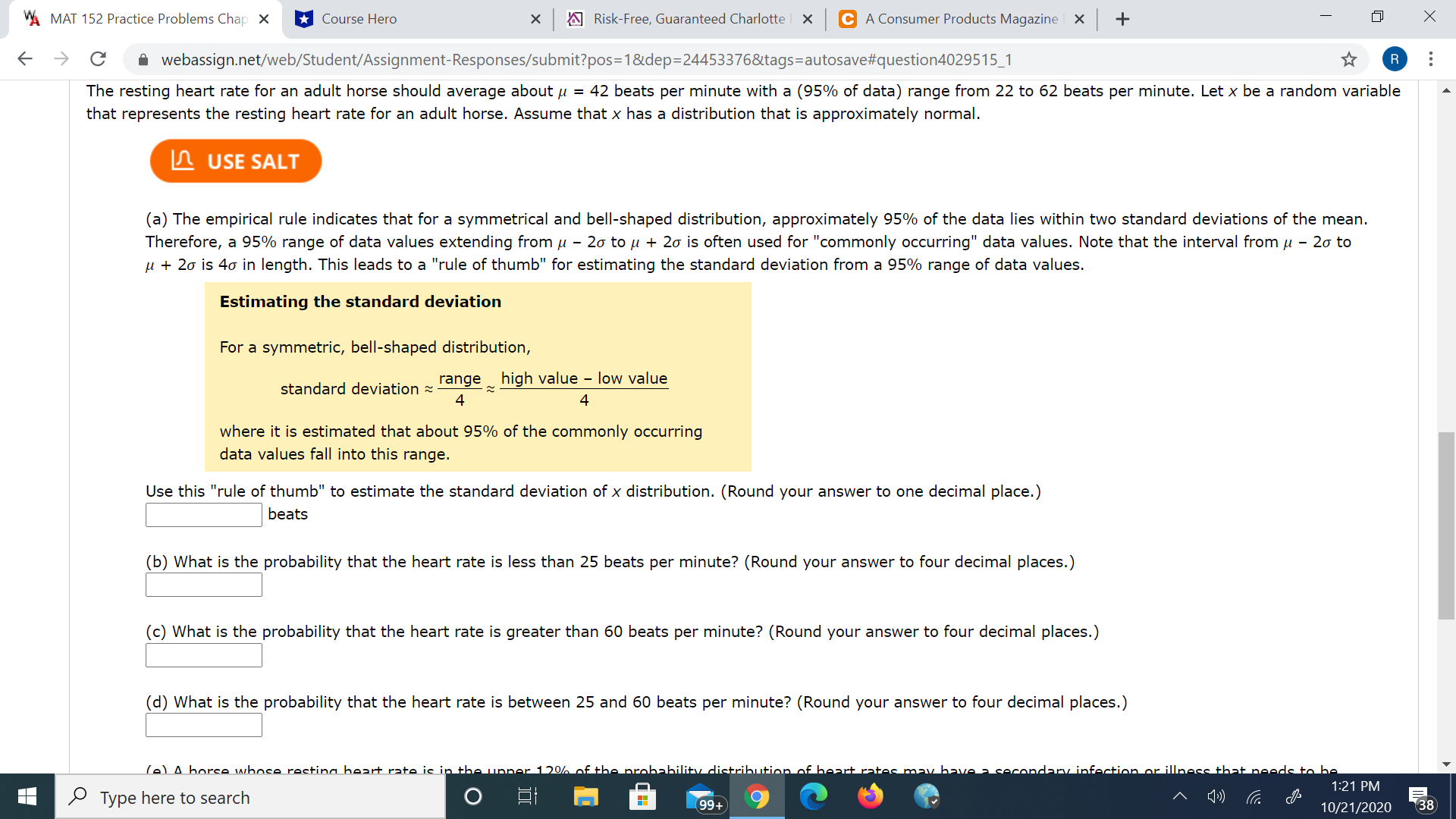
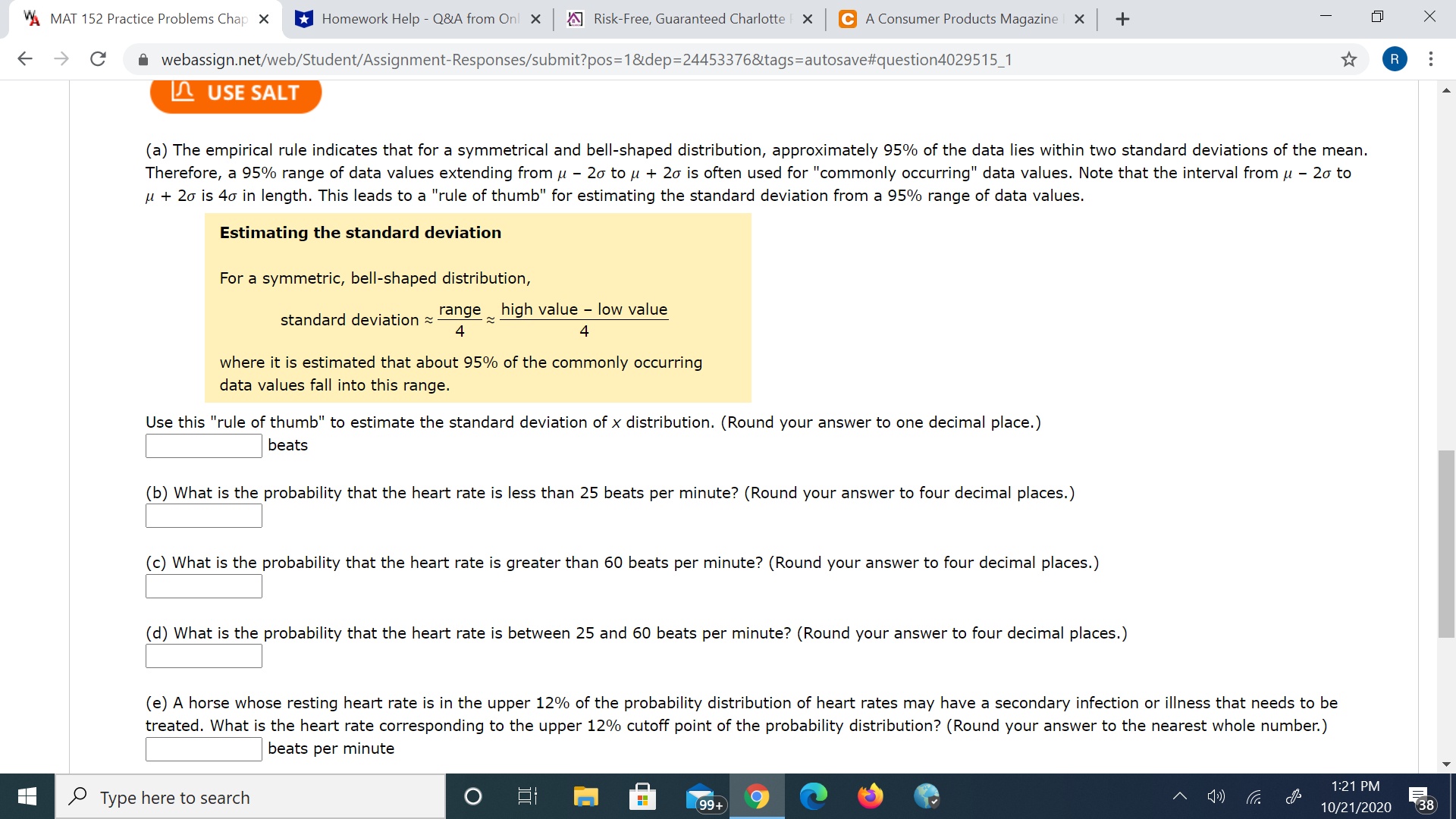
W' MAT152 Practice Problems Cha} X n Course Hero X I @ Risk-Free, Guaranteed Charlotte X I G AConsumer Products Magazine X I + 7 X ( 9 C' i webassign.net/web/Student/Assignment-Responses/submipos:'l&dep:244533768ctags:autosave#question4029515,1 1'3: 6 i The resting heart rate for an adult horse should average about u = 42 beats per minute with a (95% of data) range from 22 to 62 beats per minute. Let x be a random variable - that represents the resting heart rate for an adult horse. Assume that x has a distribution that is approximately normal. IA USE SA (a) The empirical rule indicates that for a symmetrical and bell-shaped distribution, approximately 95% of the data lies within two standard deviations of the mean. Therefore, a 95% range of data values extending from pl 20' to _u + 2a is often used for "commonly occurring" data values. Note that the interval from [1 20 to p + 20 is 40' in length. This leads to a I'rule of thumb" for estimating the standard deviation from a 95% range of data values. Estimating the standard deviation For a symmetric, bell-shaped distribution, range high value low value 4 4 standard deviation 2 where it is estimated that about 95% of the commonly occurring data values fall into this range. Use this "rule of thumb" to estimate the standard deviation of x distribution. (Round your answer to one decimal place.) S beats (b) What is the probability that the heart rate is less than 25 beats per minute? (Round your answer to four decimal places.) S (c) What is the probability that the heart rate is greater than 60 beats per minute? (Round your answer to four decimal places.) E (d) What is the probability that the heart rate is between 25 and 60 beats per minute? (Round your answer to four decimal places.) S (mnmuhmmnnnkaan-rmi. n.. _ 1:21 PM E /0 Type here to search ' 10,121,201, E3 W' MAT 152 Practice Problems Cha} X n Homework Help-QM from On X I @ Risk-Free, Guaranteed Charlotte X I G AConsumer Products Magazine X I + 7 X ( 9 C' i webassign.net/web/Student/Assignment-Responses/submipos:'i&dep:244533768ctags:autosave#question4029515,1 1'3: 6 i R USE SALT - (a) The empirical rule indicates that for a symmetrical and bell-shaped distribution, approximately 95% of the data lies within two standard deviations of the mean. Therefore, a 95% range of data values extending from u 20 to ,u + 2a is often used for "commonly occurring" data values. Note that the interval from u 20 to p + 20 is 40 in length. This leads to a I'rule of thumb" for estimating the standard deviation from a 95% range of data values. Estimating the standard deviation For a symmetric, bellshaped distribution, _ . ran e hi h value low value standard devration : 79 x g 4 4 where it is estimated that about 95% of the commonly occurring data values fall into this range. Use this "rule of thumb" to estimate the standard deviation of X distribution. (Round your answer to one decimal place.) beats (b) What is the probability that the heart rate is less than 25 beats per minute? (Round your answer to four decimal places.) (c) What is the arobability that the heart rate is greater than 60 beats per minute? (Round your answer to four decimal places.) (d) What is the probability that the heart rate is between 25 and 60 beats per minute? (Round your answer to four decimal places.) (e) A horse whose resting heart rate is in the upper 12% of the probability distribution of heart rates may have a secondary infection or illness that needs to be treated. What is the heart rate corresponding to the upper 12% cutoff point of the probability distribution? (Round your answer to the nearest whole number.) beats per minute _ 1:21 PM E /0 Type here to search ' 10,121,201, E3
Step by Step Solution
There are 3 Steps involved in it

Get step-by-step solutions from verified subject matter experts
 Study Help