







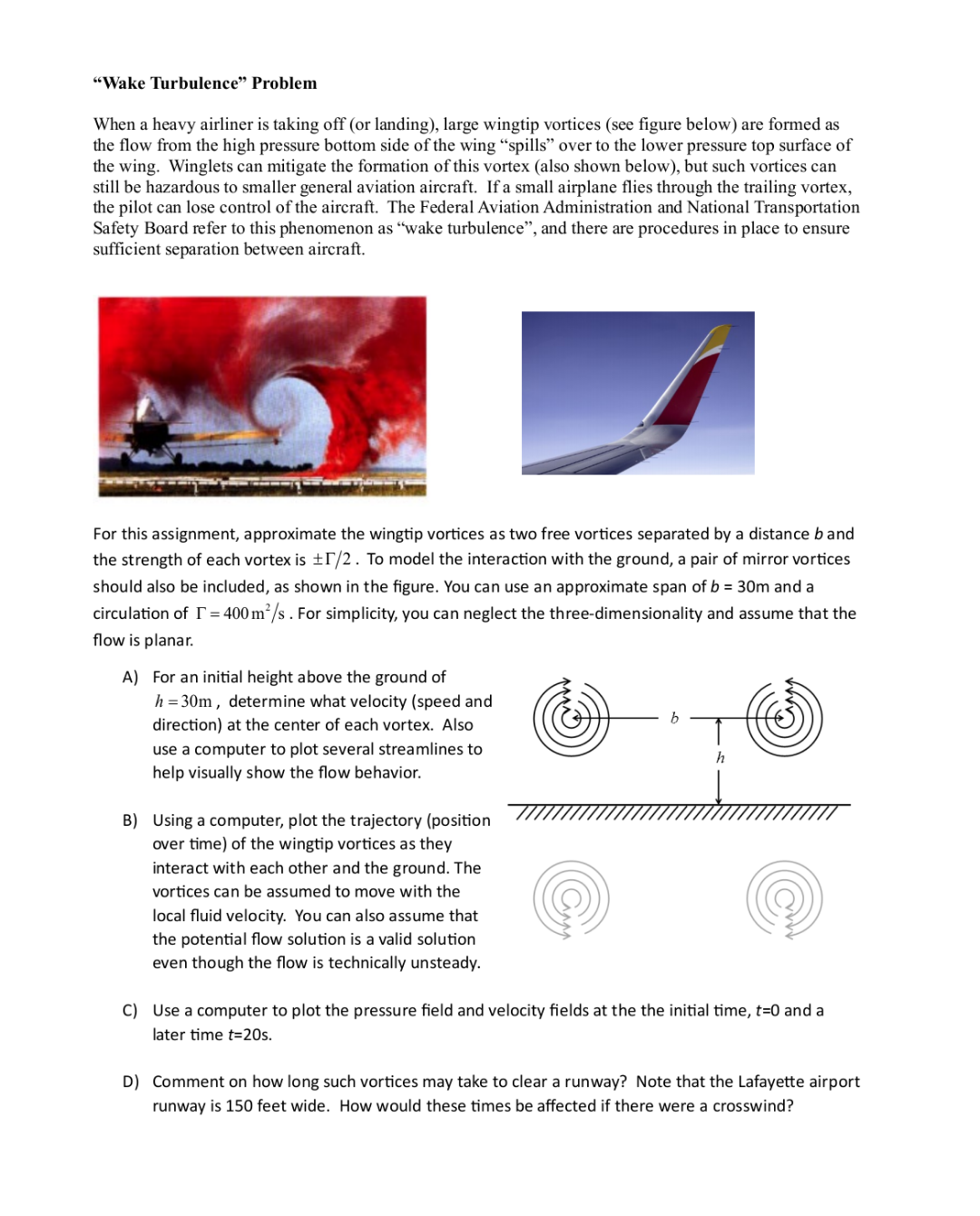
Question: Wake Turbulence Problem When a heavy airliner is taking off ( or landing ) , large wingtip vortices ( see figure below ) are formed
"Wake Turbulence" Problem
When a heavy airliner is taking off or landing large wingtip vortices see figure below are formed as
the flow from the high pressure bottom side of the wing "spills" over to the lower pressure top surface of
the wing. Winglets can mitigate the formation of this vortex also shown below but such vortices can
still be hazardous to smaller general aviation aircraft. If a small airplane flies through the trailing vortex,
the pilot can lose control of the aircraft. The Federal Aviation Administration and National Transportation
Safety Board refer to this phenomenon as "wake turbulence", and there are procedures in place to ensure
sufficient separation between aircraft.
For this assignment, approximate the wingtip vortices as two free vortices separated by a distance and
the strength of each vortex is To model the interaction with the ground, a pair of mirror vortices
should also be included, as shown in the figure. You can use an approximate span of and a
circulation of For simplicity, you can neglect the threedimensionality and assume that the
flow is planar.
A For an initial height above the ground of
determine what velocity speed and
direction at the center of each vortex. Also
use a computer to plot several streamlines to
help visually show the flow behavior.
B Using a computer, plot the trajectory position
over time of the wingtip vortices as they
interact with each other and the ground. The
vortices can be assumed to move with the
local fluid velocity. You can also assume that
the potential flow solution is a valid solution
even though the flow is technically unsteady.
C Use a computer to plot the pressure field and velocity fields at the the initial time, and a
later time
D Comment on how long such vortices may take to clear a runway? Note that the Lafayette airport
runway is feet wide. How would these times be affected if there were a crosswind?
Step by Step Solution
There are 3 Steps involved in it
1 Expert Approved Answer
Step: 1 Unlock

Question Has Been Solved by an Expert!
Get step-by-step solutions from verified subject matter experts
Step: 2 Unlock
Step: 3 Unlock
 Study Help