Question: Walter Shewart, Director, Quality Assurance Walter Shewart was hired four weeks ago as Director of Quality Assurance. He looking forward to assessing the quality problems
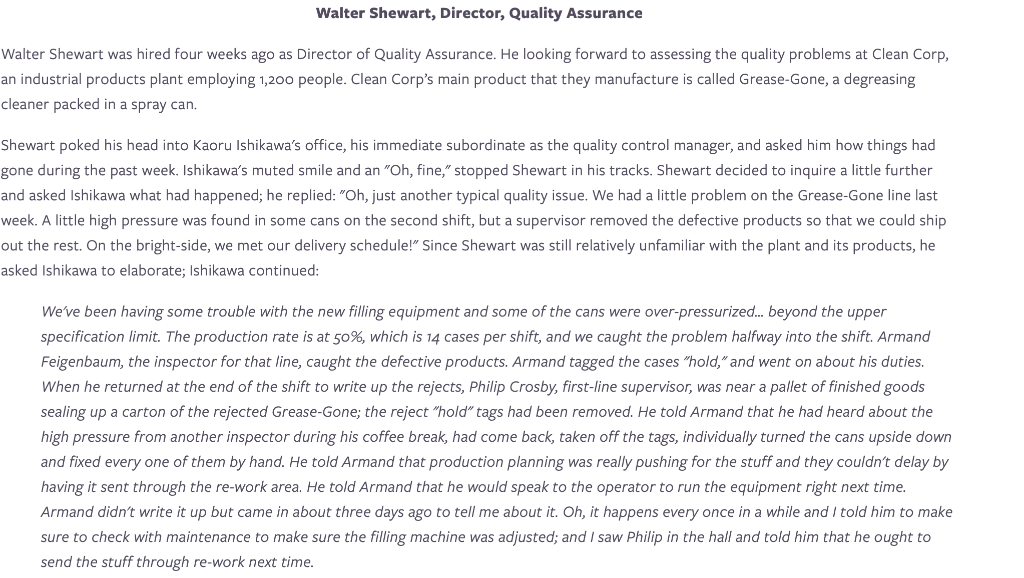
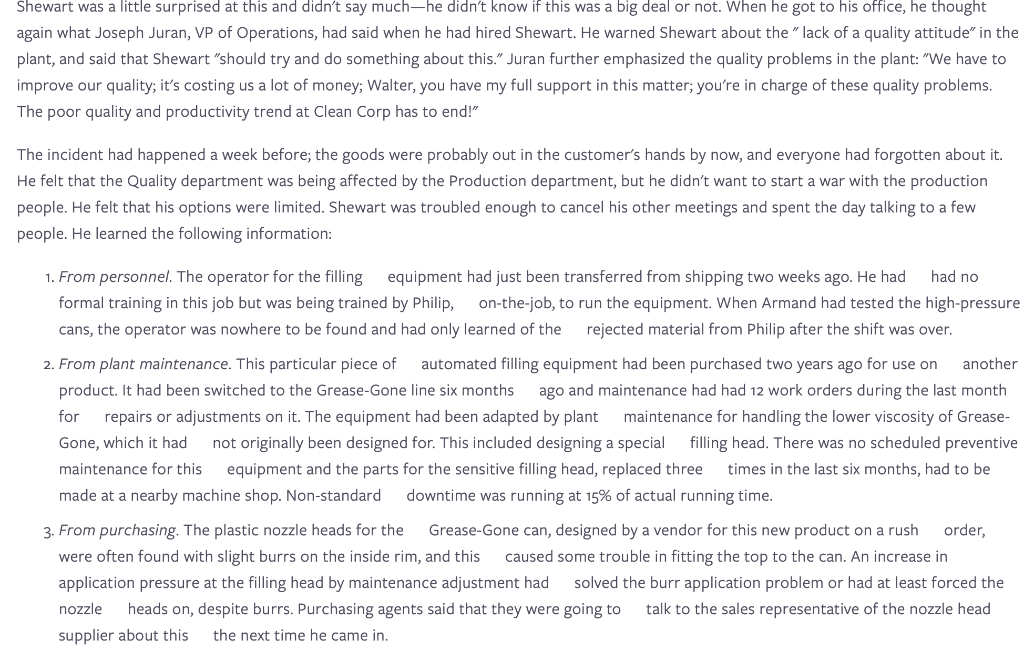
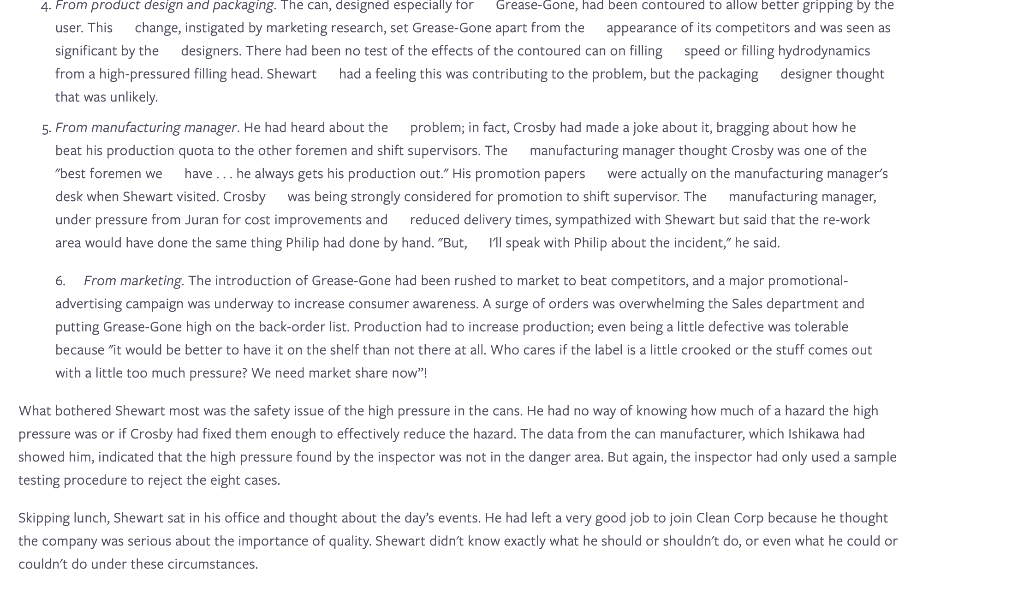
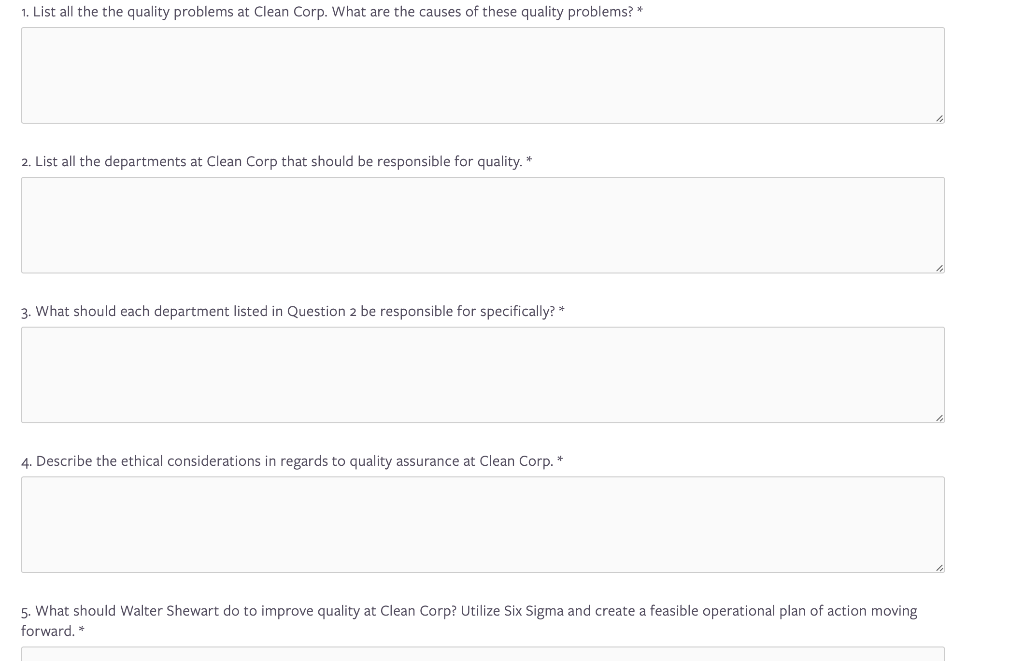
Walter Shewart, Director, Quality Assurance Walter Shewart was hired four weeks ago as Director of Quality Assurance. He looking forward to assessing the quality problems at Clean Corp, an industrial products plant employing 1,200 people. Clean Corp's main product that they manufacture is called Grease-Gone, a degreasing cleaner packed in a spray can. Shewart poked his head into Kaoru Ishikawa's office, his immediate subordinate as the quality control manager, and asked him how things had gone during the past week. Ishikawa's muted smile and an "Oh, fine," stopped Shewart in his tracks. Shewart decided to inquire a little further and asked Ishikawa what had happened; he replied: "Oh, just another typical quality issue. We had a little problem on the Grease-Gone line last week. A little high pressure was found in some cans on the second shift, but a supervisor removed the defective products so that we could ship out the rest. On the bright-side, we met our delivery schedule!" Since Shewart was still relatively unfamiliar with the plant and its products, he asked Ishikawa to elaborate; Ishikawa continued: We've been having some trouble with the new filling equipment and some of the cans were over-pressurized... beyond the upper specification limit. The production rate is at 50%, which is 14 cases per shift, and we caught the problem halfway into the shift. Armand Feigenbaum, the inspector for that line, caught the defective products. Armand tagged the cases "hold," and went on about his duties. When he returned at the end of the shift to write up the rejects, Philip Crosby, first-line supervisor, was near a pallet of finished goods sealing up a carton of the rejected Grease-Gone; the reject "hold" tags had been removed. He told Armand that he had heard about the high pressure from another inspector during his coffee break, had come back, taken off the tags, individually turned the cans upside down and fixed every one them by hand. He told Armand that production planning was really pushing for the stuff and they couldn't delay by having it sent through the re-work area. He told Armand that he would speak to the operator to run the equipment right next time. Armand didn't write it up but came in about three days ago to tell me about it. Oh it happens every once in a while and I told him to make sure to check with maintenance to make sure the filling machine was adjusted; and I saw Philip in the hall and told him that he ought to send the stuff through re-work next time. Shewart was a little surprised at this and didn't say muchhe didn't know if this was a big deal or not. When he got to his office, he thought again what Joseph Juran, VP of Operations, had said when he had hired Shewart. He warned Shewart about the " lack of a quality attitude" in the plant, and said that Shewart "should try and do something about this." Juran further emphasized the quality problems in the plant: "We have to improve our quality; it's costing us a lot of money; Walter, you have my full support in this matter; you're in charge of these quality problems. The poor quality and productivity trend at Clean Corp has to end!" The incident had happened a week before; the goods were probably out in the customer's hands by now, and everyone had forgotten about it. He felt that the Quality department was being affected by the Production department, but he didn't want to start a war with the production people. He felt that his options were limited. Shewart was troubled enough to cancel his other meetings and spent the day talking to a few people. He learned the following information: 1. From personnel. The operator for the filling equipment had just been transferred from shipping two weeks ago. He had had no formal training in this job but was being trained by Philip, on-the-job, to run the equipment. When Armand had tested the high-pressure cans, the operator was nowhere to be found and had only learned of the rejected material from Philip after the shift was over. 2. From plant maintenance. This particular piece of automated filling equipment had been purchased two years ago for use on another product. It had been switched to the Grease-Gone line six months ago and maintenance had had 12 work orders during the last month for repairs or adjustments on it. The equipment had been adapted by plant maintenance for handling the lower viscosity of Grease- Gone, which it had not originally been designed for. This included designing a special filling head. There was no scheduled preventive maintenance for this equipment and the parts for the sensitive filling head, replaced three times in the last six months, had to be made at a nearby machine shop. Non-standard downtime was running at 15% of actual running time. 3. From purchasing. The plastic nozzle heads for the Grease-Gone can, designed by a vendor for this new product on a rush order, were often found with slight burrs on the inside rim, and this caused some trouble in fitting the top to the can. An increase in application pressure at the filling head by maintenance adjustment had solved the burr application problem or had at least forced the nozzle heads on, despite burrs. Purchasing agents said that they were going to talk to the sales representative of the nozzle head supplier about this the next time he came in. 4. From product design and packaging. The can, designed especially for Grease-Gone, had been contoured to allow better gripping by the user. This change, instigated by marketing research, set Grease-Gone apart from the appearance of its competitors and was seen as significant by the designers. There had been no test of the effects of the contoured can on filling speed or filling hydrodynamics from a high-pressured filling head. Shewart had a feeling this was contributing to the problem, but the packaging designer thought that was unlikely 5. From manufacturing manager. He had heard about the problem; in fact, Crosby had made a joke about it, bragging about how he beat his production quota to the other foremen and shift supervisors. The manufacturing manager thought Crosby was one of the "best foremen we have... he always gets his production out." His promotion papers were actually on the manufacturing manager's desk when Shewart visited. Crosby was being strongly considered for promotion to shift supervisor. The manufacturing manager, under pressure from Juran for cost improvements and reduced delivery times, sympathized with Shewart but said that the re-work area would have done the same thing Philip had done by hand. "But, I'll speak with Philip about the incident," he said. 6. From marketing. The introduction of Grease-Gone had been rushed to market to beat competitors, and a major promotional- advertising campaign was underway to increase consumer awareness. A surge of orders was overwhelming the Sales department and putting Grease-Gone high on the back-order list. Production had to increase production; even being a little defective was tolerable because it would be better to have it on the shelf than not there at all. Who cares if the label is a little crooked or the stuff comes out with a little too much pressure? We need market share now"! What bothered Shewart most was the safety issue of the high pressure in the cans. He had no way of knowing how much of a hazard the high pressure was or if Crosby had fixed them enough to effectively reduce the hazard. The data from the can manufacturer, which Ishikawa had showed him, indicated that the high pressure found by the inspector was not in the danger area. But again, the inspector had only used a sample testing procedure to reject the eight cases. Skipping lunch, Shewart sat in his office and thought about the day's events. He had left a very good job to join Clean Corp because he thought the company was serious about the importance of quality. Shewart didn't know exactly what he should or shouldn't do, or even what he could or couldn't do under these circumstances. 1. List all the the quality problems at Clean Corp. What are the causes of these quality problems?* 2. List all the departments at Clean Corp that should be responsible for quality. * 3. What should each department listed in Question 2 be responsible for specifically? * Describe the ethical considerations in regards to quality assurance at Clean Corp. * 5. What should Walter Shewart do to improve quality at Clean Corp? Utilize Six Sigma and create a feasible operational plan of action moving forward. * Walter Shewart, Director, Quality Assurance Walter Shewart was hired four weeks ago as Director of Quality Assurance. He looking forward to assessing the quality problems at Clean Corp, an industrial products plant employing 1,200 people. Clean Corp's main product that they manufacture is called Grease-Gone, a degreasing cleaner packed in a spray can. Shewart poked his head into Kaoru Ishikawa's office, his immediate subordinate as the quality control manager, and asked him how things had gone during the past week. Ishikawa's muted smile and an "Oh, fine," stopped Shewart in his tracks. Shewart decided to inquire a little further and asked Ishikawa what had happened; he replied: "Oh, just another typical quality issue. We had a little problem on the Grease-Gone line last week. A little high pressure was found in some cans on the second shift, but a supervisor removed the defective products so that we could ship out the rest. On the bright-side, we met our delivery schedule!" Since Shewart was still relatively unfamiliar with the plant and its products, he asked Ishikawa to elaborate; Ishikawa continued: We've been having some trouble with the new filling equipment and some of the cans were over-pressurized... beyond the upper specification limit. The production rate is at 50%, which is 14 cases per shift, and we caught the problem halfway into the shift. Armand Feigenbaum, the inspector for that line, caught the defective products. Armand tagged the cases "hold," and went on about his duties. When he returned at the end of the shift to write up the rejects, Philip Crosby, first-line supervisor, was near a pallet of finished goods sealing up a carton of the rejected Grease-Gone; the reject "hold" tags had been removed. He told Armand that he had heard about the high pressure from another inspector during his coffee break, had come back, taken off the tags, individually turned the cans upside down and fixed every one them by hand. He told Armand that production planning was really pushing for the stuff and they couldn't delay by having it sent through the re-work area. He told Armand that he would speak to the operator to run the equipment right next time. Armand didn't write it up but came in about three days ago to tell me about it. Oh it happens every once in a while and I told him to make sure to check with maintenance to make sure the filling machine was adjusted; and I saw Philip in the hall and told him that he ought to send the stuff through re-work next time. Shewart was a little surprised at this and didn't say muchhe didn't know if this was a big deal or not. When he got to his office, he thought again what Joseph Juran, VP of Operations, had said when he had hired Shewart. He warned Shewart about the " lack of a quality attitude" in the plant, and said that Shewart "should try and do something about this." Juran further emphasized the quality problems in the plant: "We have to improve our quality; it's costing us a lot of money; Walter, you have my full support in this matter; you're in charge of these quality problems. The poor quality and productivity trend at Clean Corp has to end!" The incident had happened a week before; the goods were probably out in the customer's hands by now, and everyone had forgotten about it. He felt that the Quality department was being affected by the Production department, but he didn't want to start a war with the production people. He felt that his options were limited. Shewart was troubled enough to cancel his other meetings and spent the day talking to a few people. He learned the following information: 1. From personnel. The operator for the filling equipment had just been transferred from shipping two weeks ago. He had had no formal training in this job but was being trained by Philip, on-the-job, to run the equipment. When Armand had tested the high-pressure cans, the operator was nowhere to be found and had only learned of the rejected material from Philip after the shift was over. 2. From plant maintenance. This particular piece of automated filling equipment had been purchased two years ago for use on another product. It had been switched to the Grease-Gone line six months ago and maintenance had had 12 work orders during the last month for repairs or adjustments on it. The equipment had been adapted by plant maintenance for handling the lower viscosity of Grease- Gone, which it had not originally been designed for. This included designing a special filling head. There was no scheduled preventive maintenance for this equipment and the parts for the sensitive filling head, replaced three times in the last six months, had to be made at a nearby machine shop. Non-standard downtime was running at 15% of actual running time. 3. From purchasing. The plastic nozzle heads for the Grease-Gone can, designed by a vendor for this new product on a rush order, were often found with slight burrs on the inside rim, and this caused some trouble in fitting the top to the can. An increase in application pressure at the filling head by maintenance adjustment had solved the burr application problem or had at least forced the nozzle heads on, despite burrs. Purchasing agents said that they were going to talk to the sales representative of the nozzle head supplier about this the next time he came in. 4. From product design and packaging. The can, designed especially for Grease-Gone, had been contoured to allow better gripping by the user. This change, instigated by marketing research, set Grease-Gone apart from the appearance of its competitors and was seen as significant by the designers. There had been no test of the effects of the contoured can on filling speed or filling hydrodynamics from a high-pressured filling head. Shewart had a feeling this was contributing to the problem, but the packaging designer thought that was unlikely 5. From manufacturing manager. He had heard about the problem; in fact, Crosby had made a joke about it, bragging about how he beat his production quota to the other foremen and shift supervisors. The manufacturing manager thought Crosby was one of the "best foremen we have... he always gets his production out." His promotion papers were actually on the manufacturing manager's desk when Shewart visited. Crosby was being strongly considered for promotion to shift supervisor. The manufacturing manager, under pressure from Juran for cost improvements and reduced delivery times, sympathized with Shewart but said that the re-work area would have done the same thing Philip had done by hand. "But, I'll speak with Philip about the incident," he said. 6. From marketing. The introduction of Grease-Gone had been rushed to market to beat competitors, and a major promotional- advertising campaign was underway to increase consumer awareness. A surge of orders was overwhelming the Sales department and putting Grease-Gone high on the back-order list. Production had to increase production; even being a little defective was tolerable because it would be better to have it on the shelf than not there at all. Who cares if the label is a little crooked or the stuff comes out with a little too much pressure? We need market share now"! What bothered Shewart most was the safety issue of the high pressure in the cans. He had no way of knowing how much of a hazard the high pressure was or if Crosby had fixed them enough to effectively reduce the hazard. The data from the can manufacturer, which Ishikawa had showed him, indicated that the high pressure found by the inspector was not in the danger area. But again, the inspector had only used a sample testing procedure to reject the eight cases. Skipping lunch, Shewart sat in his office and thought about the day's events. He had left a very good job to join Clean Corp because he thought the company was serious about the importance of quality. Shewart didn't know exactly what he should or shouldn't do, or even what he could or couldn't do under these circumstances. 1. List all the the quality problems at Clean Corp. What are the causes of these quality problems?* 2. List all the departments at Clean Corp that should be responsible for quality. * 3. What should each department listed in Question 2 be responsible for specifically? * Describe the ethical considerations in regards to quality assurance at Clean Corp. * 5. What should Walter Shewart do to improve quality at Clean Corp? Utilize Six Sigma and create a feasible operational plan of action moving forward. *









 Study Help