







Question: We All Scream For Ice Cream Analytics: Using Tableau to visualize data and drive decision - making Introduction In this case study, you will examine
We All Scream For Ice Cream Analytics:
Using Tableau to visualize data and drive decisionmaking
Introduction
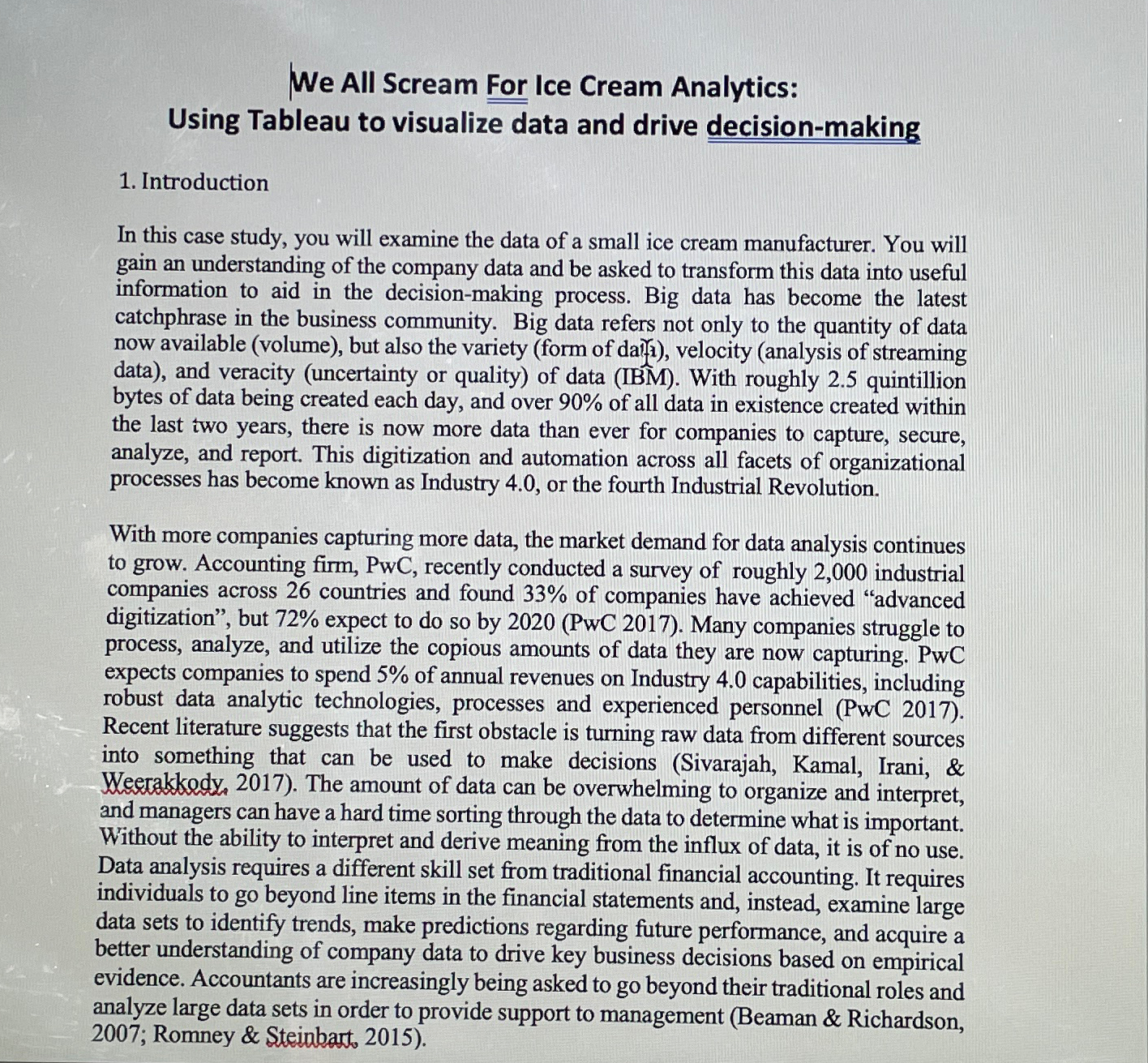
In this case study, you will examine the data of a small ice cream manufacturer. You will gain an understanding of the company data and be asked to transform this data into useful information to aid in the decisionmaking process. Big data has become the latest catchphrase in the business community. Big data refers not only to the quantity of data now available volume but also the variety form of daf velocity analysis of streaming data and veracity uncertainty or quality of data IBM With roughly quintillion bytes of data being created each day, and over of all data in existence created within the last two years, there is now more data than ever for companies to capture, secure analyze, and report. This digitization and automation across all facets of organizational processes has become known as Industry or the fourth Industrial Revolution.
With more companies capturing more data, the market demand for data analysis continues to grow. Accounting firm, PwC recently conducted a survey of roughly industrial companies across countries and found of companies have achieved "advanced digitization", but expect to do so by PwC Many companies struggle to process, analyze, and utilize the copious amounts of data they are now capturing. PwC expects companies to spend of annual revenues on Industry capabilities, including robust data analytic technologies, processes and experienced personnel PwC Recent literature suggests that the first obstacle is turning raw data from different sources into something that can be used to make decisions Sivarajah Kamal, Irani, & Weerakkedy, The amount of data can be overwhelming to organize and interpret, and managers can have a hard time sorting through the data to determine what is important. Without the ability to interpret and derive meaning from the influx of data, it is of no use. Data analysis requires a different skill set from traditional financial accounting. It requires individuals to go beyond line items in the financial statements and, instead, examine large data sets to identify trends, make predictions regarding future performance, and acquire a better understanding of company data to drive key business decisions based on empirical evidence. Accountants are increasingly being asked to go beyond their traditional roles and analyze large data sets in order to provide support to management Beaman & Richardson, ; Romney & Steinbart.
Step by Step Solution
There are 3 Steps involved in it
1 Expert Approved Answer
Step: 1 Unlock

Question Has Been Solved by an Expert!
Get step-by-step solutions from verified subject matter experts
Step: 2 Unlock
Step: 3 Unlock
 Study Help