







Question: We are evaluating a project that costs $995,000, has a life of fifteen years, and has no salvage value. Assume that depreciation is straight-line to
| We are evaluating a project that costs $995,000, has a life of fifteen years, and has no salvage value. Assume that depreciation is straight-line to zero over the life of the project. Sales are projected at 133,000 units per year. Price per unit is $43, variable cost per unit is $26, and fixed costs are $1,005,945 per year. The tax rate is 23 percent, and we require a return of 17 percent on this project. The projections given for price, quantity, variable costs, and fixed costs are all accurate to within +/- 20 percent. |
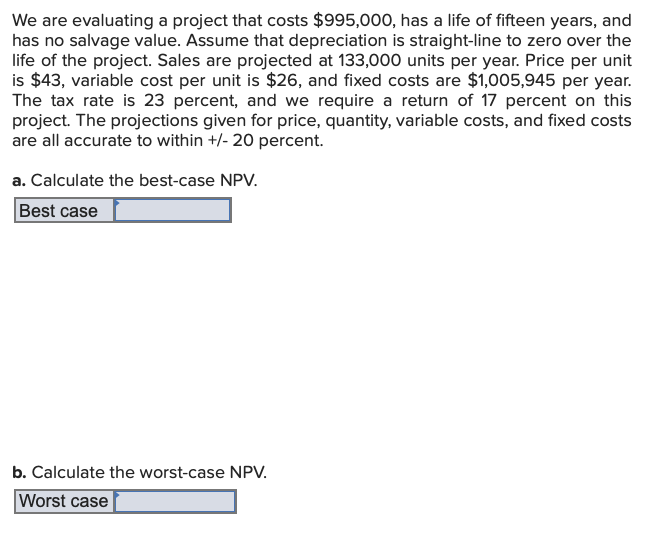
We are evaluating a project that costs $995,000, has a life of fifteen years, and has no salvage value. Assume that depreciation is straight-line to zero over the life of the project. Sales are projected at 133,000 units per year. Price per unit is $43, variable cost per unit is $26, and fixed costs are $1,005,945 per year. The tax rate is 23 percent, and we require a return of 17 percent on this project. The projections given for price, quantity, variable costs, and fixed costs are all accurate to within +/20 percent. a. Calculate the best-case NPV. Best case b. Calculate the worst-case NPV. We are evaluating a project that costs $995,000, has a life of fifteen years, and has no salvage value. Assume that depreciation is straight-line to zero over the life of the project. Sales are projected at 133,000 units per year. Price per unit is $43, variable cost per unit is $26, and fixed costs are $1,005,945 per year. The tax rate is 23 percent, and we require a return of 17 percent on this project. The projections given for price, quantity, variable costs, and fixed costs are all accurate to within +/20 percent. a. Calculate the best-case NPV. Best case b. Calculate the worst-case NPV
Step by Step Solution
There are 3 Steps involved in it

Get step-by-step solutions from verified subject matter experts
 Study Help