



Question: We are given the following rules for a context-free grammar whose start symbol is A: ABCaDEEFCCBA These rules are some of the rules for the
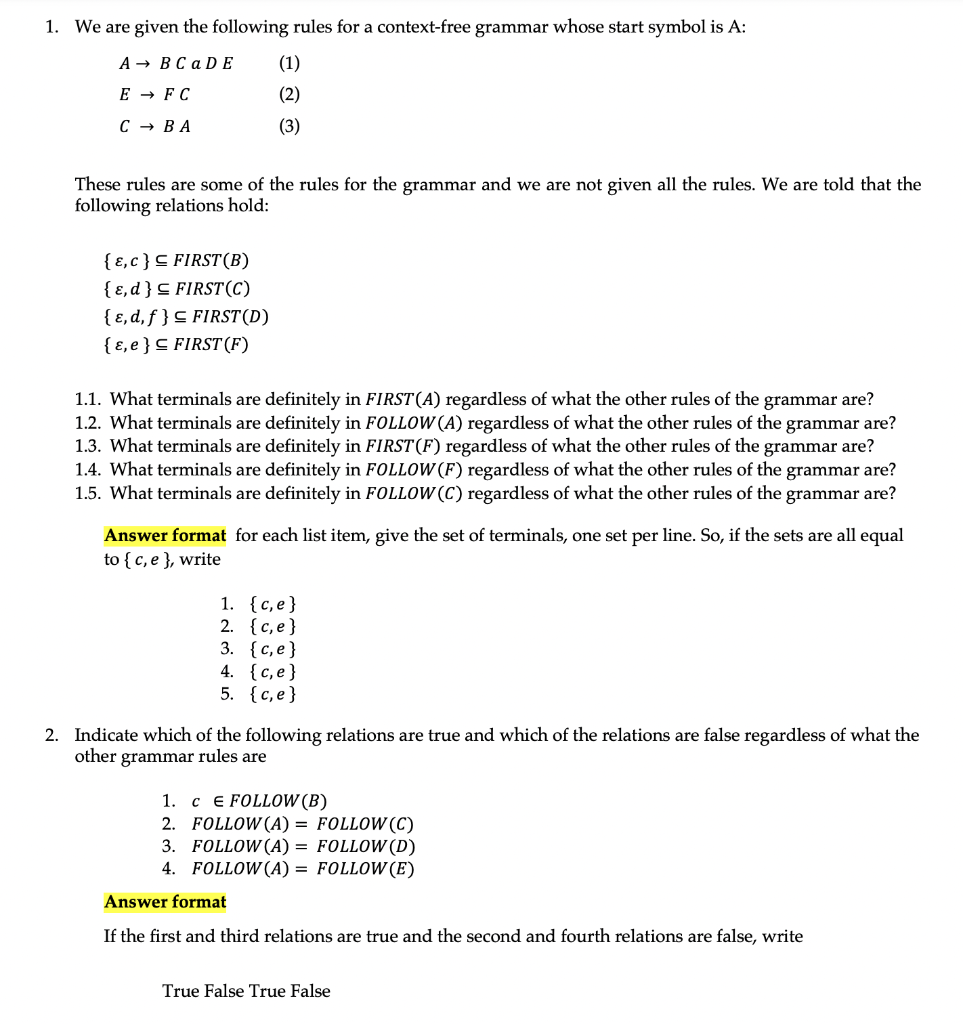
We are given the following rules for a context-free grammar whose start symbol is A: ABCaDEEFCCBA These rules are some of the rules for the grammar and we are not given all the rules. We are told that the following relations hold: {,c}FIRST(B){,d}FIRST(C){,d,f}FIRST(D){,e}FIRST(F) 1.1. What terminals are definitely in FIRST(A) regardless of what the other rules of the grammar are? 1.2. What terminals are definitely in FOLLOW(A) regardless of what the other rules of the grammar are? 1.3. What terminals are definitely in FIRST(F) regardless of what the other rules of the grammar are? 1.4. What terminals are definitely in FOLLOW(F) regardless of what the other rules of the grammar are? 1.5. What terminals are definitely in FOLLOW(C) regardless of what the other rules of the grammar are? Answer format for each list item, give the set of terminals, one set per line. So, if the sets are all equal to {c,e}, write 1. {c,e} 2. {c,e} 3. {c,e} 4. {c,e} 5. {c,e} Indicate which of the following relations are true and which of the relations are false regardless of what the other grammar rules are 1. cFOLLOW(B) 2. FOLLOW(A)=FOLLOW(C) 3. FOLLOW(A)=FOLLOW(D) 4. FOLLOW(A)=FOLLOW(E) Answer format If the first and third relations are true and the second and fourth relations are false, write True False True False
Step by Step Solution
There are 3 Steps involved in it

Get step-by-step solutions from verified subject matter experts