







Question: We are going to build a computation graph and evaluate it using the data from the car collision ( XOR ) example from class. Using
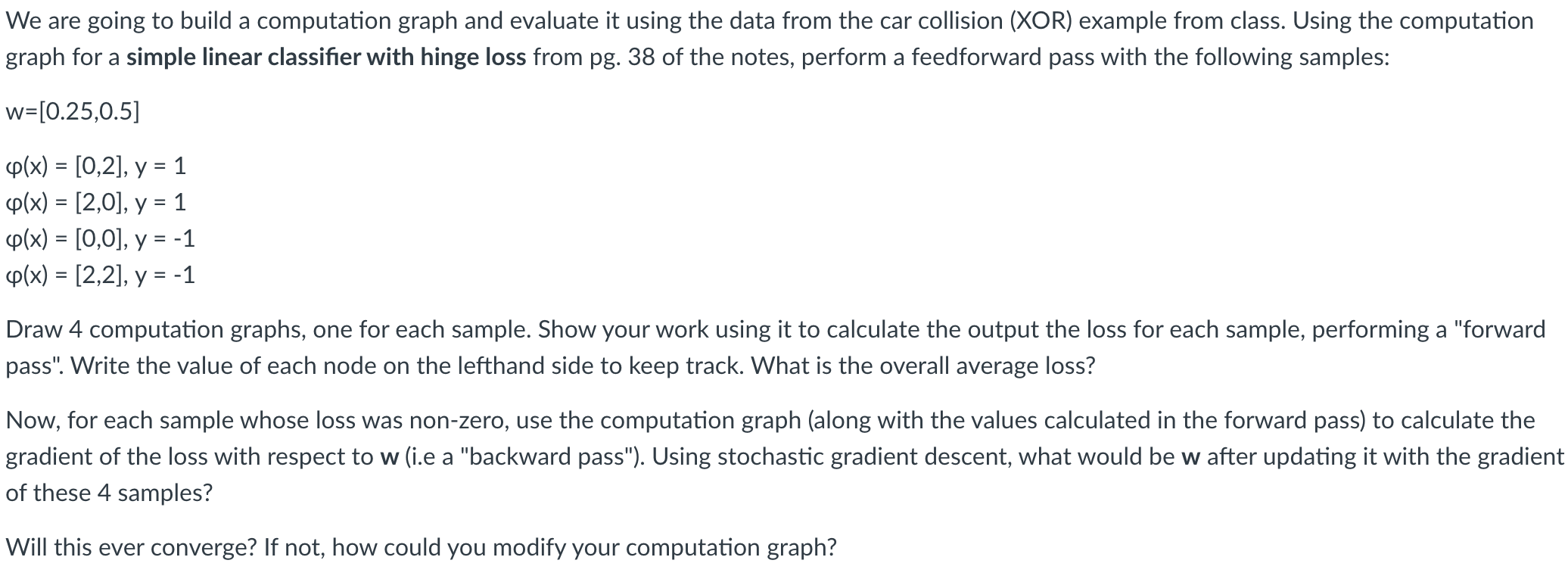
We are going to build a computation graph and evaluate it using the data from the car collision XOR example from class. Using the computation
graph for a simple linear classifier with hinge loss from pg of the notes, perform a feedforward pass with the following samples:
Draw computation graphs, one for each sample. Show your work using it to calculate the output the loss for each sample, performing a "forward
pass". Write the value of each node on the lefthand side to keep track. What is the overall average loss?
Now, for each sample whose loss was nonzero, use the computation graph along with the values calculated in the forward pass to calculate the
gradient of the loss with respect to w ie a "backward pass" Using stochastic gradient descent, what would be w after updating it with the gradient
of these samples?
Will this ever converge? If not, how could you modify your computation graph?
Step by Step Solution
There are 3 Steps involved in it
1 Expert Approved Answer
Step: 1 Unlock

Question Has Been Solved by an Expert!
Get step-by-step solutions from verified subject matter experts
Step: 2 Unlock
Step: 3 Unlock
 Study Help