







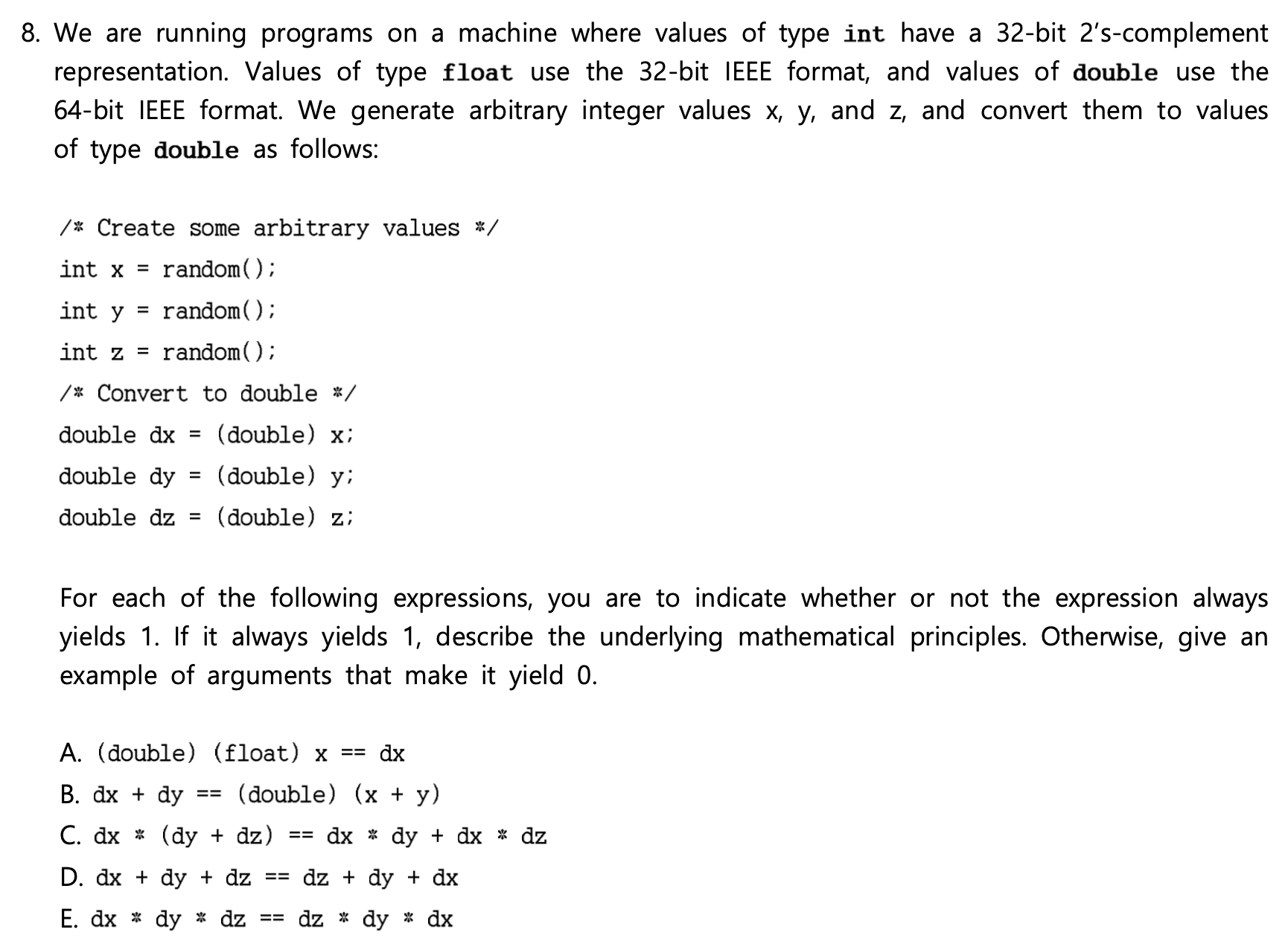
Question: We are running programs on a machine where values of type int have a 3 2 - bit 2 ' s - complement representation. Values
We are running programs on a machine where values of type int have a bit scomplement
representation. Values of type float use the bit IEEE format, and values of double use the
bit IEEE format. We generate arbitrary integer values and and convert them to values
of type double as follows:
Create some arbitrary values
int x random;
int y random;
int z random;
Convert to double
double dx double x;
double dy double y;
double dz double z;
For each of the following expressions, you are to indicate whether or not the expression always
yields If it always yields describe the underlying mathematical principles. Otherwise, give an
example of arguments that make it yield
Adoublefloat
B double
Step by Step Solution
There are 3 Steps involved in it
1 Expert Approved Answer
Step: 1 Unlock

Question Has Been Solved by an Expert!
Get step-by-step solutions from verified subject matter experts
Step: 2 Unlock
Step: 3 Unlock
 Study Help