







Question: We assume that it is costly to avoid working during nights and the observed market-determined compensation wage differential (CWD) equals wage for night time work
We assume that it is costly to avoid working during nights and the observed market-determined compensation wage differential (CWD) equals wage for night time work (wnight) minus the wage for daytime work (wday). Suppose there is a positive CWD, indicating most workers prefer to work during the day. However, some workers do not mind working during the night as much as others, and a few workers enjoy working during nights.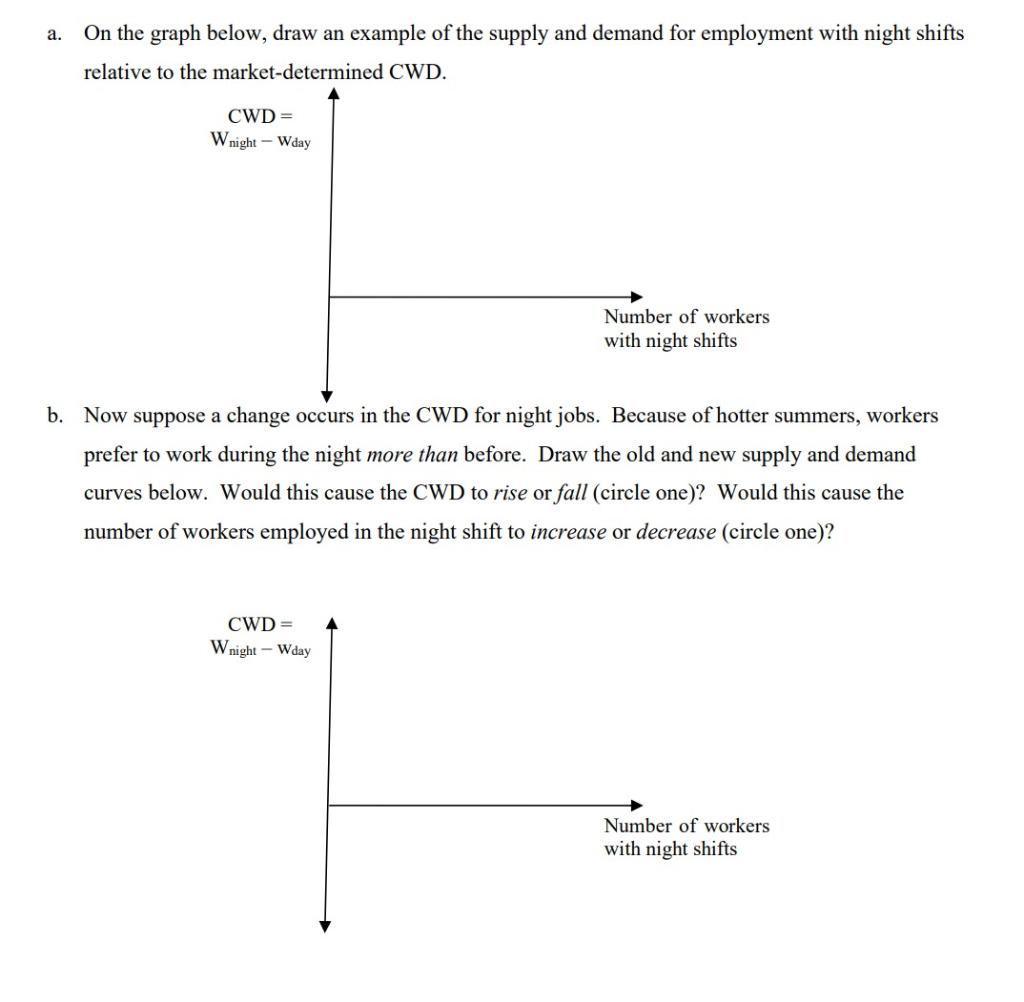
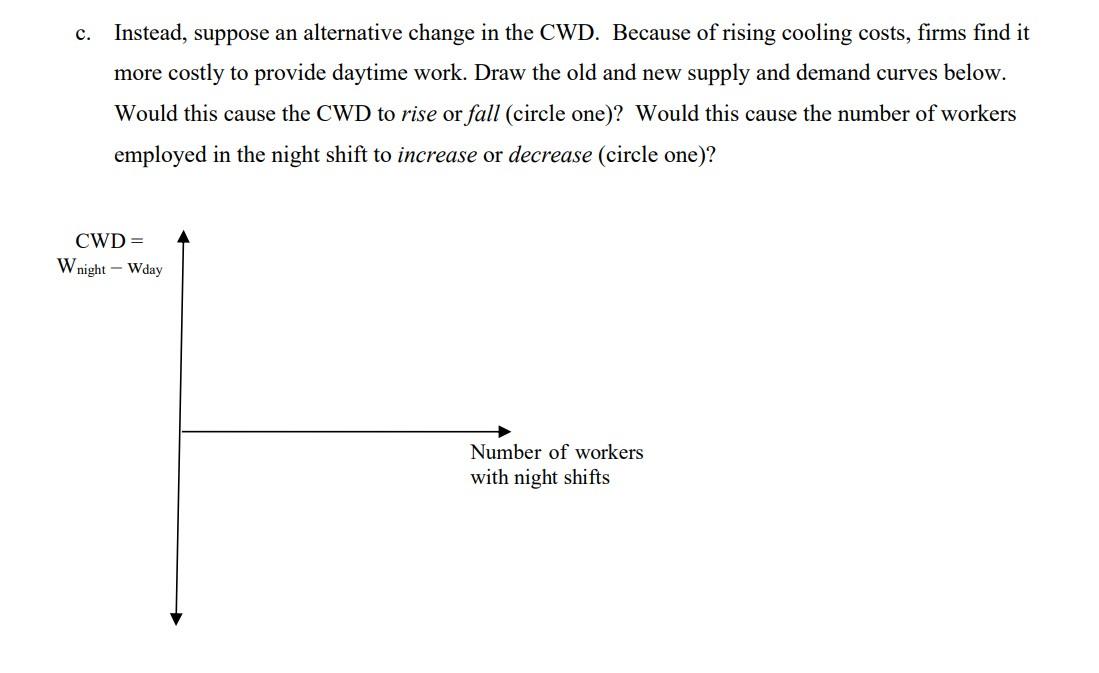
a. On the graph below, draw an example of the supply and demand for employment with night shifts relative to the market-determined CWD. b. Now suppose a change occurs in the CWD for night jobs. Because of hotter summers, workers prefer to work during the night more than before. Draw the old and new supply and demand curves below. Would this cause the CWD to rise or fall (circle one)? Would this cause the number of workers employed in the night shift to increase or decrease (circle one)? c. Instead, suppose an alternative change in the CWD. Because of rising cooling costs, firms find it more costly to provide daytime work. Draw the old and new supply and demand curves below. Would this cause the CWD to rise or fall (circle one)? Would this cause the number of workers employed in the night shift to increase or decrease (circle one)? a. On the graph below, draw an example of the supply and demand for employment with night shifts relative to the market-determined CWD. b. Now suppose a change occurs in the CWD for night jobs. Because of hotter summers, workers prefer to work during the night more than before. Draw the old and new supply and demand curves below. Would this cause the CWD to rise or fall (circle one)? Would this cause the number of workers employed in the night shift to increase or decrease (circle one)? c. Instead, suppose an alternative change in the CWD. Because of rising cooling costs, firms find it more costly to provide daytime work. Draw the old and new supply and demand curves below. Would this cause the CWD to rise or fall (circle one)? Would this cause the number of workers employed in the night shift to increase or decrease (circle one)
Step by Step Solution
There are 3 Steps involved in it

Get step-by-step solutions from verified subject matter experts
 Study Help