







Question: We can use what we've learned in this course to model many physical, real-world problems. For this project you will be modeling the flow of
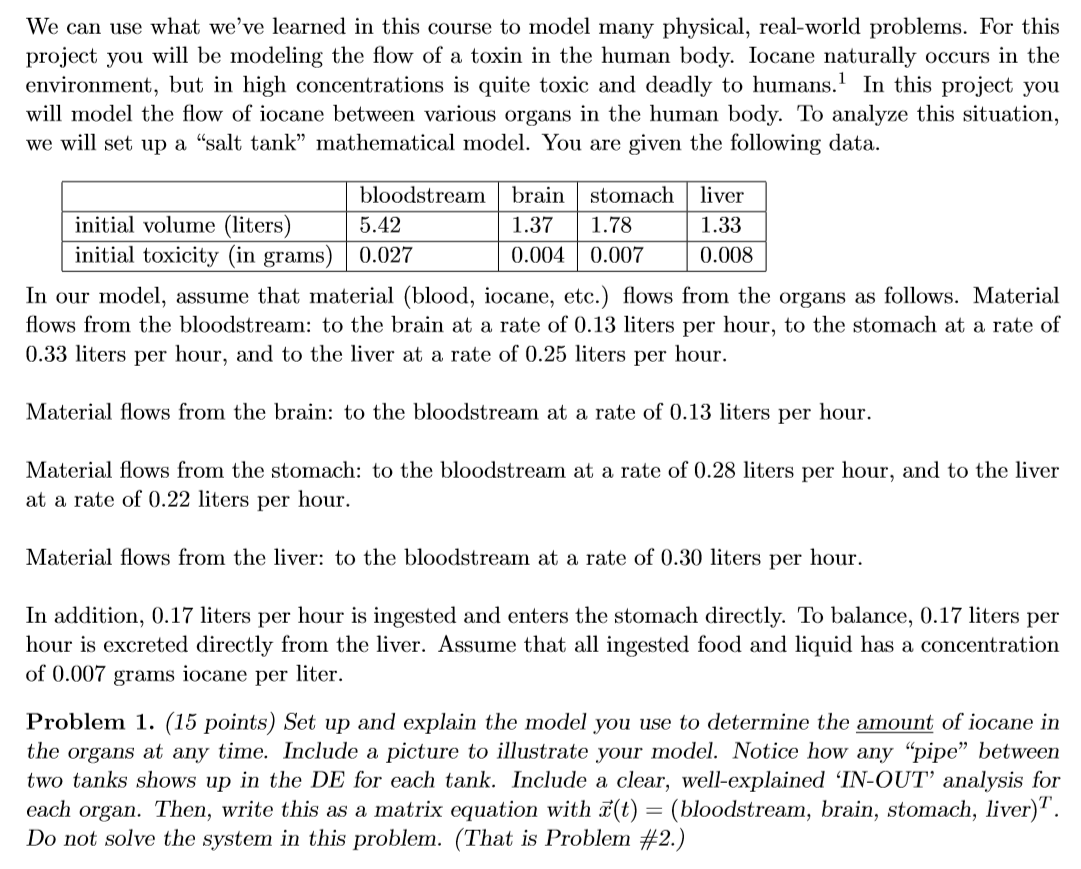
We can use what we've learned in this course to model many physical, real-world problems. For this project you will be modeling the flow of a toxin in the human body. Iocane naturally occurs in the environment, but in high concentrations is quite toxic and deadly to humans. In this project you will model the flow of iocane between various organs in the human body. To analyze this situation, we will set up a "salt tank mathematical model. You are given the following data. bloodstream brain stomach liver initial volume (liters) 5.42 1.37 1.78 1.33 initial toxicity (in grams) 0.027 0.004 0.007 0.008 In our model, assume that material (blood, iocane, etc.) flows from the organs as follows. Material flows from the bloodstream: to the brain at a rate of 0.13 liters per hour, to the stomach at a rate of 0.33 liters per hour, and to the liver at a rate of 0.25 liters per hour. Material flows from the brain: to the bloodstream at a rate of 0.13 liters per hour. Material flows from the stomach: to the bloodstream at a rate of 0.28 liters per hour, and to the liver at a rate of 0.22 liters per hour. Material flows from the liver: to the bloodstream at a rate of 0.30 liters per hour. In addition, 0.17 liters per hour is ingested and enters the stomach directly. To balance, 0.17 liters per hour is excreted directly from the liver. Assume that all ingested food and liquid has a concentration of 0.007 grams iocane per liter. Problem 1. (15 points) Set up and explain the model you use to determine the amount of iocane in the organs at any time. Include a picture to illustrate your model. Notice how any "pipe between two tanks shows up in the DE for each tank. Include a clear, well-explained 'IN-OUT' analysis for each organ. Then, write this as a matrix equation with (t) = (bloodstream, brain, stomach, liver)?. Do not solve the system in this problem. (That is Problem #2.) We can use what we've learned in this course to model many physical, real-world problems. For this project you will be modeling the flow of a toxin in the human body. Iocane naturally occurs in the environment, but in high concentrations is quite toxic and deadly to humans. In this project you will model the flow of iocane between various organs in the human body. To analyze this situation, we will set up a "salt tank mathematical model. You are given the following data. bloodstream brain stomach liver initial volume (liters) 5.42 1.37 1.78 1.33 initial toxicity (in grams) 0.027 0.004 0.007 0.008 In our model, assume that material (blood, iocane, etc.) flows from the organs as follows. Material flows from the bloodstream: to the brain at a rate of 0.13 liters per hour, to the stomach at a rate of 0.33 liters per hour, and to the liver at a rate of 0.25 liters per hour. Material flows from the brain: to the bloodstream at a rate of 0.13 liters per hour. Material flows from the stomach: to the bloodstream at a rate of 0.28 liters per hour, and to the liver at a rate of 0.22 liters per hour. Material flows from the liver: to the bloodstream at a rate of 0.30 liters per hour. In addition, 0.17 liters per hour is ingested and enters the stomach directly. To balance, 0.17 liters per hour is excreted directly from the liver. Assume that all ingested food and liquid has a concentration of 0.007 grams iocane per liter. Problem 1. (15 points) Set up and explain the model you use to determine the amount of iocane in the organs at any time. Include a picture to illustrate your model. Notice how any "pipe between two tanks shows up in the DE for each tank. Include a clear, well-explained 'IN-OUT' analysis for each organ. Then, write this as a matrix equation with (t) = (bloodstream, brain, stomach, liver)?. Do not solve the system in this problem. (That is Problem #2.)
Step by Step Solution
There are 3 Steps involved in it

Get step-by-step solutions from verified subject matter experts
 Study Help