







Question: We conduct a similar study using the same two groups as our t -Test (Reward versus No Reward). However, we are only interested in whether
We conduct a similar study using the same two groups as our t-Test (Reward versus No Reward). However, we are only interested in whether the infant provided help on the sixth trial in phase two (YES they helped or NO they did not help). You get the following:
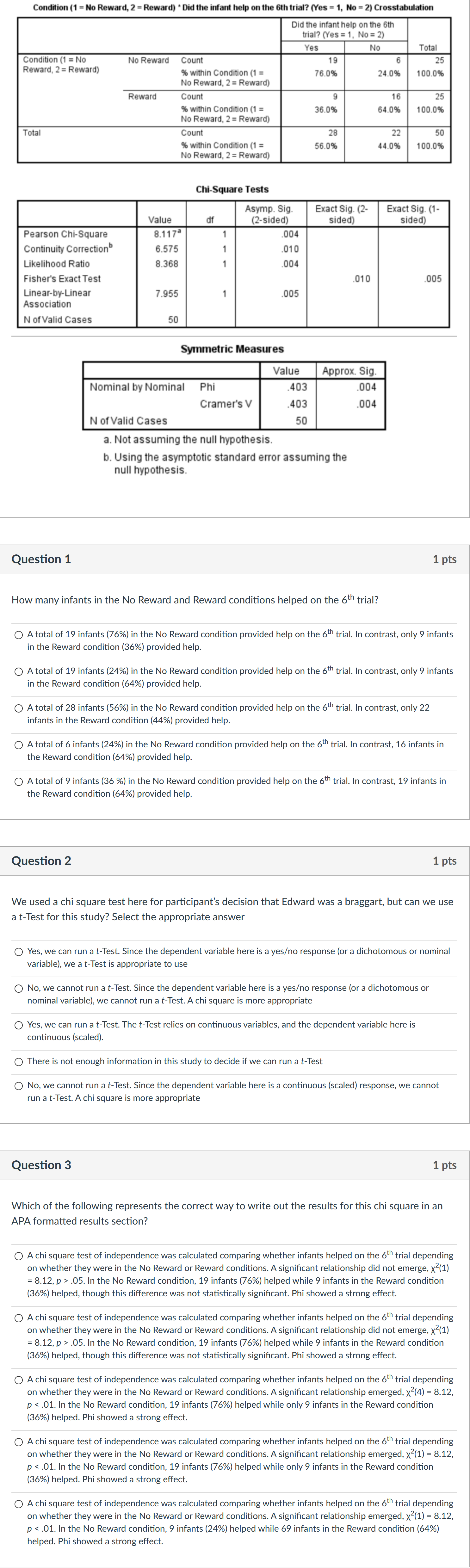
Condition (1 = No Reward, 2 = Reward) * Did the infant help on the 6th trial? (Yes = 1, No = 2) Crosstabulation Did the infant help on the 6th trial? (Yes = 1, No = 2) Yes No Total Condition (1 = No No Reward Count Reward, 2 = Reward) 19 25 % within Condition (1 = 76.0% 24.0% 100.0% No Reward, 2 = Reward) Reward Count 25 % within Condition (1 = 36.0% 64.0% 100.0% No Reward, 2 = Reward) Total Count 28 22 50 % within Condition (1 = No Reward, 2 = Reward) 56.09 44.09 100.0% Chi-Square Tests Asymp. Sig Exact Sig. (2- Exact Sig. (1- Value df (2-sided) sided) sided) Pearson Chi-Square 8.117 .004 Continuity Correction 6.575 .010 Likelihood Ratio 8.368 .004 Fisher's Exact Test .010 005 Linear-by-Linear 7.955 .005 Association N of Valid Cases 50 Symmetric Measures Value Approx. Sig. Nominal by Nominal Phi 403 004 Cramer's V 403 .004 N of Valid Cases 50 . Not assuming the null hypothesis. b. Using the asymptotic standard error assuming the null hypothesis. Question 1 1 pts How many infants in the No Reward and Reward conditions helped on the 6th trial? O A total of 19 infants (76%) in the No Reward condition provided help on the 6th trial. In contrast, only 9 infants in the Reward condition (36%) provided help. A total of 19 infants (24%) in the No Reward condition provided help on the 6th trial. In contrast, only 9 infants in the Reward condition (64%) provided help A total of 28 infants (56%) in the No Reward condition provided help on the 6th trial. In contrast, only 22 infants in the Reward condition (44%) provided help. A total of 6 infants (24%) in the No Reward condition provided help on the 6th trial. In contrast, 16 infants in the Reward condition (64%) provided help. O A total of 9 infants (36 %) in the No Reward condition provided help on the 6th trial. In contrast, 19 infants in the Reward condition (64%) provided help. Question 2 1 pts We used a chi square test here for participant's decision that Edward was a braggart, but can we use a t-Test for this study? Select the appropriate answer Yes, we can run a t-Test. Since the dependent variable here is a yeso response (or a dichotomous or nominal variable), we a t-Test is appropriate to use No, we cannot run a t-Test. Since the dependent variable here is a yeso response (or a dichotomous or nominal variable), we cannot run a t-Test. A chi square is more appropriate Yes, we can run a t-Test. The t-Test relies on continuous variables, and the dependent variable here is continuous (scaled). O There is not enough information in this study to decide if we can run a t-Test O No, we cannot run a t-Test. Since the dependent variable here is a continuous (scaled) response, we cannot run a t-Test. A chi square is more appropriate Question 3 1 pts Which of the following represents the correct way to write out the results for this chi square in an APA formatted results section? O A chi square test of independence was calculated comparing whether infants helped on the 6th trial depending on whether they were in the No Reward or Reward conditions. A significant relationship did not emerge, x (1) = 8.12, p > .05. In the No Reward condition, 19 infants (76%) helped while 9 infants in the Reward condition (36%) helped, though this difference was not statistically significant. Phi showed a strong effect. O A chi square test of independence was calculated comparing whether infants helped on the 6th trial depending on whether they were in the No Reward or Reward conditions. A significant relationship did not emerge, x-(1) = 8.12, p > .05. In the No Reward condition, 19 infants (76%) helped while 9 infants in the Reward condition (36%) helped, though this difference was not statistically significant. Phi showed a strong effect. O A chi square test of independence was calculated comparing whether infants helped on the 6th trial depending on whether they were in the No Reward or Reward conditions. A significant relationship emerged, x (4) = 8.12, p
Step by Step Solution
There are 3 Steps involved in it

Get step-by-step solutions from verified subject matter experts
 Study Help