







Question: We consider a DHKE protocol over a Galois fields GF(2Am). Up to now, we have been using groups but it is possible (and simple) to
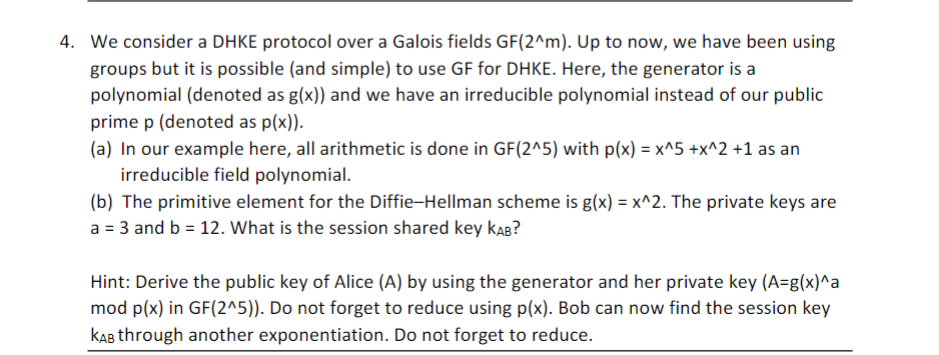
We consider a DHKE protocol over a Galois fields GF(2Am). Up to now, we have been using groups but it is possible (and simple) to use GF for DHKE. Here, the generator is a polynomial (denoted as g(x)and we have an irreducible polynomial instead of our public prime p (denoted as p(x)). (a) In our example here, all arithmetic is done in GF(2A5) with p(x) xA5 +xA2 +1 as an 4. irreducible field polynomial (b) The primitive element for the Diffie-Hellman scheme is g(x) - xA2. The private keys are a 3 and b- 12. What is the session shared key kas Hint: Derive the public key of Alice (A) by using the generator and her private key (A-g(x)^a mod p(x) in GF(245)). Do not forget to reduce using p(x). Bob can now find the session key kAB through another exponentiation. Do not forget to reduce. We consider a DHKE protocol over a Galois fields GF(2Am). Up to now, we have been using groups but it is possible (and simple) to use GF for DHKE. Here, the generator is a polynomial (denoted as g(x)and we have an irreducible polynomial instead of our public prime p (denoted as p(x)). (a) In our example here, all arithmetic is done in GF(2A5) with p(x) xA5 +xA2 +1 as an 4. irreducible field polynomial (b) The primitive element for the Diffie-Hellman scheme is g(x) - xA2. The private keys are a 3 and b- 12. What is the session shared key kas Hint: Derive the public key of Alice (A) by using the generator and her private key (A-g(x)^a mod p(x) in GF(245)). Do not forget to reduce using p(x). Bob can now find the session key kAB through another exponentiation. Do not forget to reduce
Step by Step Solution
There are 3 Steps involved in it

Get step-by-step solutions from verified subject matter experts
 Study Help