







Question: We consider a piston - cylinder system attached to a spring with a linear constant ( k ) . Inside the cylinder we
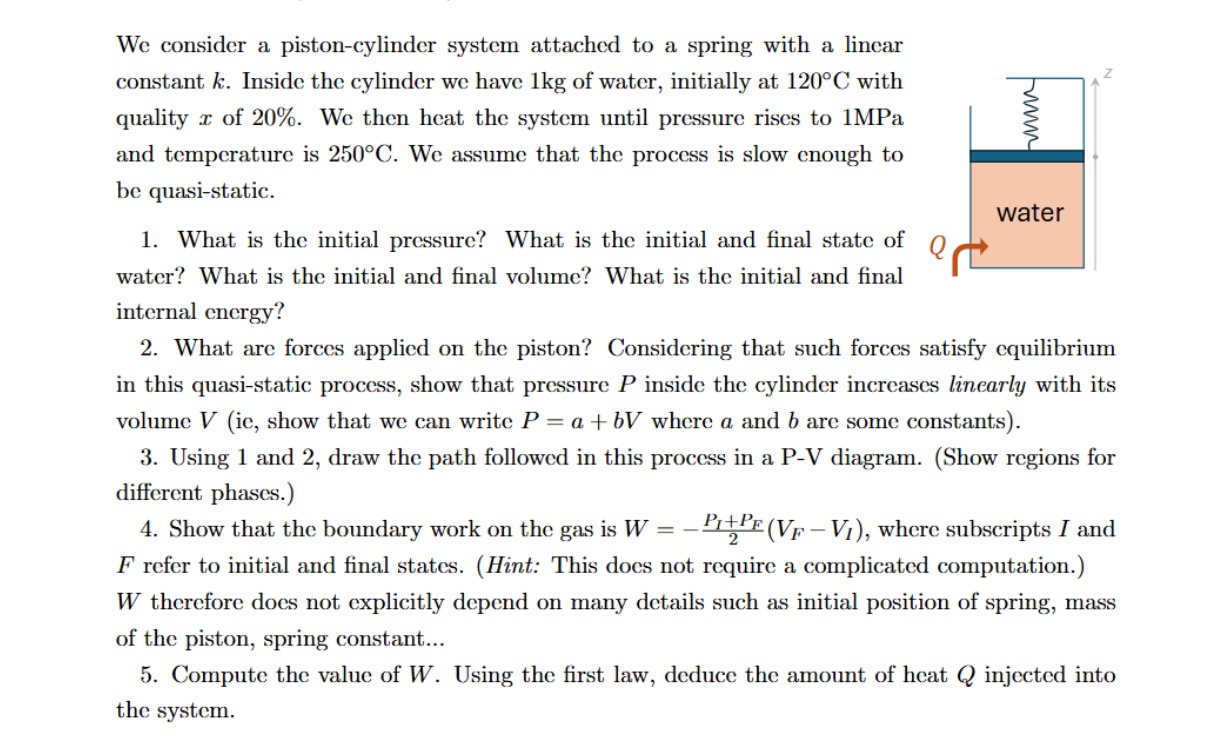
We consider a pistoncylinder system attached to a spring with a linear constant k Inside the cylinder we have kg of water, initially at circmathrmC with quality x of We then heat the system until pressure rises to MPa and temperature is circmathrmC We assume that the process is slow enough to be quasistatic.
What is the initial pressure? What is the initial and final state of water? What is the initial and final volume? What is the initial and final internal energy?
What are forces applied on the piston? Considering that such forces satisfy equilibrium in this quasistatic process, show that pressure P inside the cylinder increases linearly with its volume V ie show that we can write Pab V where a and b are some constants
Using and draw the path followed in this process in a PV diagram. Show regions for different phases.
Show that the boundary work on the gas is WfracPIPFleftVFVIright where subscripts I and F refer to initial and final states. Hint: This does not require a complicated computation. W therefore does not explicitly depend on many details such as initial position of spring, mass of the piston, spring constant...
Compute the value of W Using the first law, deduce the amount of heat Q injected into the system.
Step by Step Solution
There are 3 Steps involved in it
1 Expert Approved Answer
Step: 1 Unlock

Question Has Been Solved by an Expert!
Get step-by-step solutions from verified subject matter experts
Step: 2 Unlock
Step: 3 Unlock
 Study Help