





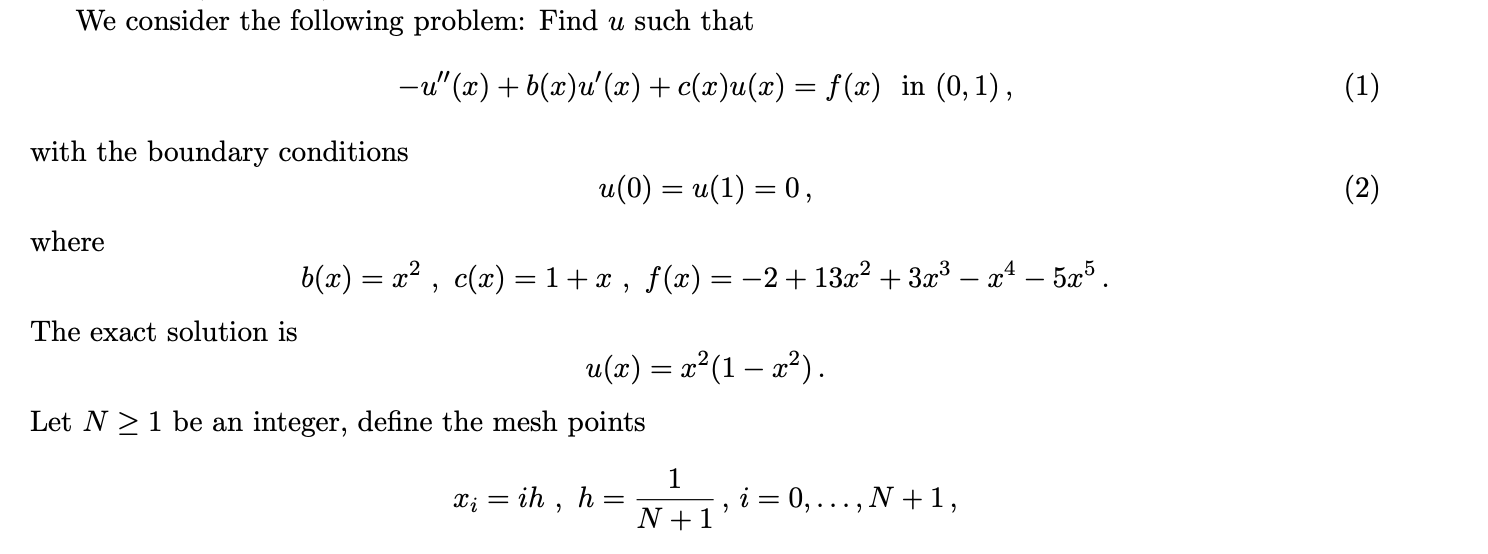
Question: We consider the following problem: Find u such that -u (x) + b(ac)u' (2) + c(x)u(x) = f(x) in (0, 1 ) , (1) with
We consider the following problem: Find u suchWe consider the following problem: Find u such
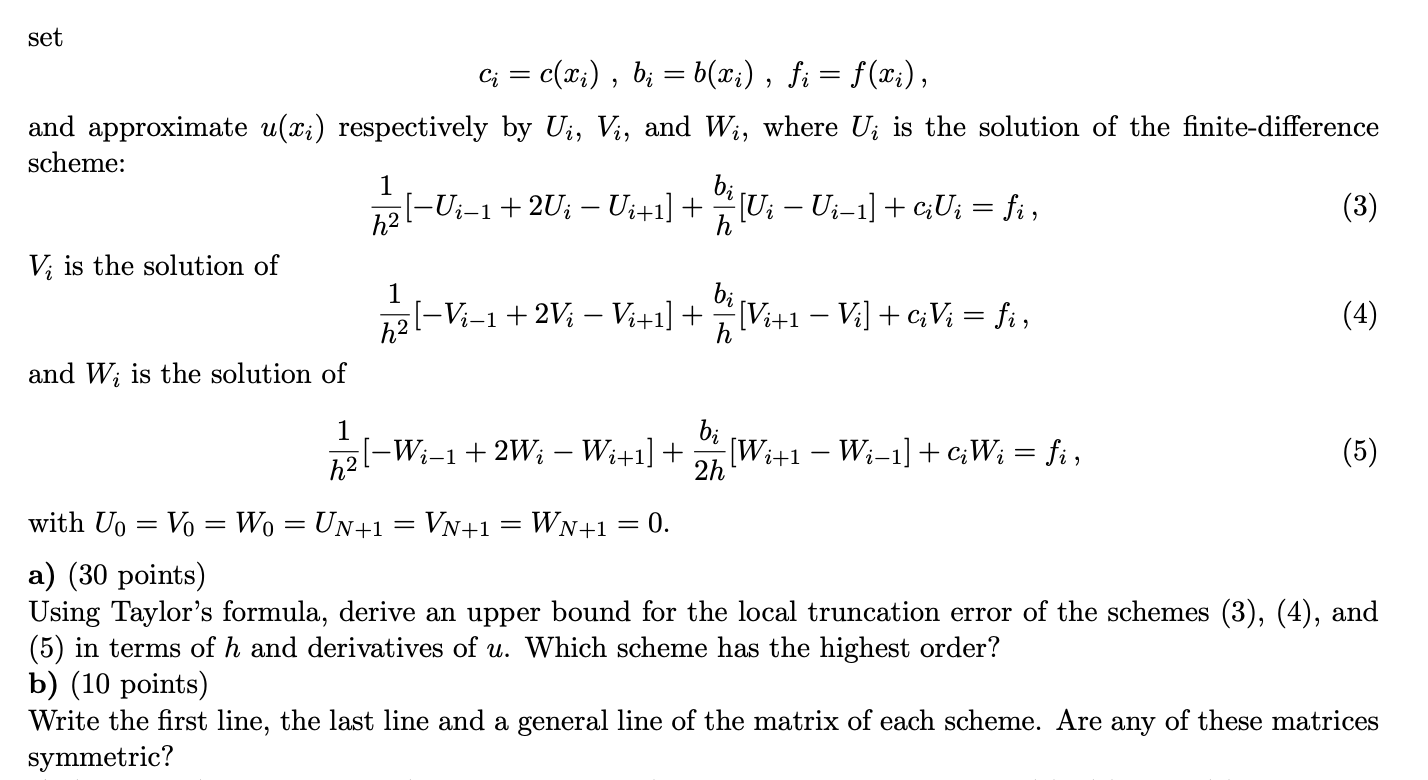
We consider the following problem: Find u such that -u" (x) + b(ac)u' (2) + c(x)u(x) = f(x) in (0, 1 ) , (1) with the boundary conditions u(0) = u(1) = 0, (2) where b(ac) = 202 , c(a) = 1+ 2, f(a) = -2+13x2 +323 -24-525. The exact solution is u(ac) = 22(1 - 22). Let N > 1 be an integer, define the mesh points ci= ih , h = N+ 1 , 2 = 0, . . ., N +1,set ci = c(xi) , bi = b(xi) , fi = f(xi), and approximate u(xi) respectively by U, Vi, and Wi, where Ui is the solution of the finite-difference scheme: b2(-Ui-1+ 20i - Uiti] + " [i - Ui-1] + cili = fi, (3) Vi is the solution of 1 b2 [-Vi-1 + 2Vi - Viti] + , [Viti - Vi] + ciVi = fi, ( 4) and Wi is the solution of b2[-Wi-1+ 2Wi - Witil+ bi 2h [With - Will + ciWi = fi, (5) with Uo = Vo = Wo = UN+1 = VN+1 = WN+1 = 0. a) (30 points) Using Taylor's formula, derive an upper bound for the local truncation error of the schemes (3), (4), and (5) in terms of h and derivatives of u. Which scheme has the highest order? b) (10 points) Write the first line, the last line and a general line of the matrix of each scheme. Are any of these matrices symmetric

Step by Step Solution

There are 3 Steps involved in it

1 Expert Approved Answer
Step: 1 Unlock blur-text-image

Question Has Been Solved by an Expert!

Get step-by-step solutions from verified subject matter experts

Step: 2 Unlock
Step: 3 Unlock

Students Have Also Explored These Related Mathematics Questions!