







Question: We consider the function f defined by f (x) = [* + 9 - 15 - for a * +6. 22 - 36 Our goal
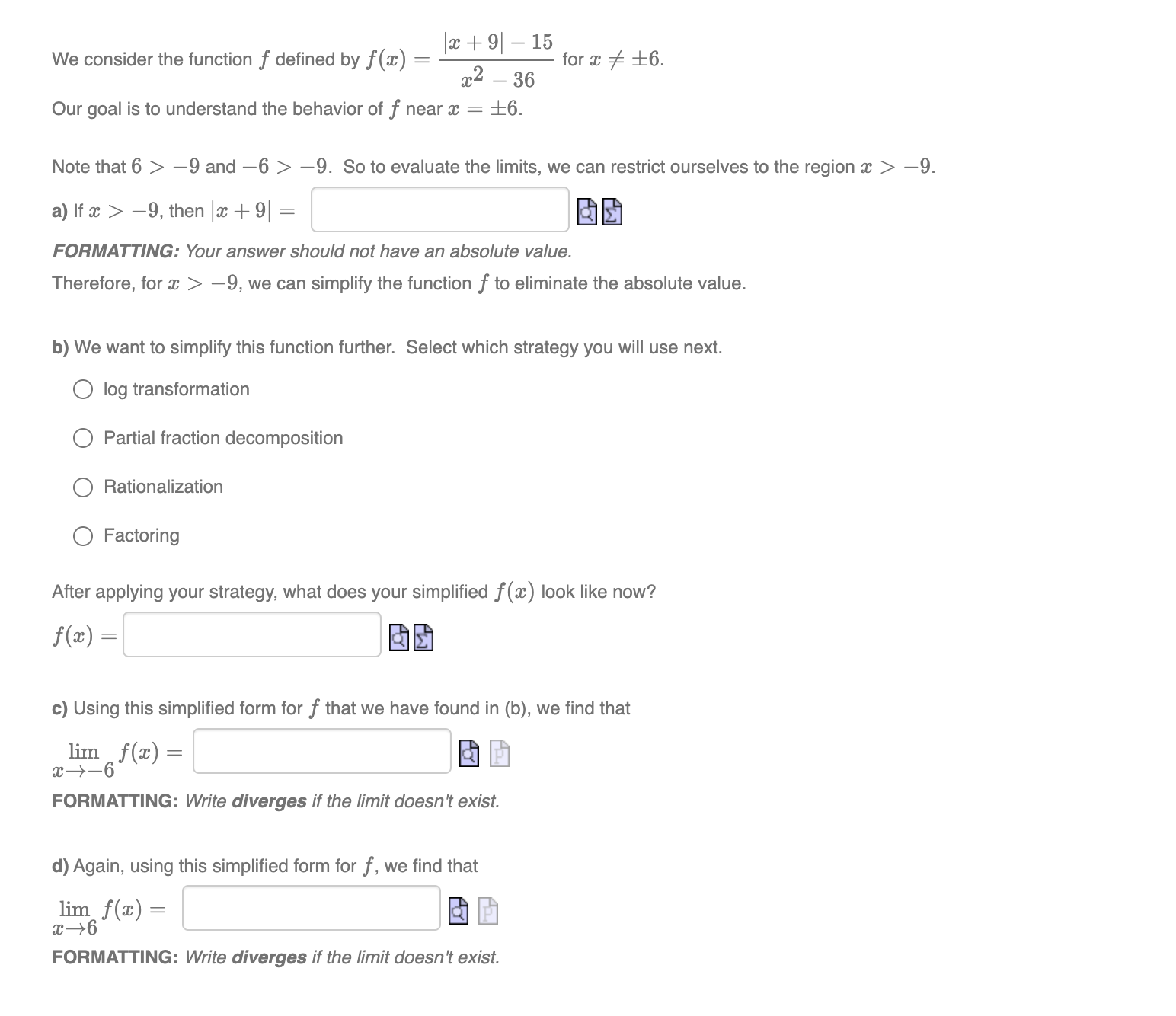
We consider the function f defined by f (x) = [* + 9 - 15 - for a * +6. 22 - 36 Our goal is to understand the behavior of f near x = 16. Note that 6 > -9 and -6 > -9. So to evaluate the limits, we can restrict ourselves to the region x > -9. a) If x > -9, then | + 9| = FORMATTING: Your answer should not have an absolute value. Therefore, for x > -9, we can simplify the function f to eliminate the absolute value. b) We want to simplify this function further. Select which strategy you will use next. O log transformation Partial fraction decomposition O Rationalization O Factoring After applying your strategy, what does your simplified f (a) look like now? f (20 ) = c) Using this simplified form for f that we have found in (b), we find that lim f(x) = FORMATTING: Write diverges if the limit doesn't exist. d) Again, using this simplified form for f, we find that lim f(x) = FORMATTING: Write diverges if the limit doesn't exist
Step by Step Solution
There are 3 Steps involved in it

Get step-by-step solutions from verified subject matter experts
 Study Help