







Question: We consider the stochastic process Xt given by Xt = e ^ (Wt), where Wt is a Brownian Motion. Stochastic calculas, Feynman-Kac application Part B.
We consider the stochastic process Xt given by Xt = e ^ (Wt), where Wt is a Brownian Motion. Stochastic calculas, Feynman-Kac application
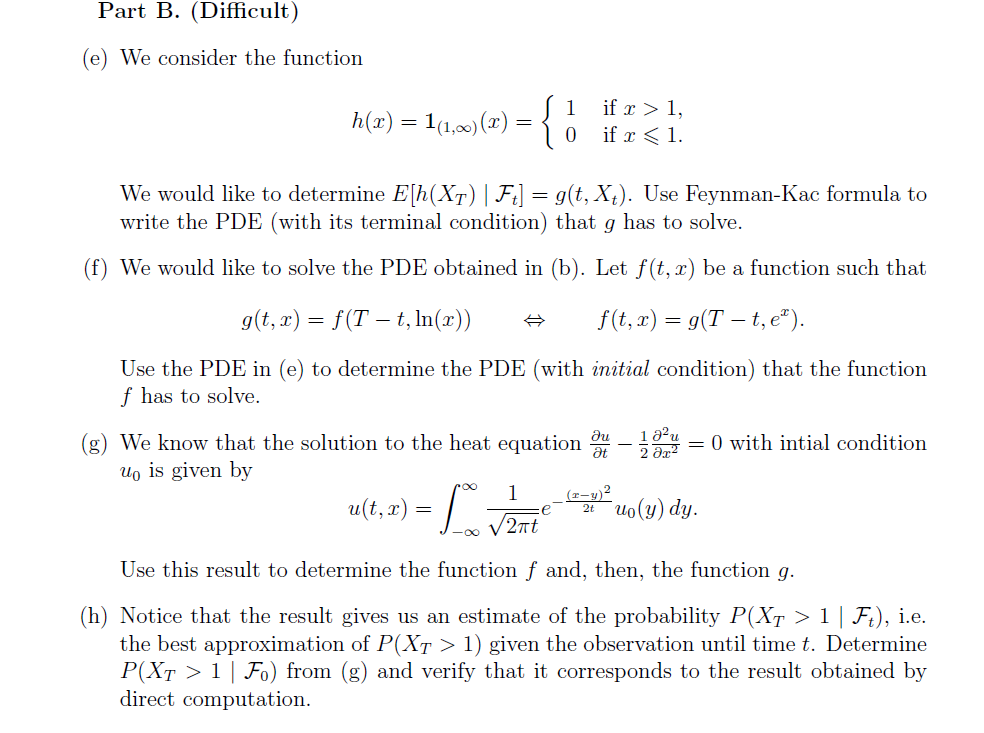
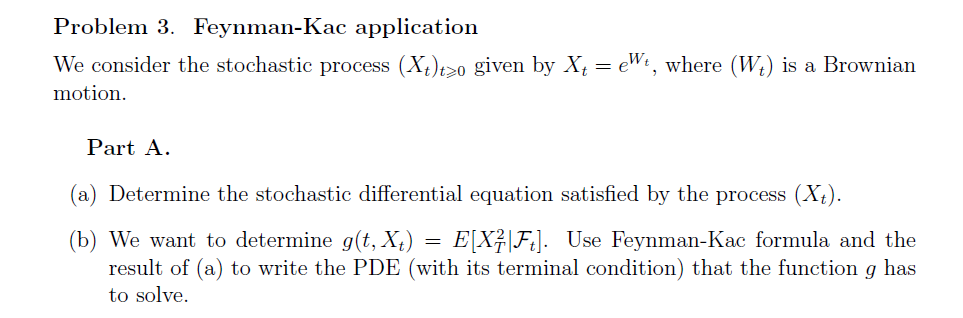
Part B. (Difficult) (e) We consider the function h(x) = 1(1,00) (20 ) = 1 0 if x > 1, if x $ 1. We would like to determine E[h(Xr) | Ft] = g(t, Xt). Use Feynman-Kac formula to write the PDE (with its terminal condition) that g has to solve. (f) We would like to solve the PDE obtained in (b). Let f(t, x) be a function such that g(t, x) = f(T - t, In(x)) f (t, x) = g(T- t, e"). Use the PDE in (e) to determine the PDE (with initial condition) that the function f has to solve. (g) We know that the solution to the heat equation of _ 102u 2072 = 0 with intial condition uo is given by (x-3)2 u(t, x) = 2t uo(y) dy. V2at Use this result to determine the function f and, then, the function g. (h) Notice that the result gives us an estimate of the probability P(Xr > 1 | F(), i.e. the best approximation of P(Xr > 1) given the observation until time t. Determine P(XT > 1 | Fo) from (g) and verify that it corresponds to the result obtained by direct computation.Problem 3. Feynman-Kac application We consider the stochastic process (Xt)tzo given by Xt = ent, where (Wt) is a Brownian motion. Part A. (a) Determine the stochastic differential equation satisfied by the process (Xt). (b) We want to determine g(t, Xt) = E[X?|F]. Use Feynman-Kac formula and the result of (a) to write the PDE (with its terminal condition) that the function g has to solve
Step by Step Solution
There are 3 Steps involved in it

Get step-by-step solutions from verified subject matter experts
 Study Help