







Question: We decide to run the kernel perceptron algorithm over this dataset using the quadratic kernel. The number of mistakes made on each point is displayed
We decide to run the kernel perceptron algorithm over this dataset using the quadratic kernel. The number of
mistakes made on each point is displayed in the table below. These points correspond to those in the plot
above.
Define the feature map of our quadratic kernel to be:
Assume all parameters are set to zero before running the algorithm.
Based on the table, what is the output of and
Enter accurate to at least decimal places.
Enter as a vector, enclosed in square brackets, and components separated by commas, eg type for
Note that this sample vector input may not be of the same dimension of the answer. Enter each
component accurate to at least decimal places.
Based on the calculation of and does the decision boundary correctly classify all the
points in the training dataset?
Yes
No
Recall for
Define the kernel function
Write as a function of the dot product To answer, let and enter in terms
of
Problem Kernel Methods
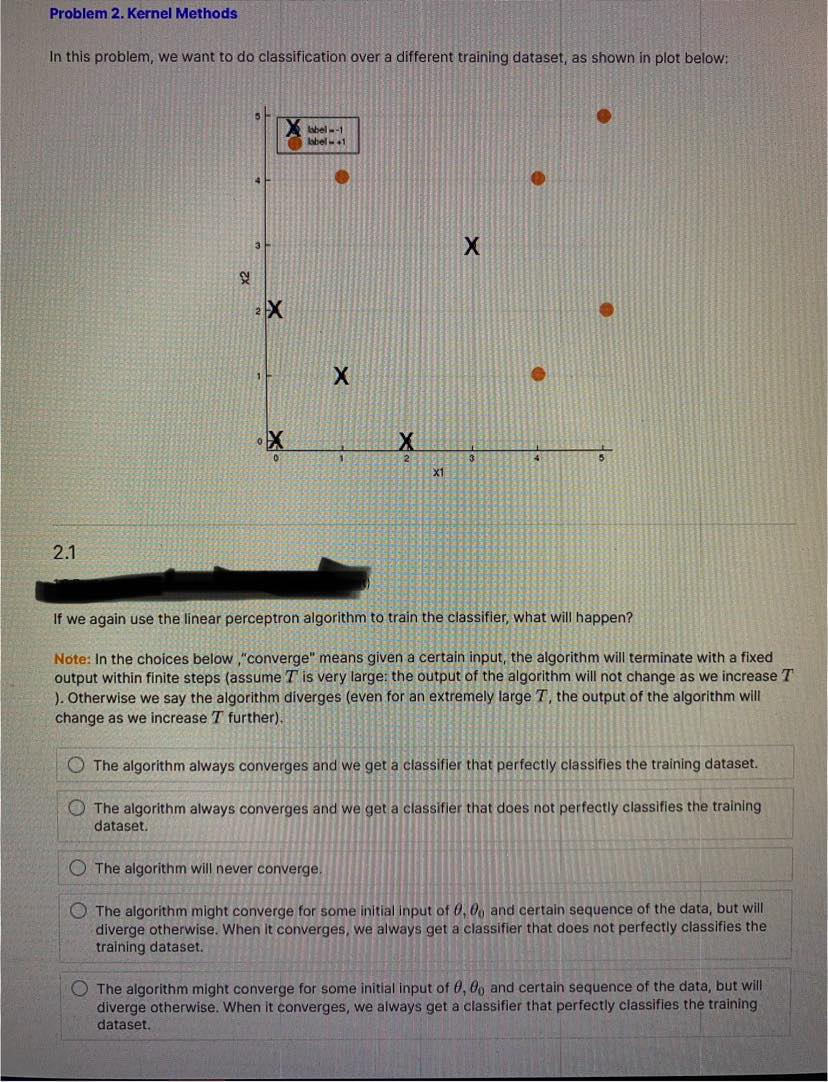
In this problem, we want to do classification over a different training dataset, as shown in plot below:
If we again use the linear perceptron algorithm to train the classifier, what will happen?
Note: In the choices below "converge" means given a certain input, the algorithm will terminate with a fixed
output within finite steps assume is very large: the output of the algorithm will not change as we increase
Otherwise we say the algorithm diverges even for an extremely large the output of the algorithm will
change as we increase further
The algorithm always converges and we get a classifier that perfectly classifies the training dataset.
The algorithm always converges and we get a classifier that does not perfectly classifies the training
dataset.
The algorithm will never converge.
The algorithm might converge for some initial input of and certain sequence of the data, but will
diverge otherwise. When it converges, we always get a classifier that does not perfectly classifies the
training dataset.
The algorithm might converge for some initial input of and certain sequence of the data, but will
diverge otherwise. When it converges, we always get a classifier that perfectly classifies the training
dataset.
Step by Step Solution
There are 3 Steps involved in it
1 Expert Approved Answer
Step: 1 Unlock

Question Has Been Solved by an Expert!
Get step-by-step solutions from verified subject matter experts
Step: 2 Unlock
Step: 3 Unlock
 Study Help