



Question: We have a cannon that can fire projectiles with speed var at an angle . What angle should we use to force our cannon to
We have a cannon that can fire projectiles with speed var at an angle What angle should we use to force our cannon to hit a target that is meters away. The trajectory of the projectile is given by the equation:
The distance is the location of x when y is zero. So the function to determine the angle given a distance is:
Rtan
Where var is the velocity is the target range is the angle needed to reach the target range degrees and is the gravity
What is the angle needed to reach a target meters away if the speed of your projectile is
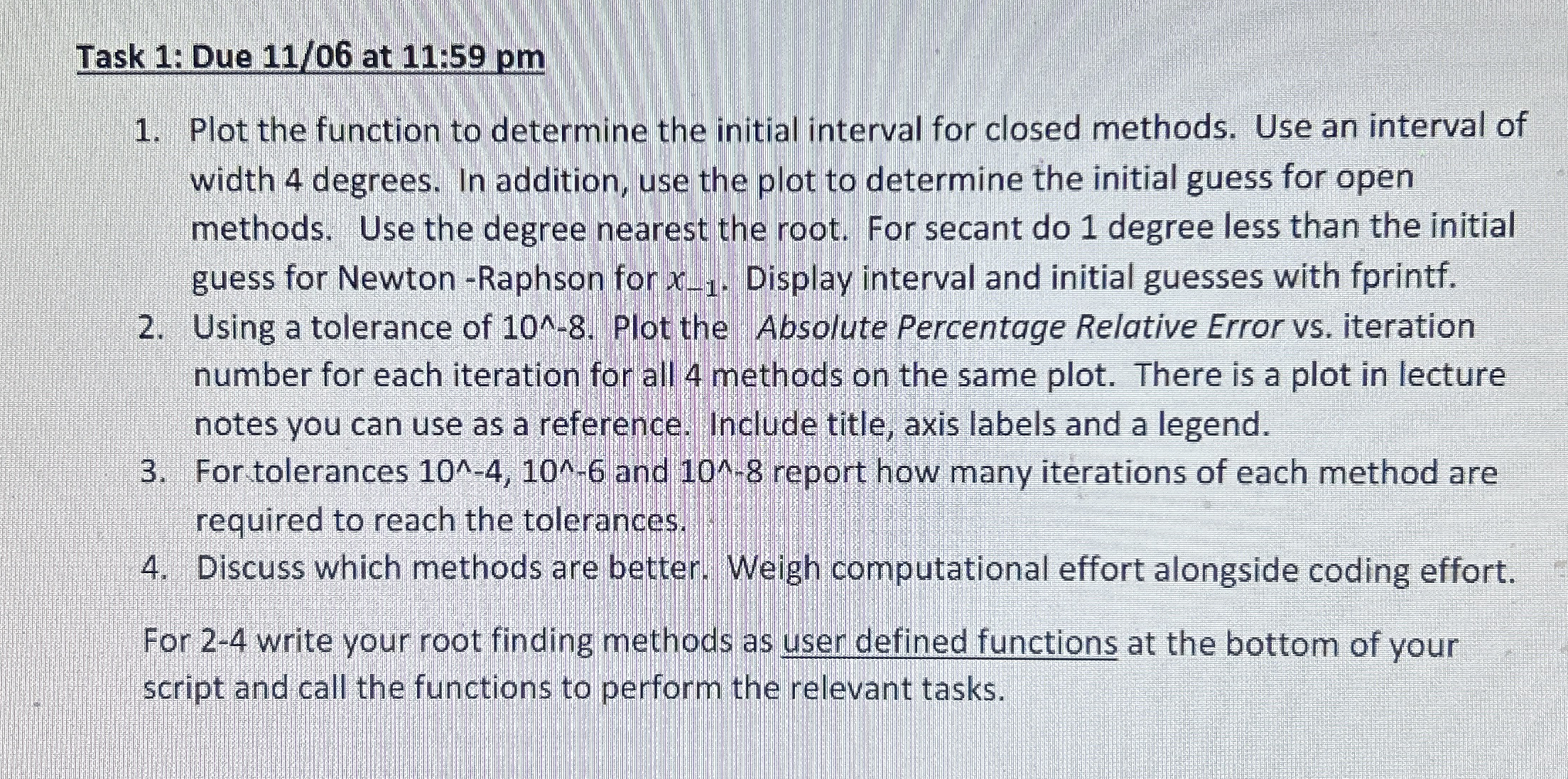
Task : Due at : pm
Plot the function to determine the initial interval for closed methods. Use an interval of width degrees. In addition, use the plot to determine the initial guess for open methods. Use the degree nearest the root. For secant do degree less than the initial guess for Newton Raphson for Display interval and initial guesses with fprintf.
Using a tolerance of Plot the Absolute Percentage Relative Error vs iteration number for each iteration for all methods on the same plot. There is a plot in lecture notes you can use as a reference. Include title, axis labels and a legend.
For tolerances and report how many iterations of each method are required to reach the tolerances.
Discuss which methods are better. Weigh computational effort alongside coding effort.
For write your root finding methods as user defined functions at the bottom of your script and call the functions to perform the relevant tasks.
Step by Step Solution
There are 3 Steps involved in it
1 Expert Approved Answer
Step: 1 Unlock

Question Has Been Solved by an Expert!
Get step-by-step solutions from verified subject matter experts
Step: 2 Unlock
Step: 3 Unlock