







Question: We have a general method for solving a system of equations Ax-b- we can just use Gaussian elimination (or LU decomposition; they are equivalent). However,
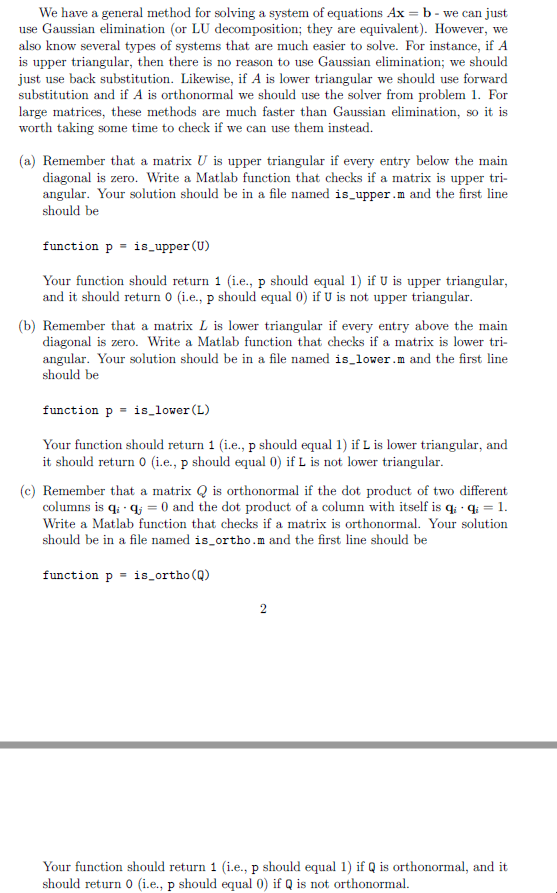
We have a general method for solving a system of equations Ax-b- we can just use Gaussian elimination (or LU decomposition; they are equivalent). However, we also know several types of systems that are much easier to solve. For instance, if A is upper triangular, then there is no reason to use Gaussian elimination; we should just use back substitution. Likewise, if A is lower triangular we should use forward substitution and if A is orthonormal we should use the solver from problem 1. For large matrices, these methods are much faster than Gaussian elimination, so it is worth taking some time to check if we can use them instead. (a) Remember that a matrix U is upper triangular if every entry below the main diagonal is zero. Write a Matlab function that checks if a matrix is upper tri angular. Your solution should be in a file named is_upper.m and the first line should be function p -is_upper (U) Your function should return 1 (i.e., p should equal 1) if U is upper triangular, and it should return 0 (i.e., p should equal 0) if U is not upper triangular (b) Remember that a matrix L is lower triangular if every entry above the main diagonal is zero. Write a Matlab function that checks if a matrix is lower tri angular. Your solution should be in a file named is_lower.m and the first line should be function p -is_lower (L) Your function should return 1 (i.e., p should equal 1) if L is lower triangular, and it should return 0 (i.e., p should equal 0) if L is not lower triangular (c) Remember that a matrix Q is orthonormal if the dot product of two different columns is qi qi = 0 and the dot product of a column with itself is q-qi-1 Write a Matlab function that checks if a matrix is orthonormal. Your solution should be in a file named is ortho.m and the first line should be function p -is_ortho (Q) Your function should return 1 (i.e., p should equal 1) if Q is orthonormal, and it should return 0 (i.e., p should equal 0) if Q is not orthonormal
Step by Step Solution
There are 3 Steps involved in it

Get step-by-step solutions from verified subject matter experts
 Study Help