







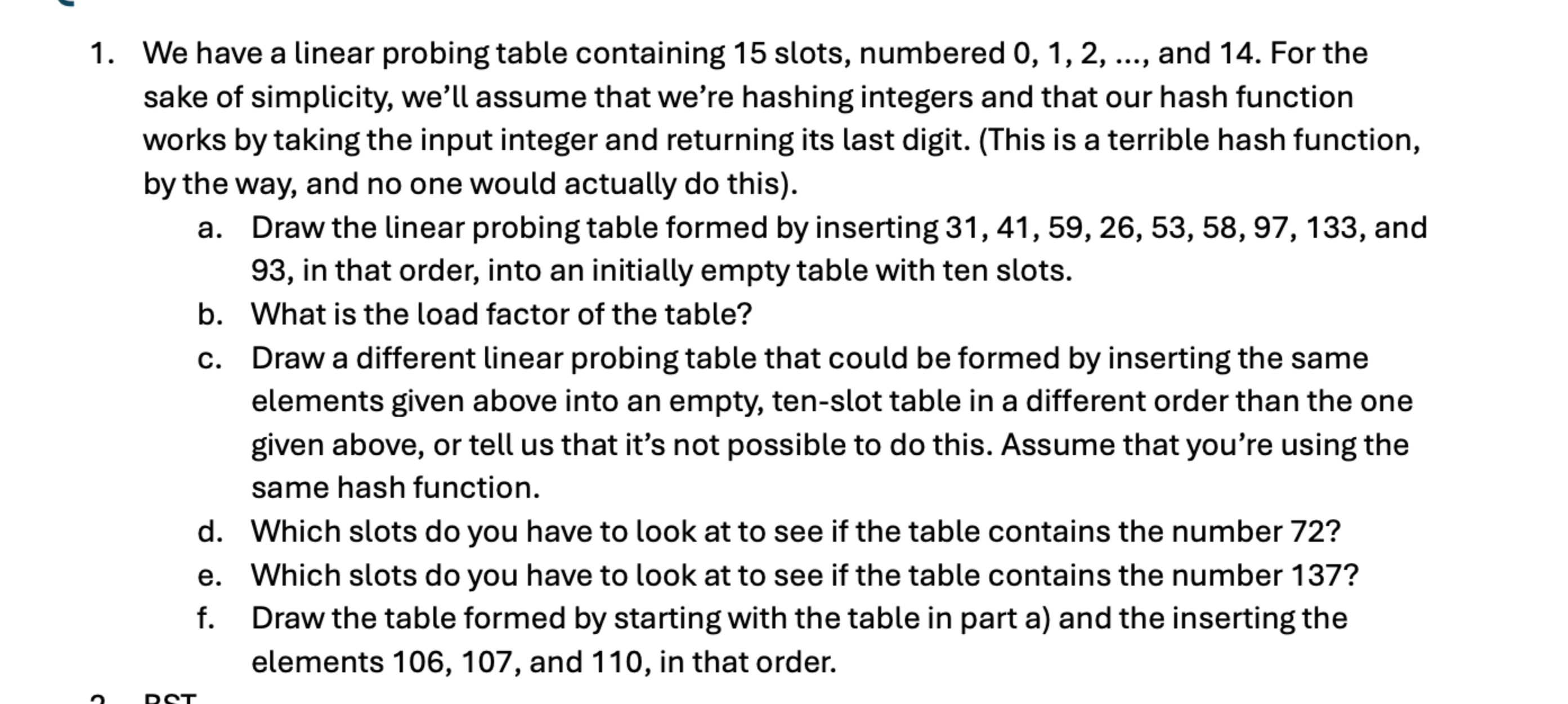
Question: We have a linear probing table containing 1 5 slots, numbered 0 , 1 , 2 , dots, and 1 4 . For the sake
We have a linear probing table containing slots, numbered dots, and For the
sake of simplicity, we'll assume that we're hashing integers and that our hash function
works by taking the input integer and returning its last digit. This is a terrible hash function,
by the way, and no one would actually do this
a Draw the linear probing table formed by inserting and
in that order, into an initially empty table with ten slots.
b What is the load factor of the table?
c Draw a different linear probing table that could be formed by inserting the same
elements given above into an empty, tenslot table in a different order than the one
given above, or tell us that it's not possible to do this. Assume that you're using the
same hash function.
d Which slots do you have to look at to see if the table contains the number
e Which slots do you have to look at to see if the table contains the number
f Draw the table formed by starting with the table in part a and the inserting the
elements and in that order.
Step by Step Solution
There are 3 Steps involved in it
1 Expert Approved Answer
Step: 1 Unlock

Question Has Been Solved by an Expert!
Get step-by-step solutions from verified subject matter experts
Step: 2 Unlock
Step: 3 Unlock
 Study Help