







Question: We have dened the integral of a continuous function using upper and lower sums. We might try to copy this process to dene the integral
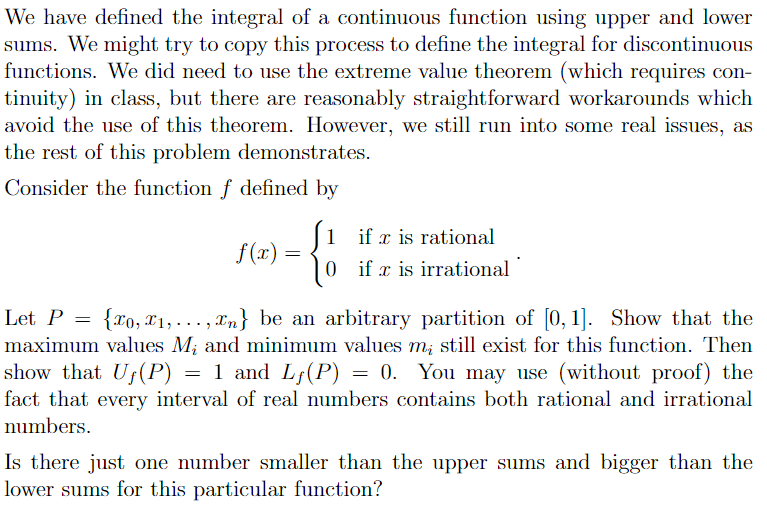
We have dened the integral of a continuous function using upper and lower sums. We might try to copy this process to dene the integral for discontinuous functions. We did need to use the extreme value theorem (which requires con- tinuity) in class, but there are reasonably straightforward workarounds which avoid the use of this theorem. However, we still run into some real issues, as the rest of this problem demonstrates. Consider the function f dened by 1 if :r is rational a = { 0 if :r is irrational Let P = {:L'n, 1:1,...,:1cn} be an arbitrary partition of [II], 1]. Show that the maximum values M, and minimum values 131.; still exist for this function. Then show that III-(P) = 1 and LAP) = 0. You may use (without proof) the fact that every interval of real numbers contains both rational and irrational numbers. Is there just one number smaller than the upper sums and bigger than the lower sums for this particular function
Step by Step Solution
There are 3 Steps involved in it

Get step-by-step solutions from verified subject matter experts
 Study Help