







Question: We have five objects (A, B, C, D, E) which may or may not be charged. We observe the following I. Object E attracts Objects
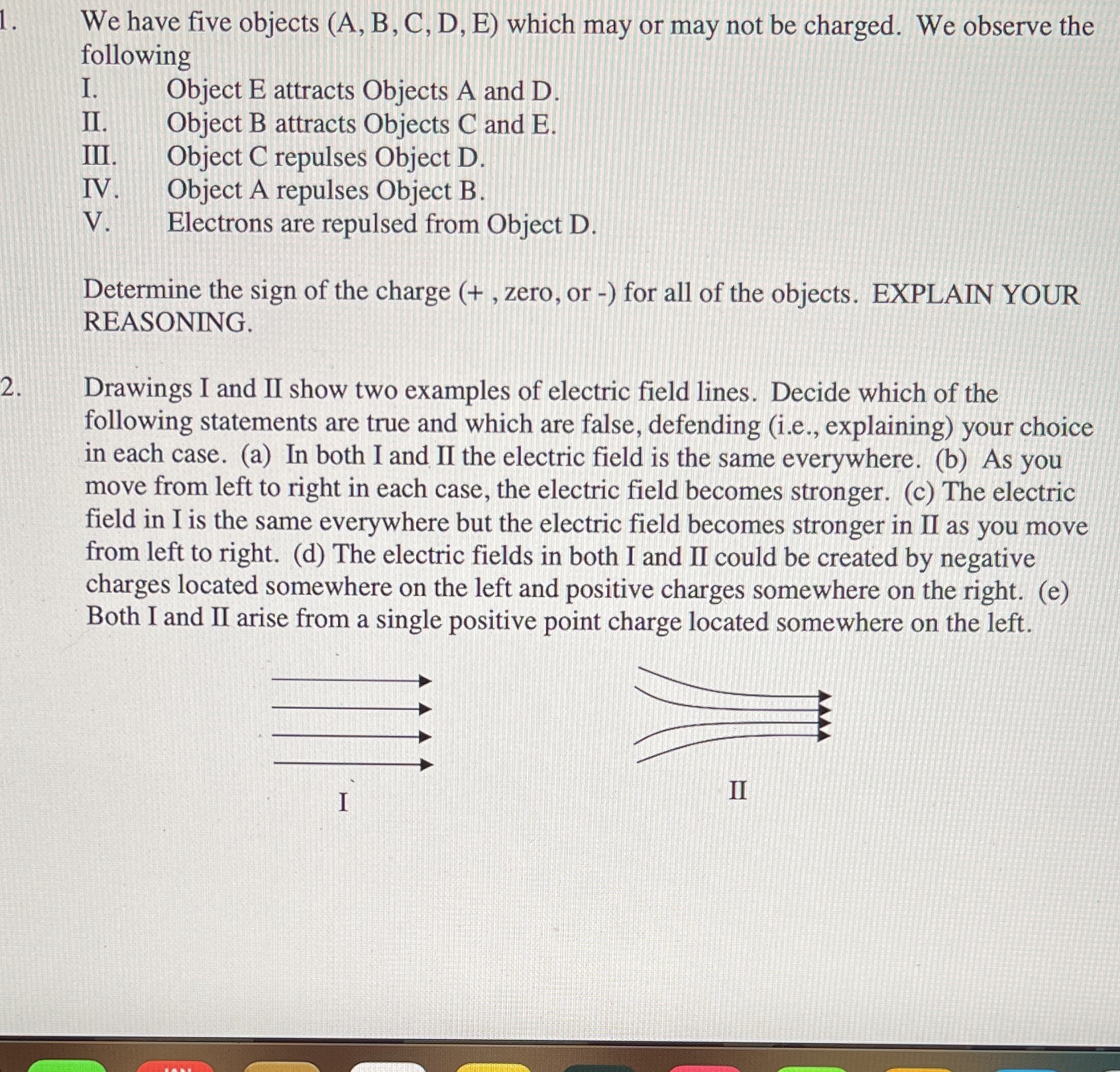
We have five objects (A, B, C, D, E) which may or may not be charged. We observe the following I. Object E attracts Objects A and D. II. Object B attracts Objects C and E. III. Object C repulses Object D IV. Object A repulses Object B. V. Electrons are repulsed from Object D. Determine the sign of the charge (+ , zero, or -) for all of the objects. EXPLAIN YOUR REASONING. Drawings I and II show two examples of electric field lines. Decide which of the following statements are true and which are false, defending (i.e., explaining) your choice in each case. (a) In both I and II the electric field is the same everywhere. (b) As you move from left to right in each case, the electric field becomes stronger. (c) The electric field in I is the same everywhere but the electric field becomes stronger in II as you move from left to right. (d) The electric fields in both I and II could be created by negative charges located somewhere on the left and positive charges somewhere on the right. (e) Both I and II arise from a single positive point charge located somewhere on the left
Step by Step Solution
There are 3 Steps involved in it

Get step-by-step solutions from verified subject matter experts
 Study Help