







Question: We have shown that the QR algorithm without shift is equivalent to simultaneous iteration. Assume that Ao is real and sysmetric. Recall that in QR
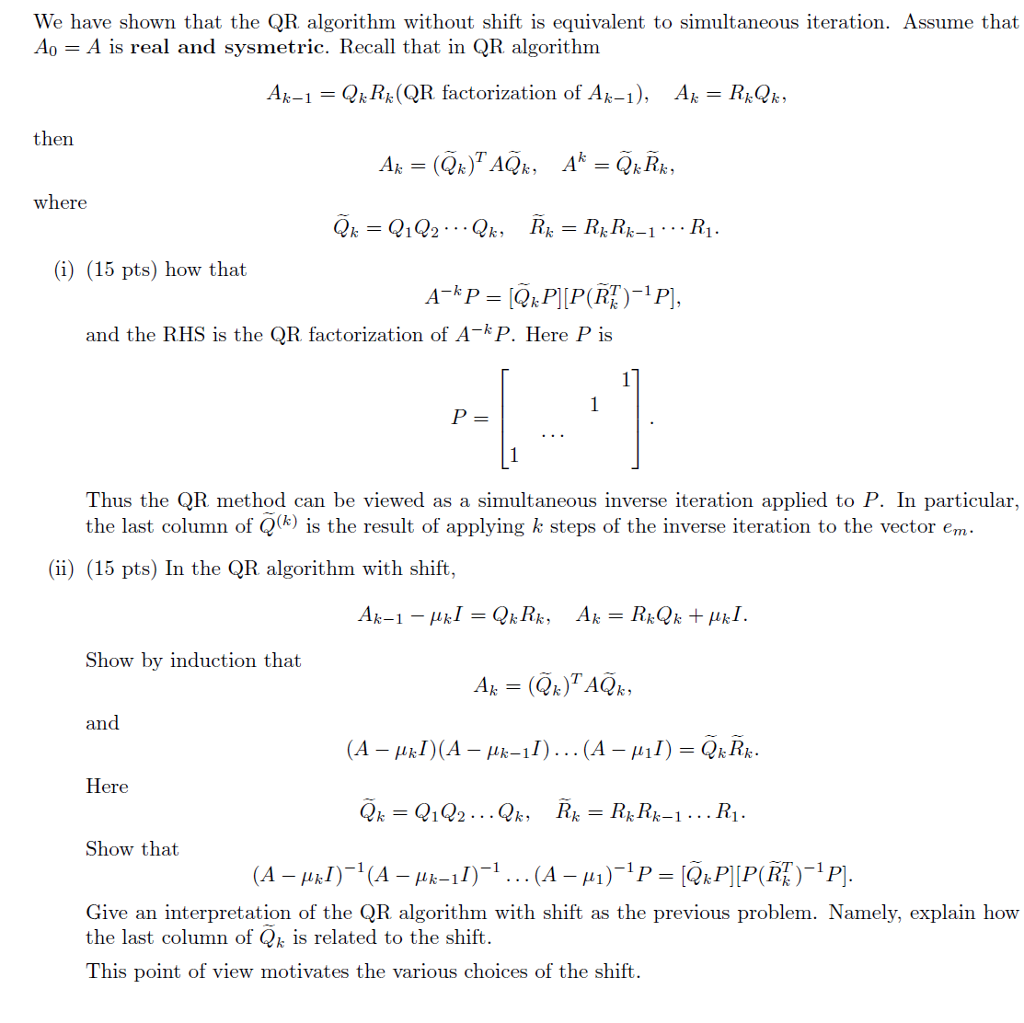
We have shown that the QR algorithm without shift is equivalent to simultaneous iteration. Assume that Ao is real and sysmetric. Recall that in QR algorithm Ak-1 = QkRa(QR factorization of Ak-1), Ak = RkQk, then where (i) (15 pts) how that and the RHS is the QR factorization of A-kP. Here P is Thus the QR method can be viewed as a simultaneous inverse iteration applied to P. In particular, the last column of Qk is the result of applying k steps of the inverse iteration to the vector em (ii) (15 pts) In the QR algorithm with shift, Show by induction that and (A-4k1)(A-M-11) . . . (A-111) = QkRk. ere Show that Give an interpretation of the QR algorithm with shift as the previous problem. Namely, explain how the last column of Qk is related to the shift. This point of view motivates the various choices of the shift. We have shown that the QR algorithm without shift is equivalent to simultaneous iteration. Assume that Ao is real and sysmetric. Recall that in QR algorithm Ak-1 = QkRa(QR factorization of Ak-1), Ak = RkQk, then where (i) (15 pts) how that and the RHS is the QR factorization of A-kP. Here P is Thus the QR method can be viewed as a simultaneous inverse iteration applied to P. In particular, the last column of Qk is the result of applying k steps of the inverse iteration to the vector em (ii) (15 pts) In the QR algorithm with shift, Show by induction that and (A-4k1)(A-M-11) . . . (A-111) = QkRk. ere Show that Give an interpretation of the QR algorithm with shift as the previous problem. Namely, explain how the last column of Qk is related to the shift. This point of view motivates the various choices of the shift
Step by Step Solution
There are 3 Steps involved in it

Get step-by-step solutions from verified subject matter experts
 Study Help