







Question: We have the network below. Our computer klient is connected to network that has two routers that runs network address translation(NAT). This means we can
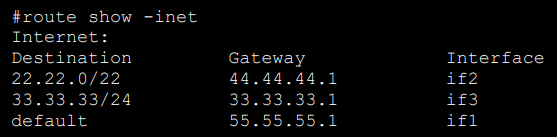
We have the network below. Our computer klient is connected to network that has two routers that runs network address translation(NAT). This means we can access the internet in two ways. 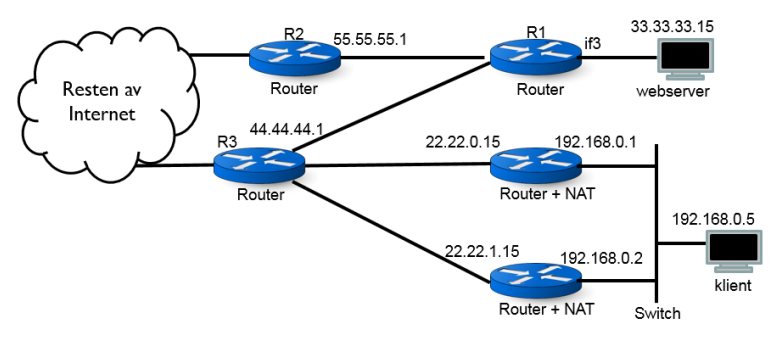 Router R1 has the routing table below:
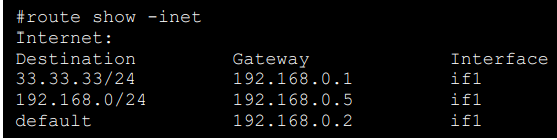
  While klient has the following:
  Choose the right alternative: 1) When klient(client) sends a packet to the webserver IP-address it will be sent via a)192.168.0.1 b)192.168.0.2
2)Assume that klient runs "ping 55.55.55.1". The packet will then first be sent to a)192.168.0.1 b)192.168.0.2
3)If klient sends a packet to 192.168.0.3 it will send a)the packet to 192.168.0.1 b)an ARP-command c)a DNS-command
4)A packet that reaches webserver from klient will have the "source address" a)192.168.0.5 b)192.168.0.1 c)192.168.0.2 d)22.22.0.15 e)22.22.1.15
5)A packet that reaches a server with address 33.33.34.15 from klient will have as "source address" a)192.168.0.5 b)192.168.0.1 c)192.168.0.2 d)22.22.0.15 e)22.22.1.15
6)If R1 receives a packet with "destination address" 44.44.44.44, R1 will send it to a) R2 b)R3
#routeshow-inetInternet:Destination22.22.0/2233.33.33/24defaultGateway44.44.44.133.33.33.155.55.55.1Interfaceif2if3if1 \begin{tabular}{lll} \#route show -inet & & \\ Internet: & & \\ Destination & Gateway & Interface \\ 33.33.33/24 & 192.168 .0 .1 & if1 \\ 192.168.0/24 & 192.168 .0 .5 & if1 \\ default & 192.168 .0 .2 & if1 \\ \hline \end{tabular}
Step by Step Solution
There are 3 Steps involved in it

Get step-by-step solutions from verified subject matter experts
 Study Help