







Question: We haven't learned loops yet, so please don't use loops. Please help with writing the code for the following. Please use plenty of comments. I
We haven't learned loops yet, so please don't use loops.
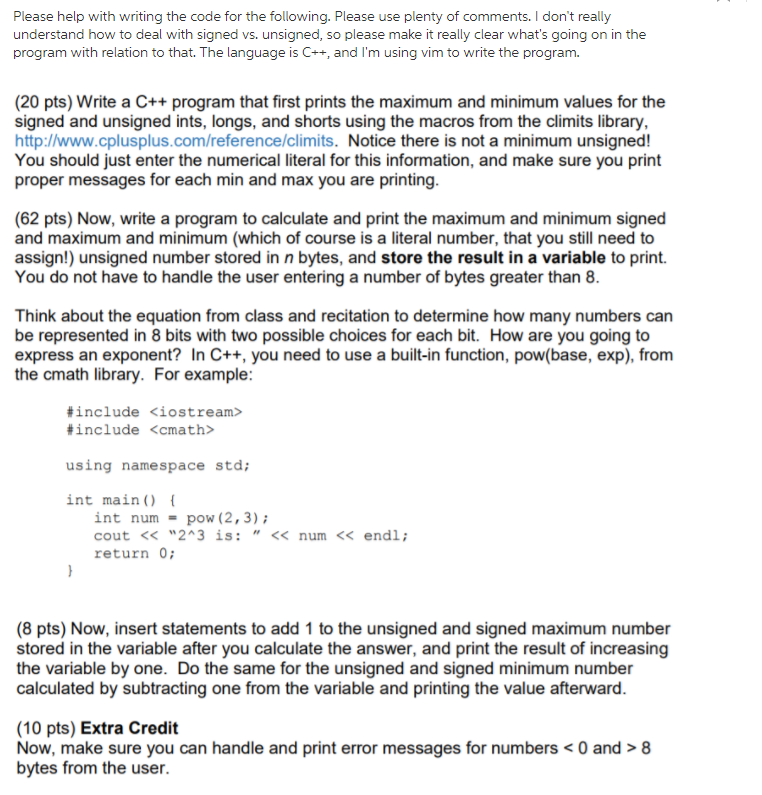
Please help with writing the code for the following. Please use plenty of comments. I don't really understand how to deal with signed vs. unsigned, so please make it really clear what's going on in the program with relation to that. The language is C++, and I'm using vim to write the program. (20 pts) Write a C++program that first prints the maximum and minimum values for the signed and unsigned ints, longs, and shorts using the macros from the climits library http://www.cplusplus.com/reference/climits. Notice there is not a minimum unsigned! You should just enter the numerical literal for this information, and make sure you print proper messages for each min and max you are printing (62 pts) Now, write a program to calculate and print the maximum and minimum signed and maximum and minimum (which of course is a literal number, that you still need to assign!) unsigned number stored in n bytes, and store the result in a variable to print. You do not have to handle the user entering a number of bytes greater than 8 Think about the equation from class and recitation to determine how many numbers can be represented in 8 bits with two possible choices for each bit. How are you going to express an exponent? In C++, you need to use a built-in function, pow(base, exp), from the cmath library. For example: #include
Step by Step Solution
There are 3 Steps involved in it

Get step-by-step solutions from verified subject matter experts
 Study Help