



Question: We model stock price moves as a binomial tree with time step Delta t and a probability to move up at each time equal to
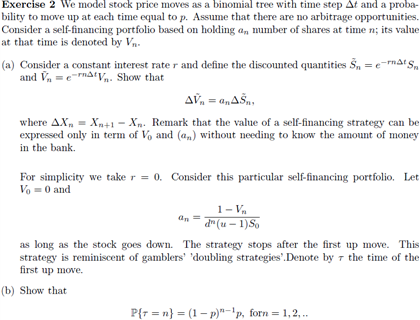
We model stock price moves as a binomial tree with time step Delta t and a probability to move up at each time equal to p. Assume that there are no arbitrage opportunities. Consider a self-financing portfolio based on holding an number of shares at time n: its value at that time is denoted by Vn. Consider a constant interest rate r and define the discounted quantities n= e-rnDeltat Sn and n = c-rnDeltatVn. Show that Delta n = anDelta n, where DeltaXn = Xn +1 - Xn. Remark that the value of a self-financing strategy can be expressed only in term of V0 and (an) without needing to know the amount of money in the hank. For simplicity we take r = 0. Consider this particular self-financing portfolio. Let V0 = 0 and an = 1- Vn/dn(u - l)S0 as long as the stock goes down. The strategy stops after the first up move. This strategy is reminiscent of gamblers' 'doubling strategies'. Denote by r the time of the first up move. Show that P{r = n} = (1 - p)n-1p, forn = 1,2,.. We model stock price moves as a binomial tree with time step Delta t and a probability to move up at each time equal to p. Assume that there are no arbitrage opportunities. Consider a self-financing portfolio based on holding an number of shares at time n: its value at that time is denoted by Vn. Consider a constant interest rate r and define the discounted quantities n= e-rnDeltat Sn and n = c-rnDeltatVn. Show that Delta n = anDelta n, where DeltaXn = Xn +1 - Xn. Remark that the value of a self-financing strategy can be expressed only in term of V0 and (an) without needing to know the amount of money in the hank. For simplicity we take r = 0. Consider this particular self-financing portfolio. Let V0 = 0 and an = 1- Vn/dn(u - l)S0 as long as the stock goes down. The strategy stops after the first up move. This strategy is reminiscent of gamblers' 'doubling strategies'. Denote by r the time of the first up move. Show that P{r = n} = (1 - p)n-1p, forn = 1,2
Step by Step Solution
There are 3 Steps involved in it

Get step-by-step solutions from verified subject matter experts