







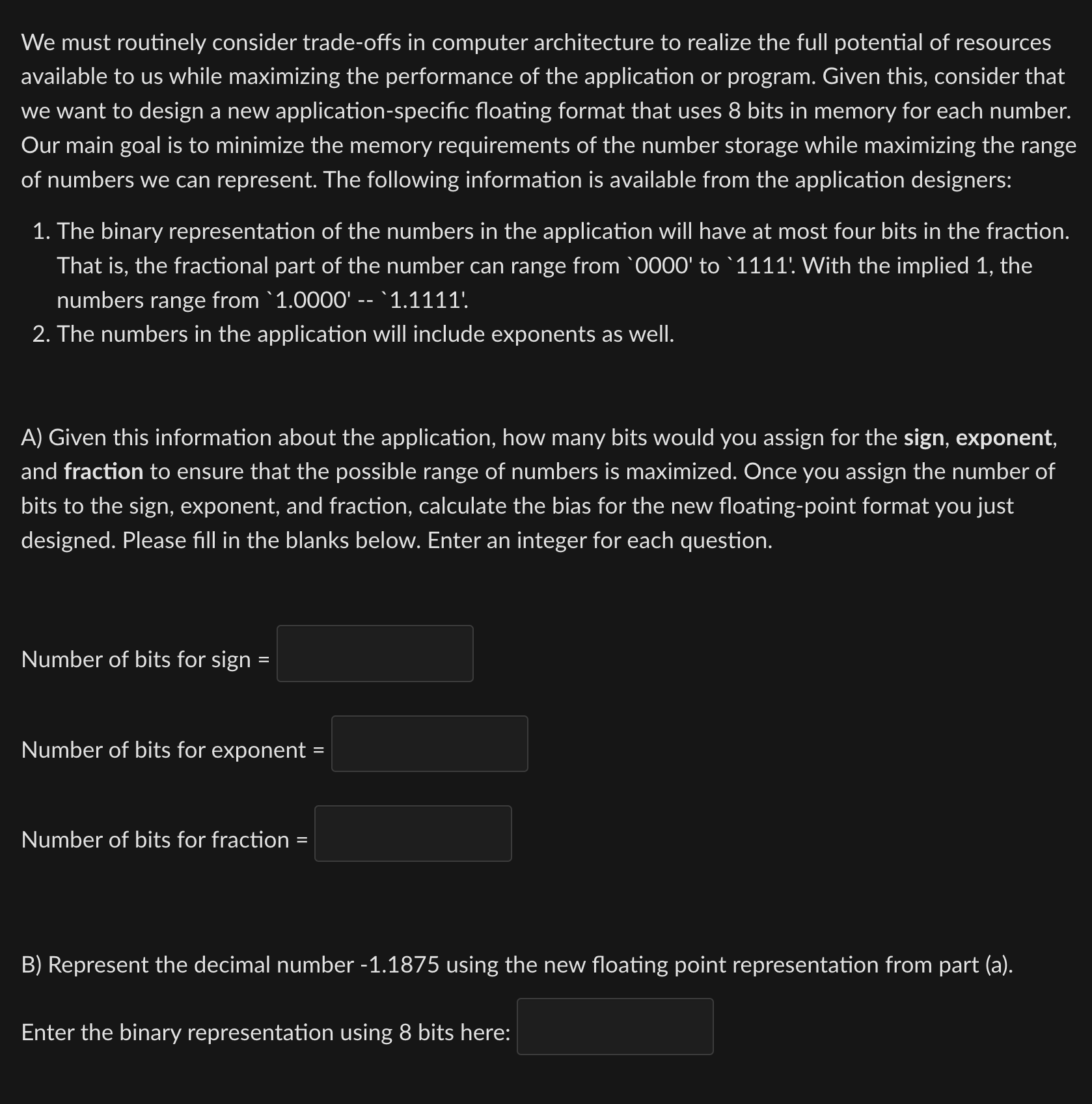
Question: We must routinely consider trade - offs in computer architecture to realize the full potential of resources available to us while maximizing the performance of
We must routinely consider tradeoffs in computer architecture to realize the full potential of resources
available to us while maximizing the performance of the application or program. Given this, consider that
we want to design a new applicationspecific floating format that uses bits in memory for each number.
Our main goal is to minimize the memory requirements of the number storage while maximizing the range
of numbers we can represent. The following information is available from the application designers:
The binary representation of the numbers in the application will have at most four bits in the fraction.
That is the fractional part of the number can range from to With the implied the
numbers range from
The numbers in the application will include exponents as well.
A Given this information about the application, how many bits would you assign for the sign, exponent,
and fraction to ensure that the possible range of numbers is maximized. Once you assign the number of
bits to the sign, exponent, and fraction, calculate the bias for the new floatingpoint format you just
designed. Please fill in the blanks below. Enter an integer for each question.
B Represent the decimal number using the new floating point representation from part a
Enter the binary representation using bits here:
Step by Step Solution
There are 3 Steps involved in it
1 Expert Approved Answer
Step: 1 Unlock

Question Has Been Solved by an Expert!
Get step-by-step solutions from verified subject matter experts
Step: 2 Unlock
Step: 3 Unlock
 Study Help