







Question: We return to the Stanford Stadium pricing problem.. assuming a capacity of 60,000 seats and the demand curves for students and for the general public
We return to the Stanford Stadium pricing problem.. assuming a capacity of 60,000 seats and the demand curves for students and for the general public as given in Equations 5.1 and 5.2. Assume that 5% of the general public will masquerade as students (perhaps using borrowed ID cards) in order to save money.a) Single admission price with concessions b) Individual daily prices under variable pricing policy with concession revenue c) Impact on optimal prices from including concessions in optimization. Which prices are lower and why? d) Impact on total weekly margin from including concessions in optimization vs not including. Note, in the base case the company still gains concession revenue even if it is not included in the optimization.
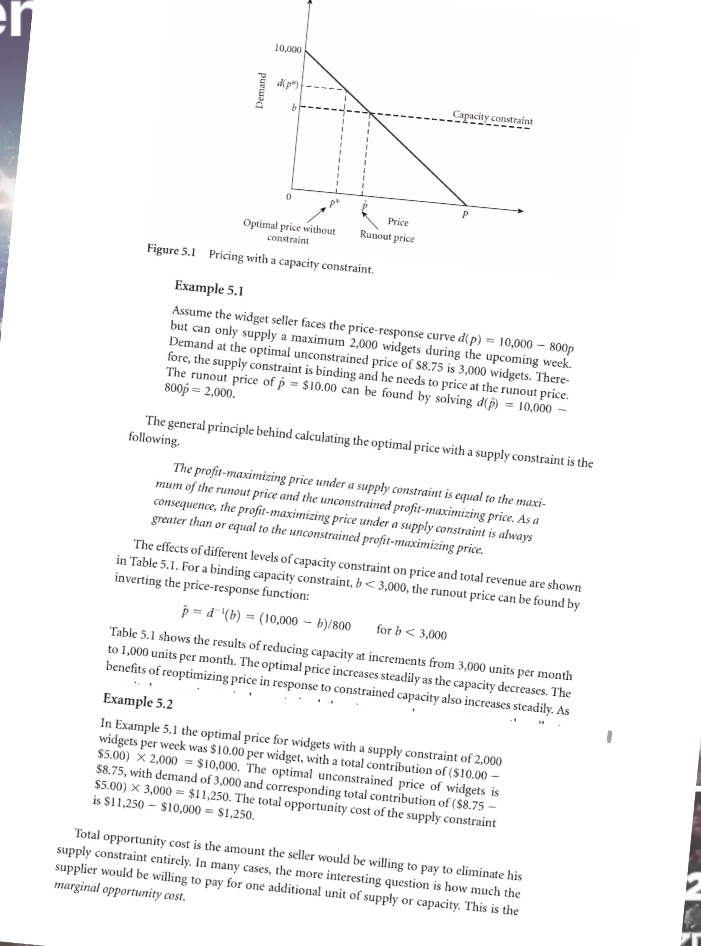
10,000 Demand Capacity constraint P Price Optimal price without Runout price constraint Figure 5.1 Pricing with a capacity constraint. Example 5.1 Assume the widget seller faces the price-response curve d(p) = 10,000 - 800p but can only supply a maximum 2,000 widgets during the upcoming week. Demand at the optimal unconstrained price of $8.75 is 3,000 widgets. There- fore, the supply constraint is binding and he needs to price at the runout price. The runout price of p = $10.00 can be found by solving d(p) = 10,000 - 80Op = 2,000. The general principle behind calculating the optimal price with a supply constraint is the following. The profit-maximizing price under a supply constraint is equal to the maxi- mum of the runout price and the unconstrained profit-maximizing price. As a consequence, the profit-maximizing price under a supply constraint is always greater than or equal to the unconstrained profit-maximizing price. The effects of different levels of capacity constraint on price and total revenue are shown in Table 5.1. For a binding capacity constraint, b
Step by Step Solution
There are 3 Steps involved in it

Get step-by-step solutions from verified subject matter experts
 Study Help