Question: We start through considering a four 12 months bond issued by means of GM Corp. The bond changed into initially bought to traders 6 years

We start through considering a four 12 months bond issued by means of GM Corp. The bond changed into initially bought to traders 6 years ago as a ten-yr bond. At the time it changed into bought at par. The face value for every bond become $1,000 and the annual coupon rate changed into set at a hard and fast fee of four% (coupons are paid semi-yearly). You are told that presently the desired go back, or yield, for this bond is four.4% (quoted yearly). Discuss qualitatively how you will determine the ideal yield

1. Assuming that 4.Four% is the ideal yield, what will be the cutting-edge fee?

2. Suppose you acquire the bond 6 years ago when first issued by using the organization. What fee of return could you have realized if you held the bond for 6 years and then offered it at the modern-day price? What explains this charge of return?

It turns out that GM Corp also has a bond with 7 years to adulthood extraordinary. That bond also has a face cost of $1,000 and the annual coupon price became additionally set at a set fee of 4% (coupons are paid semi-yearly).

3. If this bond had the same required return because the four-12 months bond, what could be its fee?

4. You find out that the bond recently bought for $985. What is the contemporary yield in this bond? Does this yield make experience relative to the yield on the four-yr bond? What explanations are you able to offer for the yield variations among the two GM bonds?

Finally, you hear that GM is considering presenting a new 4-12 months bond to the general public, but the structure of bills proposed is pretty unusual. For the first two years the bond will not pay any coupons. Starting in the 1/3 yr (30 months from now) the bond pays equal semi-annual coupons for the remainder of its life. The annual coupon price from yr three via four is predicted to be set at 10%.

5. Would you expect the yield in this bond to be above or under four.4% and why?

6. Why could GM be considering issuing any such "step up" bond? GM might be promoting each new bond at par fee.

7. If the actual required return on this bond is four.4%, would investors discover it appealing? If GM is raising 100 million in this bond providing, how a good deal price might GM be shifting to new investors?

8. What coupon charge ought to the enterprise pick out if it desired to ensure the charge of the bond (at par) might be honest (neither over or underpriced)?
We start through considering a four 12 monthsWe start through considering a four 12 monthsWe start through considering a four 12 months
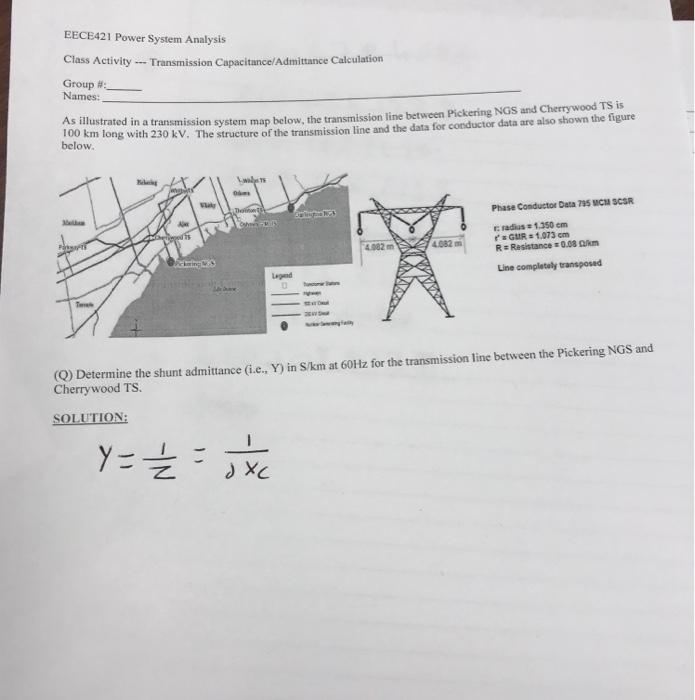
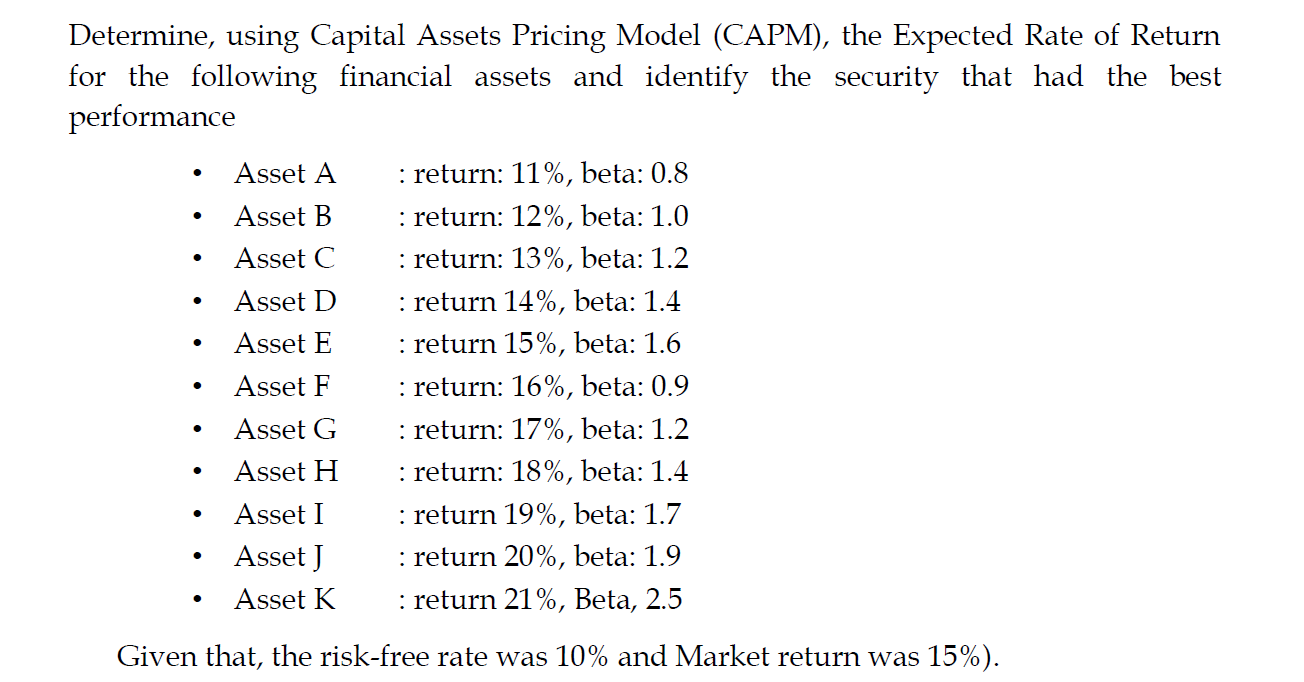
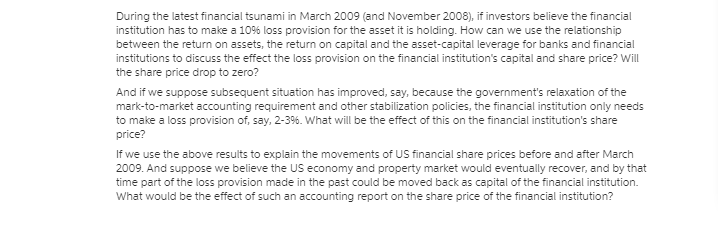
Determine, using Capital Assets Pricing Model (CAPM), the Expected Rate of Return for the following financial assets and identify the security that had the best performance - Asset A : return: 11%, beta: 0.8 ' Asset B : return: 12%, beta: 1.0 - Asset C : return: 13%, beta: 1.2 ' Asset D : return 14%, beta: 1.4 - Asset E : return 15%, beta: 1.6 - Asset F : return: 16%, beta: 0.9 ' Asset G : return: 17%, beta: 1.2 - Asset H : return: 18%, beta: 1.4 - Asset I : return 19%, beta: 1.7 - Asset] : return 20%, beta: 1.9 - Asset K : return 21%, Beta, 2.5 Given that, the risk-free rate was 10% and Market return was 15%). During the latest financial tsunami in March 2009 (and November 2008), if investors believe the financial institution has to make a 10% loss provision for the asset it is holding. How can we use the relationship between the return on assets, the return on capital and the asset-capital leverage for banks and financial institutions to discuss the effect the loss provision on the financial institution's capital and share price? Will the share price drop to zero? And if we suppose subsequent situation has improved, say, because the government's relaxation of the mark-to-market accounting requirement and other stabilization policies, the financial institution only needs to make a loss provision of, say, 2-396. What will be the effect of this on the financial institution's share price? If we use the above results to explain the movements of US financial share prices before and after March 2009. And suppose we believe the US economy and property market would eventually recover, and by that time part of the loss provision made in the past could be moved back as capital of the financial institution. What would be the effect of such an accounting report on the share price of the financial institution?EECE421 Power System Analysis Class Activity --- Transmission Capacitance/Admittance Calculation Group #: Names: As illustrated in a transmission system map below, the transmission line between Pickering NGS and Cherrywood TS is 100 km long with 230 kV. The structure of the transmission line and the data for conductor data are also shown the figure below. Darlington KEY Phase Conductor Data 795 MCI SCGR. radios = 1.350 em 4.082 m 7 4082 m I' GUR =1.073 em R = Resistance = 0.08 [km Legend Line completely transposed (Q) Determine the shunt admittance (i.e., Y) in S/km at 60Hz for the transmission line between the Pickering NGS and Cherrywood TS. SOLUTION: Y = JX C

Step by Step Solution

There are 3 Steps involved in it

1 Expert Approved Answer
Step: 1 Unlock blur-text-image
Question Has Been Solved by an Expert!

Get step-by-step solutions from verified subject matter experts

Step: 2 Unlock
Step: 3 Unlock

Students Have Also Explored These Related Finance Questions!