







Question: We use the form y = a + bx for the least-squares line. In some computer printouts, the least-squares equation is not given directly. Instead,
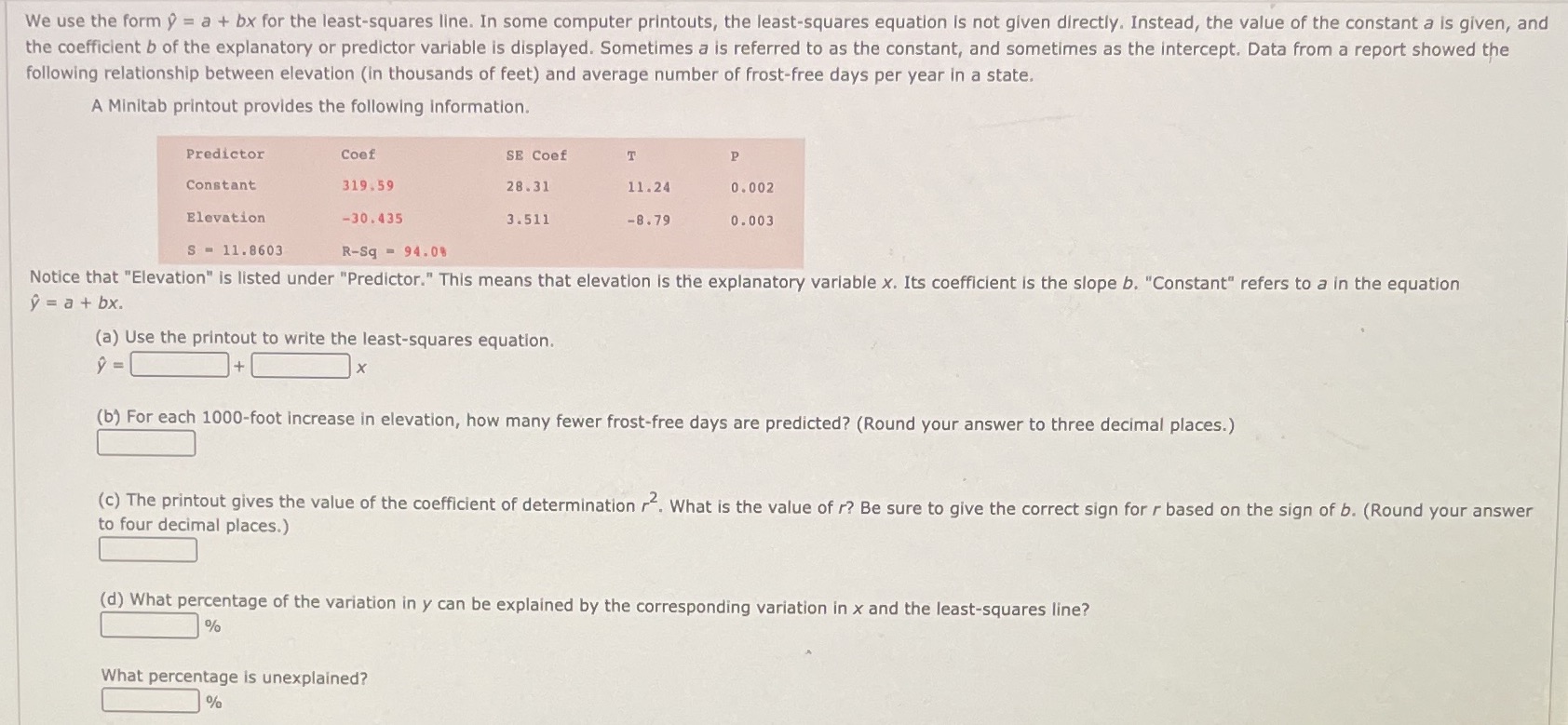
We use the form y = a + bx for the least-squares line. In some computer printouts, the least-squares equation is not given directly. Instead, the value of the constant a is given, and the coefficient b of the explanatory or predictor variable is displayed. Sometimes a is referred to as the constant, and sometimes as the intercept. Data from a report showed the following relationship between elevation (in thousands of feet) and average number of frost-free days per year in a state. A Minitab printout provides the following information. Predictor Coof SE Coef T P Constant 319.59 28.31 11.24 0 . 002 Elevation -30. 435 3.511 -8. 79 0. 003 S = 11. 8603 R-Sq - 94.08 Notice that "Elevation" is listed under "Predictor." This means that elevation is the explanatory variable x. Its coefficient is the slope b. "Constant" refers to a in the equation y = a + bx. (a) Use the printout to write the least-squares equation. 9 =L + x (b) For each 1000-foot increase in elevation, how many fewer frost-free days are predicted? (Round your answer to three decimal places.) (c) The printout gives the value of the coefficient of determination . What is the value of r? Be sure to give the correct sign for r based on the sign of b. (Round your answer to four decimal places.) (d) What percentage of the variation in y can be explained by the corresponding variation in x and the least-squares line? % What percentage is unexplained? %
Step by Step Solution
There are 3 Steps involved in it

Get step-by-step solutions from verified subject matter experts
 Study Help