



Question: We usually have batteries pointed in the same direction. What if they aren't? Suppose you have a circuit with two batteries and one bulb (equivalent
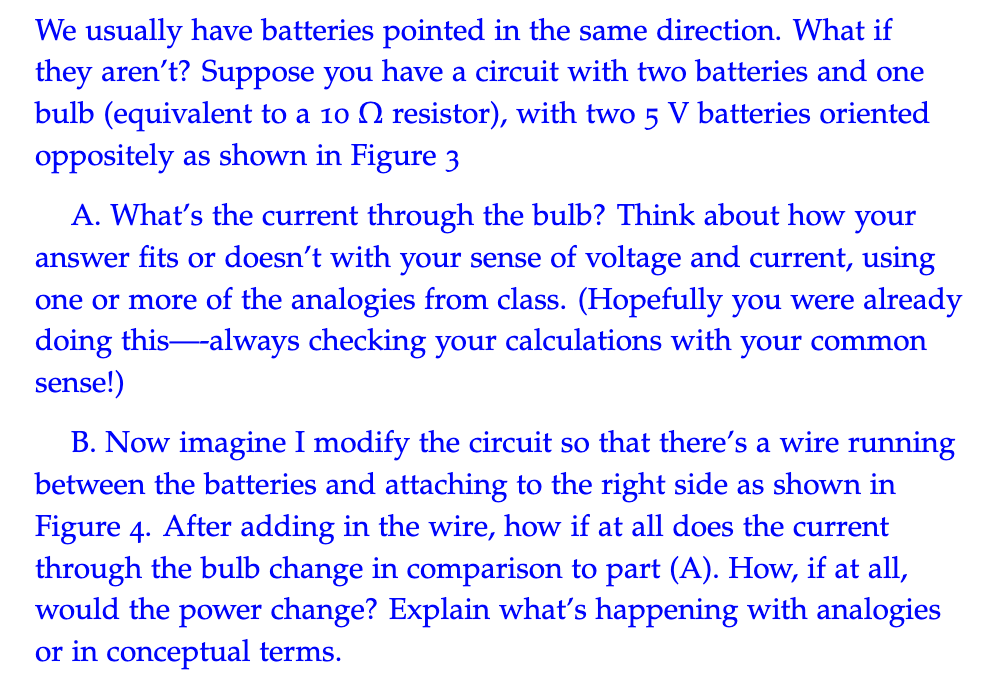
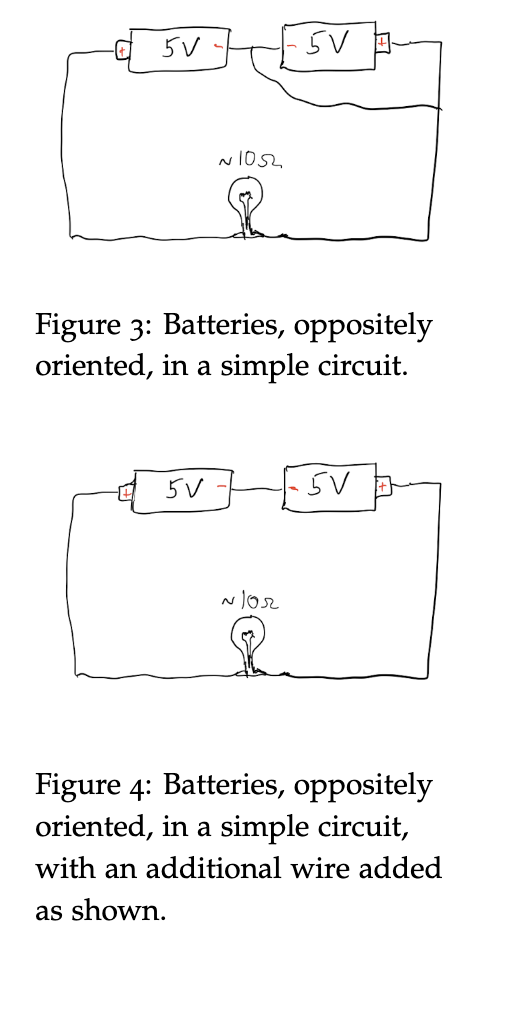
We usually have batteries pointed in the same direction. What if they aren't? Suppose you have a circuit with two batteries and one bulb (equivalent to a 10 Q resistor), with two 5 V batteries oriented oppositely as shown in Figure 3 A. What's the current through the bulb? Think about how your answer ts or doesn't with your sense of voltage and current, using one or more of the analogies from class. (Hopefully you were already doing thisalways checking your calculations with your common sense!) B. Now imagine I modify the circuit so that there's a wire running between the batteries and attaching to the right side as shown in Figure 4. After adding in the wire, how if at all does the current through the bulb change in comparison to part (A). How, if at all, would the power change? Explain what's happening with analogies or in conceptual terms. Figure 3: Batteries, oppositely oriented, in a simple circuit. Figure 4: Batteries, oppositely oriented, in a simple circuit, with an additional wire added as shown
Step by Step Solution
There are 3 Steps involved in it

Get step-by-step solutions from verified subject matter experts