







Question: We will compare three different technologies for cars. Car A is a conventional gasoline-burning car, which converts about 22% of the fuel energy to power
We will compare three different technologies for cars. Car A is a conventional gasoline-burning car, which converts about 22% of the fuel energy to power at the wheels. The gasoline has 46 MJ/kg and is 86% carbon. Car B is purely electric and can convert about 75% of electrical energy from the grid to power at the wheels, taking into account losses in the electric motors and in the batteries. The electrical power is supplied by a natural gas-burning power plant operating at 40% efficiency. The natural gas has 51 MJ/kg and is 75% carbon. Car C has a fuel cell that reacts hydrogen fuel with oxygen in air to produce only water as a product. The fuel cell is 50% efficient at converting the energy in the hydrogen to power at the wheels. The hydrogen is produced by steam reforming of natural gas, in which 70% of the energy in natural gas is converted to energy stored as hydrogen, and 100% of the carbon in natural gas is released as CO2. The natural gas is again 51 MJ/kg, 75% carbon. When all three cars are supplying 100 kW = 134 horsepower to the wheels, find the rate of CO2 emission attributable to each car, in grams per second.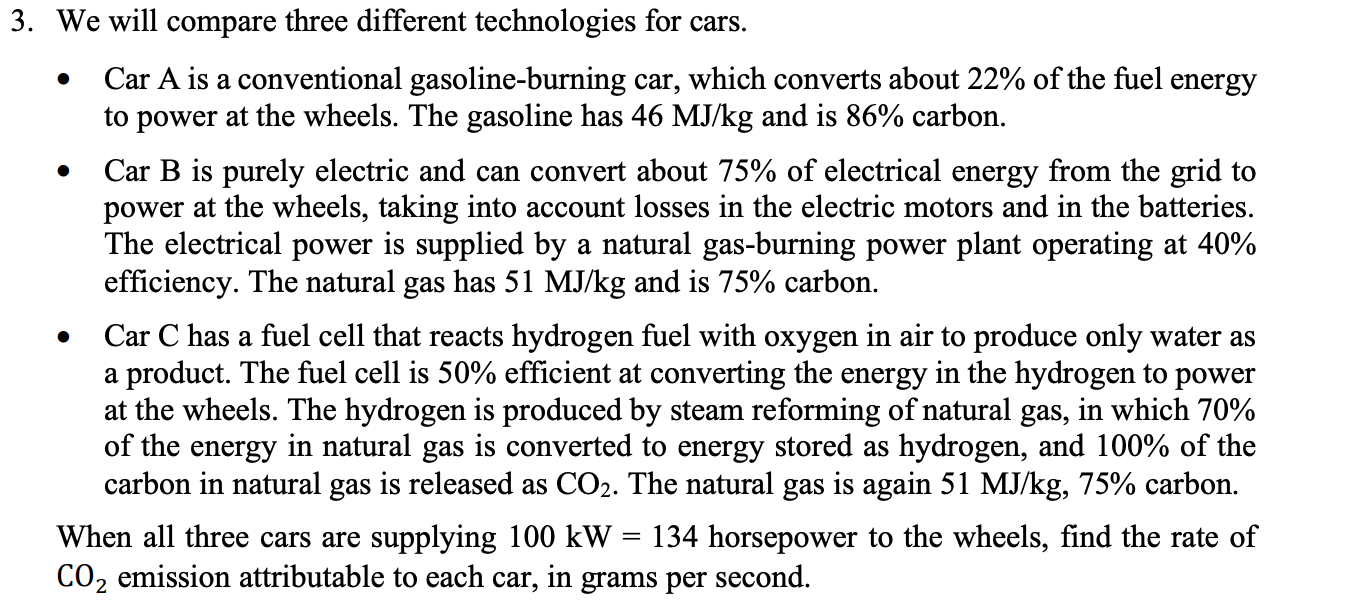
3. We will compare three different technologies for cars. - Car A is a conventional gasoline-burning car, which converts about 22% of the fuel energy to power at the wheels. The gasoline has 46MJ/kg and is 86% carbon. - Car B is purely electric and can convert about 75% of electrical energy from the grid to power at the wheels, taking into account losses in the electric motors and in the batteries. The electrical power is supplied by a natural gas-burning power plant operating at 40% efficiency. The natural gas has 51MJ/kg and is 75% carbon. - Car C has a fuel cell that reacts hydrogen fuel with oxygen in air to produce only water as a product. The fuel cell is 50% efficient at converting the energy in the hydrogen to power at the wheels. The hydrogen is produced by steam reforming of natural gas, in which 70% of the energy in natural gas is converted to energy stored as hydrogen, and 100% of the carbon in natural gas is released as CO2. The natural gas is again 51MJ/kg,75% carbon. When all three cars are supplying 100kW=134 horsepower to the wheels, find the rate of CO2 emission attributable to each car, in grams per second
Step by Step Solution
There are 3 Steps involved in it

Get step-by-step solutions from verified subject matter experts
 Study Help