





Question: We wish to compare two methods for determining the percentage of iron ore in ore samples. Because inherent differences in the ore samples would be
We wish to compare two methods for determining

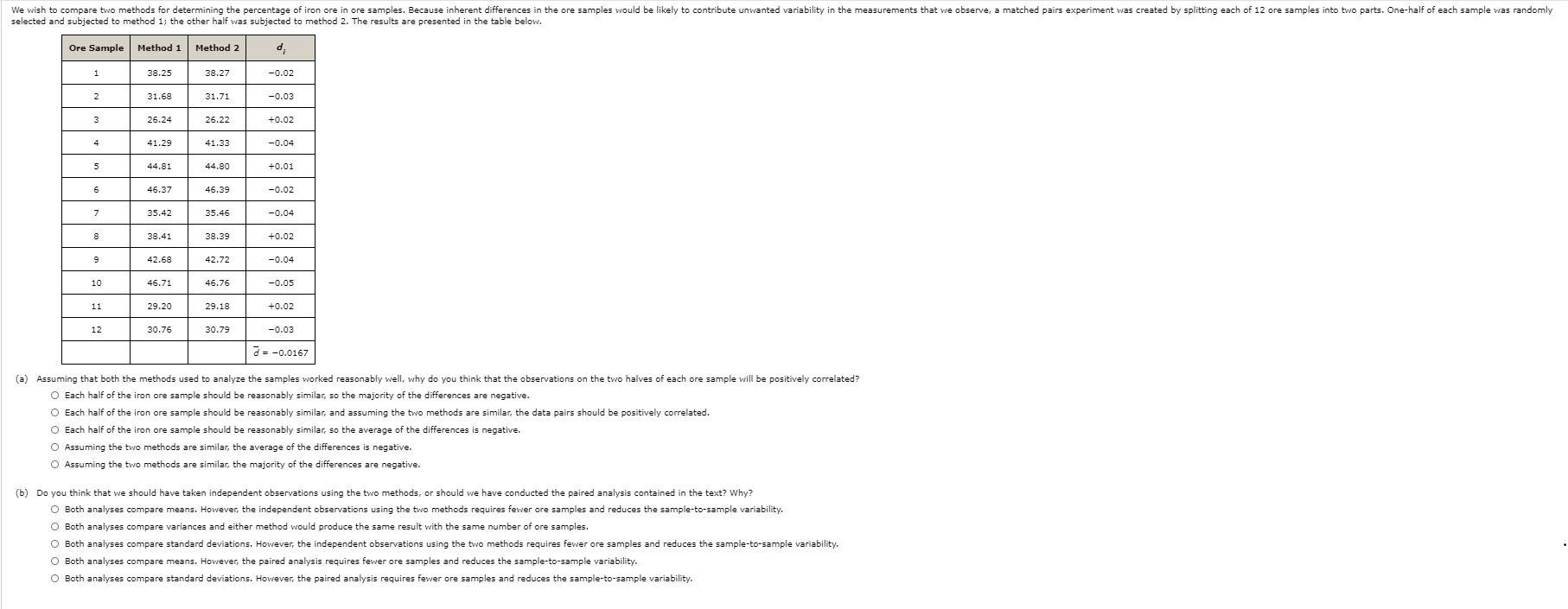
We wish to compare two methods for determining the percentage of iron ore in ore samples. Because inherent differences in the ore samples would be likely to contribute unwanted variability in the measurements that we observe, a matched pairs experiment was created by splitting each of 12 ore samples into two parts. One-half of each sample was randomly selected and subjected to method 1; the other half was subjected to method 2. The results are presented in the table below. Ore Sample Method 1 Method 2 d; 1 38.25 38.27 -0.02 2 31.68 31.71 -0.03 3 26.24 26.22 +0.02 4 41.29 41.33 -0.04 5 44.81 44.80 +0.01 46.37 46.39 -0.02 7 35.42 35.46 -0.04 8 38.41 38.39 +0.02 9 42.68 42.72 -0.04 10 46.71 46.76 -0.05 11 29.20 29.18 +0.02 12 30.76 30.79 -0.03 = -0.0167 (a) Assuming that both the methods used to analyze the samples worked reasonably well, why do you think that the observations on the two halves of each ore sample will be positively correlated? Each half of the iron ore sample should be reasonably similar, so the majority of the differences are negative. Each half of the iron ore sample should be reasonably similar, and assuming the two methods are similar, the data pairs should be positively correlated. O Each half of the iron ore sample should be reasonably similar, so the average of the differences is negative. O Assuming the two methods are similar, the average of the differences is negative. O Assuming the two methods are similar, the majority of the differences are negative. (b) Do you think that we should have taken independent observations using the two methods, or should we have conducted the paired analysis contained in the text? Why? O Both analyses compare means. However, the independent observations using the two methods requires fewer ore samples and reduces the sample-to-sample variability. O Both analyses compare variances and either method would produce the same result with the same number of ore samples. O Both analyses compare standard deviations. However, the independent observations using the two methods requires fewer ore samples and reduces the sample-to-sample variability. O Both analyses compare means. However, the paired analysis requires fewer ore samples and reduces the sample-to-sample variability. O Both analyses compare standard deviations. However, the paired analysis requires fewer ore samples and reduces the sample-to-sample variability

Step by Step Solution

There are 3 Steps involved in it

1 Expert Approved Answer
Step: 1 Unlock blur-text-image

Question Has Been Solved by an Expert!

Get step-by-step solutions from verified subject matter experts

Step: 2 Unlock
Step: 3 Unlock

Students Have Also Explored These Related General Management Questions!