





Question: WEB Master 1. A rm's beta can be estimated from the slope of the security characteristic line (SCL) The rst step is to plot the
WEB Master 1. A rm's beta can be estimated fromWEB Master 1. A rm's beta can be estimated from
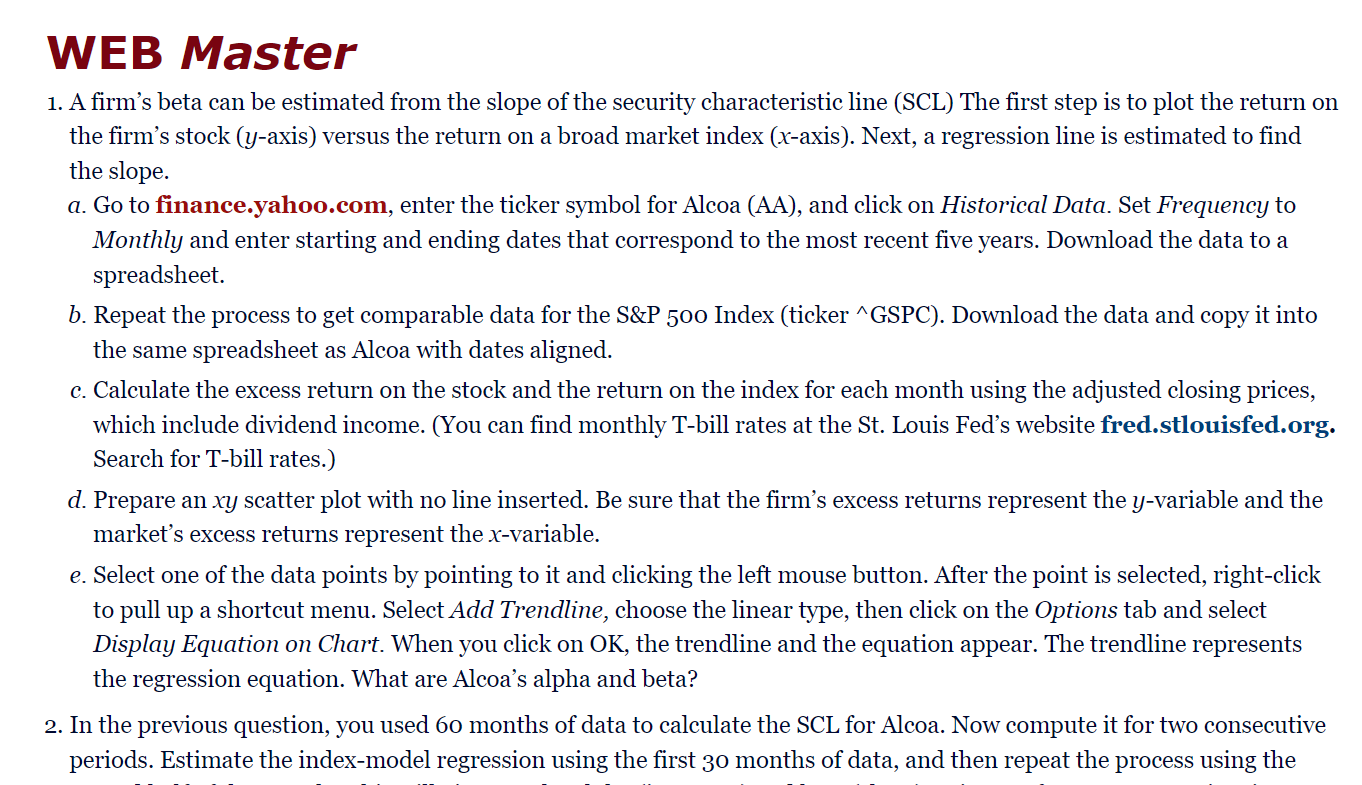
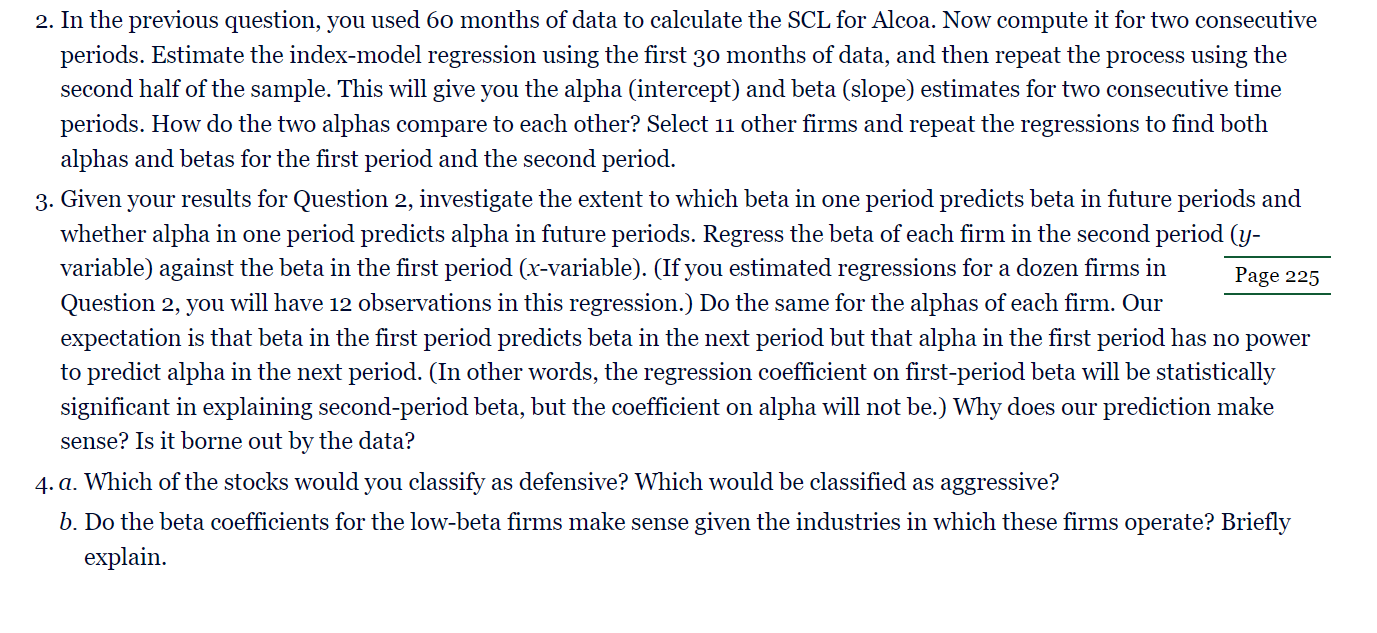
WEB Master 1. A rm's beta can be estimated from the slope of the security characteristic line (SCL) The rst step is to plot the return on the rms stock (yaxis) versus the return on a broad market index (xaxis). Next, a regression line is estimated to nd the slope. a. Go to nance.yahoo.com, enter the ticker symbol for Alcoa (AA), and click on Historical Data. Set Frequency to Monthly and enter starting and ending dates that correspond to the most recent ve years. Dovmload the data to a spreadsheet. b. Repeat the process to get comparable data for the S&P 500 Index (ticker AGSPC). Download the data and copy it into the same spreadsheet as Alcoa with dates aligned. c. Calculate the excess return on the stock and the return on the index for each month using the adjusted closing prices, which include dividend income. (You can nd monthly T-bill rates at the St. Louis Fed's website fred.stlouisfed.org. Search for T-bill rates.) (1'. Prepare an xy scatter plot with no line inserted. Be sure that the rm's excess returns represent the y-Variable and the market's excess returns represent the xvariable. 9. Select one of the data points by pointing to it and clicking the left mouse button. After the point is selected, rightclick to pull up a shortcut menu. Select Add Trendline, choose the linear type, then click on the Options tab and select Display Equation on Chart. When you click on OK, the trendline and the equation appear. The trendline represents the regression equation. What are Alcoa's alpha and beta? 2. In the previous question, you used 60 months of data to calculate the SCL for Alcoa. Now compute it for two consecutive periods. Estimate the index-model regression using the rst 30 months of data, and then repeat the process using the 2. In the previous question, you used 60 months of data to calculate the SCL for Alcoa. Now compute it for two consecutive periods. Estimate the index-model regression using the first 30 months of data, and then repeat the process using the second half of the sample. This will give you the alpha (intercept) and beta (slope) estimates for two consecutive time periods. How do the two alphas compare to each other? Select 11 other firms and repeat the regressions to find both alphas and betas for the first period and the second period. 3. Given your results for Question 2, investigate the extent to which beta in one period predicts beta in future periods and whether alpha in one period predicts alpha in future periods. Regress the beta of each firm in the second period (y- variable) against the beta in the first period (x-variable). (If you estimated regressions for a dozen firms in Page 225 Question 2, you will have 12 observations in this regression.) Do the same for the alphas of each firm. Our expectation is that beta in the first period predicts beta in the next period but that alpha in the first period has no power to predict alpha in the next period. (In other words, the regression coefficient on first-period beta will be statistically significant in explaining second-period beta, but the coefficient on alpha will not be.) Why does our prediction make sense? Is it borne out by the data? 4. a. Which of the stocks would you classify as defensive? Which would be classified as aggressive? b. Do the beta coefficients for the low-beta firms make sense given the industries in which these firms operate? Briefly explain

Step by Step Solution

There are 3 Steps involved in it

1 Expert Approved Answer
Step: 1 Unlock blur-text-image
Question Has Been Solved by an Expert!

Get step-by-step solutions from verified subject matter experts

Step: 2 Unlock
Step: 3 Unlock

Students Have Also Explored These Related Finance Questions!