



Question: WEB Master 1. Use data from finance.yahoo.com to answer the following questions. a. Select the Company tab and enter the ticker symbol for Adobe, ADBE.
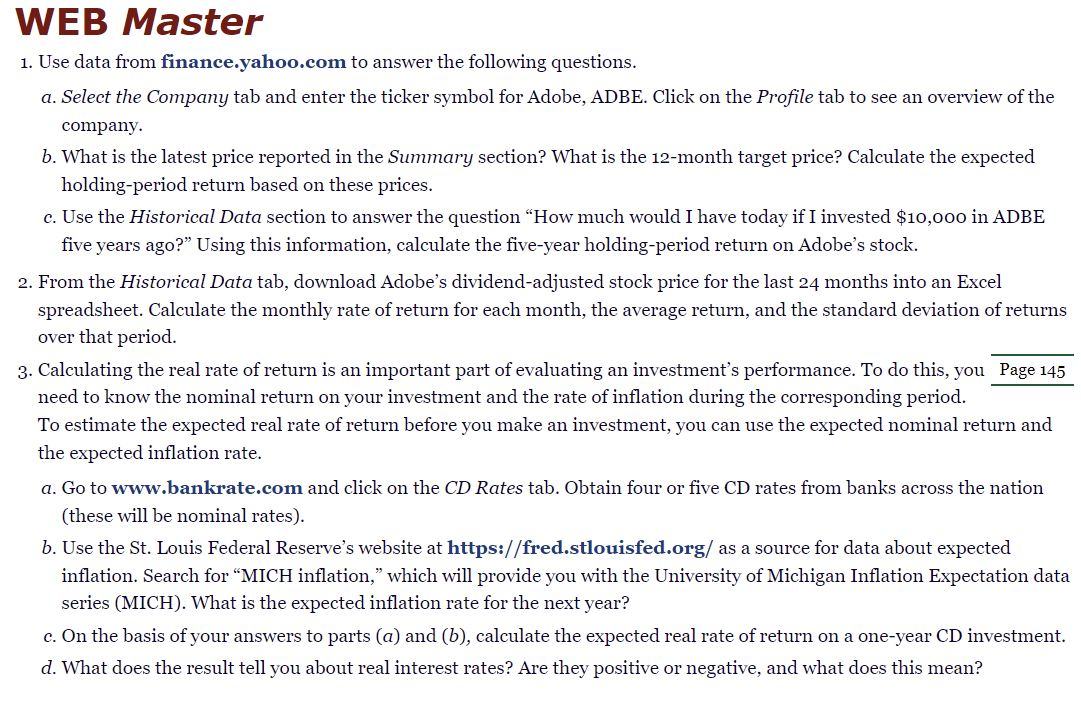
WEB Master 1. Use data from finance.yahoo.com to answer the following questions. a. Select the Company tab and enter the ticker symbol for Adobe, ADBE. Click on the Profile tab to see an overview of the company. b. What is the latest price reported in the Summary section? What is the 12-month target price? Calculate the expected holding-period return based on these prices. c. Use the Historical Data section to answer the question "How much would I have today if I invested $10,000 in ADBE five years ago?" Using this information, calculate the five-year holding-period return on Adobe's stock. 2. From the Historical Data tab, download Adobe's dividend-adjusted stock price for the last 24 months into an Excel spreadsheet. Calculate the monthly rate of return for each month, the average return, and the standard deviation of returns over that period. 3. Calculating the real rate of return is an important part of evaluating an investment's performance. To do this, you Page 145 need to know the nominal return on your investment and the rate of inflation during the corresponding period. To estimate the expected real rate of return before you make an investment, you can use the expected nominal return and the expected inflation rate. a. Go to www.bankrate.com and click on the CD Rates tab. Obtain four or five CD rates from banks across the nation (these will be nominal rates). b. Use the St. Louis Federal Reserve's website at https://fred.stlouisfed.org/ as a source for data about expected inflation. Search for "MICH inflation, which will provide you with the University of Michigan Inflation Expectation data series (MICH). What is the expected inflation rate for the next year? c. On the basis of your answers to parts (a) and (b), calculate the expected real rate of return on a one-year CD investment. d. What does the result tell you about real interest rates? Are they positive or negative, and what does this mean? WEB Master 1. Use data from finance.yahoo.com to answer the following questions. a. Select the Company tab and enter the ticker symbol for Adobe, ADBE. Click on the Profile tab to see an overview of the company. b. What is the latest price reported in the Summary section? What is the 12-month target price? Calculate the expected holding-period return based on these prices. c. Use the Historical Data section to answer the question "How much would I have today if I invested $10,000 in ADBE five years ago?" Using this information, calculate the five-year holding-period return on Adobe's stock. 2. From the Historical Data tab, download Adobe's dividend-adjusted stock price for the last 24 months into an Excel spreadsheet. Calculate the monthly rate of return for each month, the average return, and the standard deviation of returns over that period. 3. Calculating the real rate of return is an important part of evaluating an investment's performance. To do this, you Page 145 need to know the nominal return on your investment and the rate of inflation during the corresponding period. To estimate the expected real rate of return before you make an investment, you can use the expected nominal return and the expected inflation rate. a. Go to www.bankrate.com and click on the CD Rates tab. Obtain four or five CD rates from banks across the nation (these will be nominal rates). b. Use the St. Louis Federal Reserve's website at https://fred.stlouisfed.org/ as a source for data about expected inflation. Search for "MICH inflation, which will provide you with the University of Michigan Inflation Expectation data series (MICH). What is the expected inflation rate for the next year? c. On the basis of your answers to parts (a) and (b), calculate the expected real rate of return on a one-year CD investment. d. What does the result tell you about real interest rates? Are they positive or negative, and what does this mean
Step by Step Solution
There are 3 Steps involved in it

Get step-by-step solutions from verified subject matter experts