







Question: Week 3- 2019 SPRING -- Homework: RR, Attributable Risk, Population Attributable Risk, Person-lime (20 pts) Incidence of Exposed (Isl Incidence of Not Exposed (lNE) Incidence
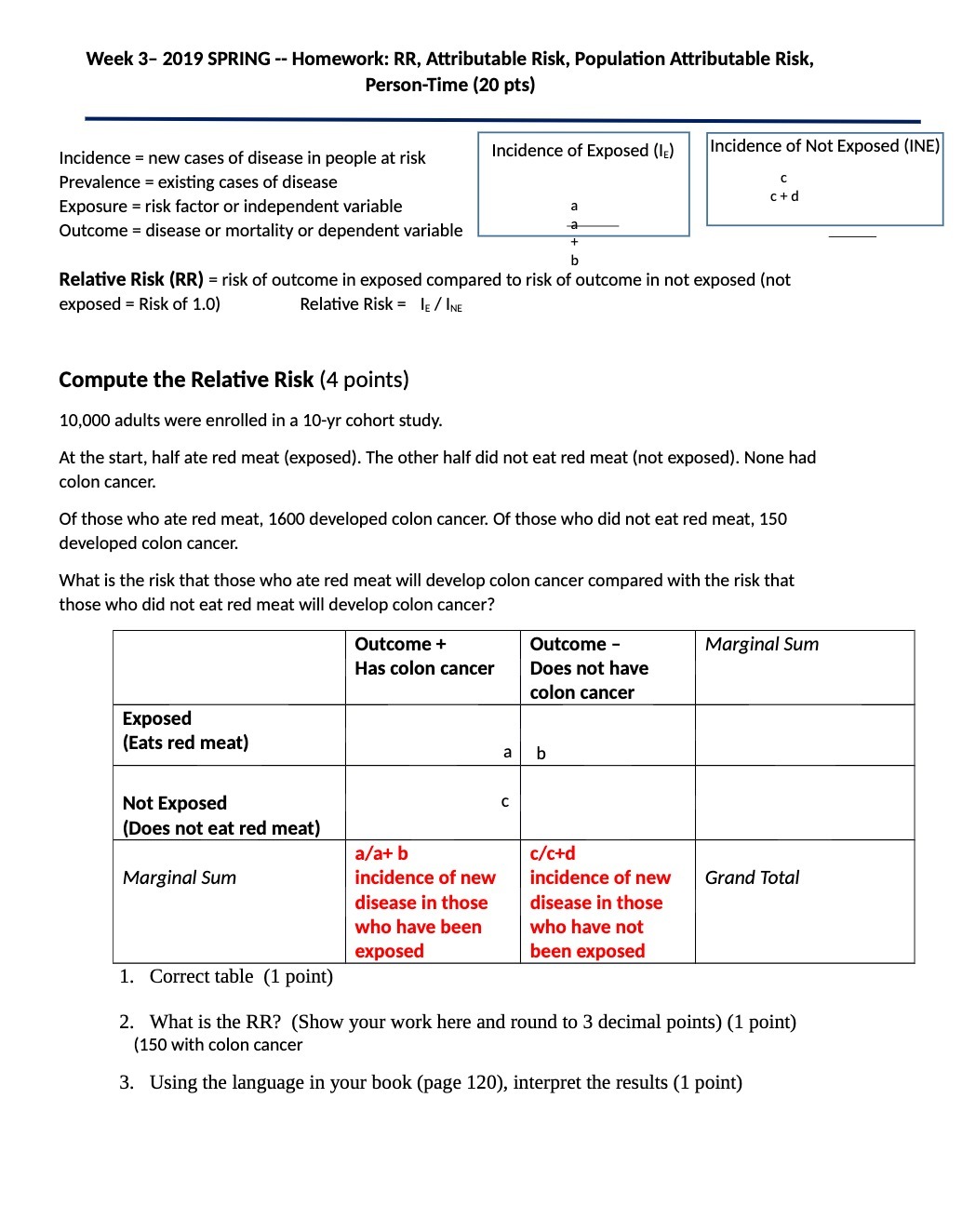
Week 3- 2019 SPRING -- Homework: RR, Attributable Risk, Population Attributable Risk, Person-"lime (20 pts) Incidence of Exposed (Isl Incidence of Not Exposed (lNE) Incidence = new cases of disease in people at risk Prevalence = existing cases of disease C Exposure = risk factor or independent variable c + d Outcome = disease or mortality or dependent variable Relative Risk (RR) = risk of outcome in exposed compared to risk of outcome in not exposed (not exposed = Risk of 1.0) Relative Risk = I: / INE Compute the Relative Risk (4 points) 10,000 adults were enrolled in a 10-yr cohort study. At the start, half ate red meat {exposed}. The other half did not eat red meat (not exposed). None had colon cancer. Of those who ate red meat. 1600 developed colon cancer. Of those who did not eat red meat. 150 developed colon cancer. What is the risk that those who ate red meat will develop colon cancer compared with the risk that those who did not eat red meat will develop colon cancer? Outcome + Outcome - Marginal Sum Has colon cancer Does not have colon cancer Exposed (Eats red meat) 3 b Not Exposed C (Does not eat red meat} a/a+ b c/c+d Marginal Sum incidence of new incidence of new Grand Total disease in those disease in those who have been who have not exposed been exposed 1. Correct table (1 point) 2. What is the RR? (Show your work here and round to 3 decimal points) (1 point) (150 with colon cancer 3. Using the language in your book (page 120), interpret the results (1 point)
Step by Step Solution
There are 3 Steps involved in it

Get step-by-step solutions from verified subject matter experts
 Study Help