



Question: week8 please answer the 4 questions of this case study. describe what you feel the case study is related to when answering the question vou
describe what you feel the case study is related to when answering the question vou have chosen.
Nonmaleficience- (refraining from harming I am in a position to potentially myself or another) destrovs or otherwise harms someone else.
Beneficence - (bringing about good) I am in a position to benefit someone else.
Fidelity - (promise Keeping) I have made a promise, explicit or Implicit, to someone else.
Veracity - I am in a position to tell the truth or deceive someone
Justice- I am in a position to distribute benefits and burdens among Individuals or groups in society who have legitimate claims on the benefits.
Reparations - I have wronged someone else.
Gratitude- I have been the beneficiary of someone else's goodness.
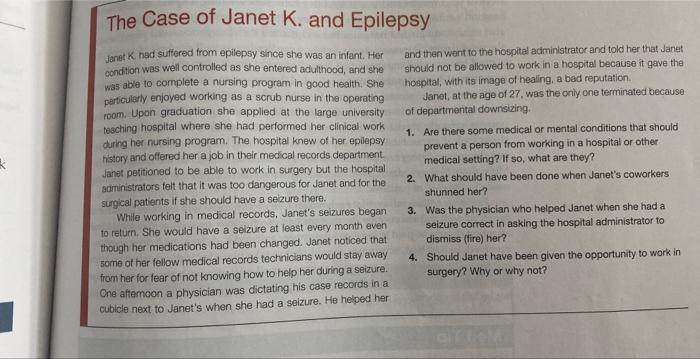
The Case of Janet K. and Epilepsy Janet K. had suffered from epilepsy since she was an infant. Her and then went to the hospital administrator and told her that Janet condition was well controlled as she entered adulthood, and she should not be allowed to work in a hospital because it gave the was able to complete a nursing program in good heaith. She hospital, with its image of healing, a bed reputation. particularly enjoyed working as a scrub nurse in the operating Janet, at the age of 27, was the only one terminated because room. Upon graduation she applied at the large university of departmental downising. tasching hospital where she had performed her clinical work. during her nursing program. The hospital knew of her epilepsy 1. Are there some medical or mental conditions that should history and offered her a job in their medical records department. prevent a person from working in a hospital or other Janet petitioned to be able to work in surgery but the hospital medical setting? If so, what are they? administrators felt that it was too dangerous for Janet and for the 2. What should have been done when Janet's coworkers sumgical patients if she should have a seizure there. shunned her? While working in medical records, Janet's seizures began 3. Was the physician who helped Janet when she had a to return. She would have a selzure at least every month even seizure correct in asking the hospital administrator to though her medications had been changed. Janet noticed that dismiss (fire) her? 50me ot her fellow medical records technicians would stay away 4. Should Janet have been given the opportunity to work in from her for lear of not knowing how to help her during a seizure. surgery? Why or why not? One aftemoon a physician was dictating his case records in a cubicle next to Janet's when she had a seizure. He helped her should not be allowed to work in a hospital because it gave the hospital, with its image of healing, a bad reputation. Janet, at the age of 27 , was the only one terminated because of departmental downsizing. 1. Are there some medical or mental conditions that should prevent a person from working in a hospital or other medical setting? If so, what are they? 2. What should have been done when Janet's coworkers shunned her? 3. Was the physician who helped Janet when she had a seizure correct in asking the hospital administrator to dismiss (fire) her? 4. Should Janet have been given the opportunity to work in surgery? Why or why not
Step by Step Solution
There are 3 Steps involved in it

Get step-by-step solutions from verified subject matter experts